Showing posts with label Indo-Iranian. Show all posts

Hinduism - Who Is Varuna In The Hindu Pantheon?


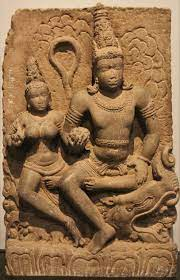
Varuna with his consort Varunani

Who Is The Indo-Aryan Deity Varuna?

Statue of Varuna at the National Museum in Delhi


In the Vedas, the oldest and most authoritative religious texts, Varuna is a deity associated with the sky, with waters, with justice, and with truth.
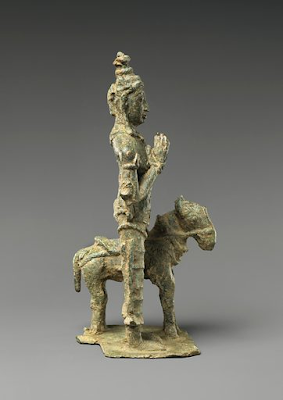
Statue of Varuna - Lord of knowledge


Varuna belongs to the earliest layer of the Indo-Aryan deities; this is clearly shown by comparisons with the Avesta, an ancient Iranian sacred text that shows many parallels with the Vedas, and with even older epigraphic sources.

As portrayed in the Vedas, however, Varuna’s influence has clearly declined—there are far fewer hymns addressed to him than to deities such as Indra, Agni, and Soma, and he seems to have played a far less important role than these other deities in Vedic religion.

In the Vedas, Varuna is portrayed as the guardian of rta, the cosmic order through which the world proceeds.
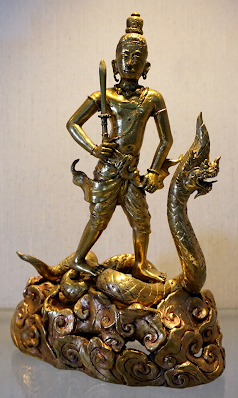
Varuna Riding Naga


As the deity associated with the high heaven, he also watches over the deeds of human beings and punishes them for any transgressions.

The best known hymn to Varuna, Rig Veda 7.86, shows Varuna’s connection with justice, moral order, and the waters.

The hymn is the lament of a person who has committed some offense against Varuna and whose sin has become visible through being afflicted with dropsy, in which the body retains its fluids and swells.

USS Varuna


The speaker begs Varuna to reveal the forbidden act, “committed under the influence of liquor, anger, or heedlessness,” so that Varuna may be propitiated and the sufferer healed.

Despite his virtual eclipse early in the tradition, in the later tradition, Varuna retains his association as the god presiding over the waters.

He is also considered to be one of the eight Guardians of the Directions, each of which is associated with one of eight points on the compass.

Varuna presides over the western direction.


~Kiran Atma


You may also want to read more about Hinduism here.

Be sure to check out my writings on religion here.


Hinduism - What Is The Indigenous Aryan Theory?


The idea that the Aryans were natives of the Indian subcontinent rather than immigrants from other countries is postulated and argued within the "The Indigenous Aryan Theory".

There is increasing evidence to suggest that historic populations inhabiting the Indo-European regions across Eastern Europe, Eurasia, Iran, And India may have been in cultural contact across millennia resulting in admixtures that contain DNA belonging to the Yamnaya peoples among other native Neolithic Indo-Iranian Agro-pastoral peoples.

There is reason to argue and theorize that these networks of Human tribes could have originated in the Indian sub continent or the Indo-Iranian plateau rather than the other way round. 

An eventual migration into Western Europe might have occurred after this event.

A lack of archaeological and genetic evidence, perhaps yet to be discovered, is not sufficient grounds to rule out the theory, or to conclusively/widely accept another based solely on circumstantial genetic forensic studies and instances of scattered artifacts.

The individuals who wrote the Vedas, the first Hindu religious writings, gave themselves the moniker Arya, which means "noble." The structural relationships between Sanskrit and classical European languages were uncovered by nineteenth-century European scholars, who theorized that all of these languages had a common ancestor.

These researchers speculated that individuals speaking this parent language originated in central Asia, maybe around the Caspian Sea, based on additional investigation.

From there, some traveled west to Europe, some southwest to Turkey, and yet others south to Iran and then India.

Comparisons between the Avesta and the Veda, Iranian and Indian religious writings, led to the conclusion that these Indian pilgrims came from Iran.

These writings have a lot of grammatical similarities, suggesting that the people who spoke the languages were connected.

Thus, the whole hypothesis is based purely on observable linguistic commonalities and hypotheses about how they developed.

Supporters of the indigenous Aryan idea dispute this assertion, claiming that the Aryans were the first occupants of India, citing artifacts discovered in the Indus Valley civilization, an ancient urban network in northeastern India, as evidence.

Both of these assertions are flimsy at best, and they ignore the philological data that supports the original Aryan idea.

Political consequences have aided in the establishment of the Indigenous Aryan idea.

Some supporters are responding to what they consider to be a colonialist bias in the Aryan migration hypothesis, which was devised by Europeans and implies that the dominant populations in contemporary India must have arrived from outside.

Hindutva proponents, for example, argue that all Indians are “truly” Hindus, and hence belong to the same social group, regardless of their religious views.

In contemporary India, where Christians and Muslims are not simply religious communities, but also social and political ones, this assertion has significant political implications.

Hindutva supporters marginalize Christians and Muslims as outsiders by equating Hindu identification with good Indian citizenship.


You may also want to read more about Hinduism here.

Be sure to check out my writings on religion here.