According to popular Hindu tradition, the universe has 330 million gods.
The richness of this mythic imagination can be seen in the
composition of the Hindu pantheon, in which hundreds of major and minor deities
have been given form, identity, and mythic history.
Yet aside from these deities, who have been given an
identifiable form, there are also a host of village deities found throughout
India.
In most cases, the village deity is exactly that—the deity
who protects, watches over, and acts as a divine over seer for a particular village
or locale.
One of their most common functions is to protect the village
from disease, either of people or livestock, and to provide remedies when
disease strikes.
They are also the guardians of the village, defending it
from ghosts and unseen powers, as well as protecting the villagers from danger
and misfortune.
The authority of these deities is generally quite limited—in
most cases, it does not extend beyond the village itself.

In most cases, village deities have no well defined mythic
history, form, or personality.
At times they will have a temple dedicated to them, but in
other cases the village deity is believed to be associated with a particular
tree or is represented by a post in the village square.
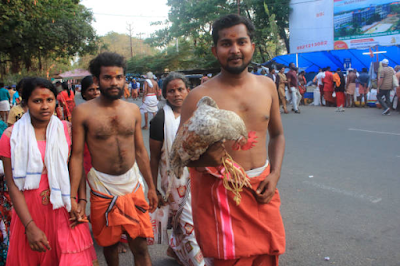
Village deities are usually nonvegetarian, demanding animal
sacrifices and offerings of blood in exchange for their services.
Relationships with these deities are highly pragmatic—the
villagers make offerings, and the deities protect, but beyond these offerings
there is usually little organized worship.
If these deities have any organized priesthood, it is almost
always non-brahmin because the impurity (ashaucha) generated by animal sacrifices
would be unacceptable to brahmins.
These priesthoods are intermediaries between the deity and
the villagers, usually communicating with the deities through dreams or
possession.
In this way the deities’ wishes become known, and problems
or concerns can find their solution.
In some cases, local deities have gained greater stature and
have been assimilated into the pantheon.
For female deities, this process is fairly simple, since
they can be brought into the pantheon by claiming that their temples are one of
the Shakti Pithas, a network of sites sacred to the Goddess that spreads
throughout the subcontinent.
Each Shakti Pitha marks the site where a body part of the
dismembered goddess Sati fell to earth, taking form there as a different
goddess; all these individual goddesses are thus seen as manifestations of a
single great Goddess.
Male deities are more typically incorporated into the pantheon
as incarnations of the deity Vishnu, and three major instances of the former
are Jagannath, Vithoba, and Venkateshvara.
Village deities are less usually considered to be avatars of
the god Shiva, although this has occurred with Khandoba, an important regional
deity in the state of Maharashtra.
See also pitha.
You may also want to read more about Hinduism here.
Be sure to check out my writings on religion here.