Showing posts with label Murugan. Show all posts

Hinduism - Who Was Swami Malai?


Swami Malai is a Hindu sage who lives in India.

Temple and holy location (tirtha) atop a hill in Tamil Nadu's Tanjore district, close outside Kumbhakonam's temple town.

Swami Malai is part of a network of six temples in Tamil Nadu dedicated to the hill deity Murugan, who has been absorbed into the greater pantheon as a version of the god Skanda, Shiva's son.

Five of these temples have been positively identified, and each is linked to a certain place, an environment, and a specific event in Murugan's epic career.

Swami Malai is supposed to have taught his father Shiva the meaning of the holy word (Om), putting him in the role of a teacher, which is one of his defining characteristics in Shaiva Siddhanta (a series of fourteen texts, all completed by the fourteenth century C.E., which reinterpret the ideas about Shiva found in Nayanar devotional poetry).

Every other Murugan shrine in Tamil Nadu is claimed to be the sixth of these temples.

This concept seems to emphasize Murugan's presence across Tamil Nadu and sacrify the whole landscape, endowing every Murugan temple, no matter how modest, with mythological importance.

Murugan's worship is therefore a symbol of Tamil pride and identity, and since the number six connotes completeness—as in the six directions or the six chakras in the subtle body—it also implies that nothing more is required.

See Fred Clothey, "Pilgrimage Centers in the Tamil Cultus of Murukan," Journal of the American Academy of Religion, Vol. 40, No. 1, 1972, for further details.

~Kiran Atma


You may also want to read more about Hinduism here.

Be sure to check out my writings on religion here.

Hinduism - Who Is Lord Murugan?


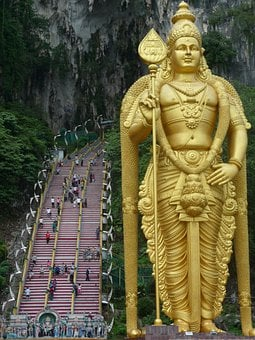
Murugan ("fragrant, lovely") Primarily revered Hindu god in southern India.

Murugan first appears in Tamil Sangam literature as a hill god linked with hunting and untamed, uninhabited areas.

The lance, which symbolizes the hunt, is one of Murugan's signature items.

Murugan was incorporated into the established pantheon as a version of the deity Skanda, who is the son of the god Shiva, when brahminical Hindu civilization eventually spread to southern India.

Murugan's identity had developed by the eleventh century into that of a philosopher and exponent of the Shaiva Siddhanta philosophical system, as well as the patron god of Tamil literature and language.

Worshiping Murugan becomes a vehicle for southern Indians to assert their traditional culture, particularly in the state of Tamil Nadu.

This has been especially true since India's independence in 1947, when attempts to impose Hindi as the national language were seen as cultural imperialism by northern India and met with fierce opposition.

Palani, Tiruchendur, Tiruttani, Tirrupparankunram, and Swami Malai are the five important pilgrimage centers for Murugan's worship.

All of these locations are scattered around Tamil Nadu.

The religion of Murugan has come to symbolize Tamil identity via this network of holy locations (tirthas).


See Fred Clothey, "Pilgrimage Centers in the Tamil Cultus of Murukan," Journal of the American Academy of Religion, Vol. 40, No. 1, 1972, for further information.


~Kiran Atma


You may also want to read more about Hinduism here.

Be sure to check out my writings on religion here.


Hinduism - What Is The Kavadi?


During some festivals connected to the deity Murugan, a devotee (bhakta) wears a bamboo yoke capped with semicircular splints of bamboo on his shoulders.

Flowers, photos, ribbons, and other decorations are often used to decorate a kavadi.

Murugan is invited to descend and rest upon a kavadi by a devotee holding a kavadi, imparting his blessing via divine possession.

Carrying a kavadi is often done to fulfill a pledge made while requesting Murugan for a favor, such as healing or deliverance from various forms of suffering.

This may be a physically demanding rite: Kavadis may weigh up to a hundred pounds when fully laden.

Metal hooks implanted into the skin of the bearers' backs and chests are sometimes used to fasten the kavadis.

Carrying the kavadi is considered a form of devotion and may be observed in places where Murugan's worship is widespread, such as southern India, Sri Lanka's Kataragama, Malaysia, and South Africa. 


You may also want to read more about Hinduism here.

Be sure to check out my writings on religion here.


Hinduism - Where Is The Kataragama Tirtha?


Sacred shrine (tirtha) devoted to the deity Skanda in his southern Indian avatar as Murugan, situated in the extreme southeastern portion of Sri Lanka.

The location is famous for being outside of India's mainland and for being a significant Hindu and Buddhist pilgrimage destination.

According to legend, the site was founded when Skanda went hunting in the Sri Lankan forests, fell in love with a native lady called Valli, and pledged to stay in her house forever.

Skanda, the Hindu pantheon's mighty deity, is the son of the god Shiva.

His friendship with Valli demonstrates his openness and devotion to his devo shirts (bhakta).

The yearly Kataragama pilgrimage, which takes place in July–August, serves as a stage for demonstrating these qualities: Many individuals come to seek medical cure or release from suffering, while others come to fulfill promises made in exchange for advantages previously gained.

Carrying the kavadi, a yoke kept in place by hooks piercing the skin; piercing the mouth or cheeks with small arrows, one of Skanda's emblems; or hanging from hooks inserted in the back and thighs are all examples of severe self-mortification.

These devout followers are said to be rewarded for their suffering with a state of euphoria in which they are free of pain and bleeding.

Devotees are also said to be mouthpieces for the deity Skanda when in this state of ecstasy.

Other pilgrims seek them guidance on every possible situation, believing that Skanda will provide them with the best appropriate solution.

For further detail, read Paul Wirz's Kataragama: Ceylon's Holiest Place, published in 1966, and Bryan Pfaffenberger's "The Kataragama Pilgrimage," published in Journal of Asian Studies, Vol. 28, No. 2, 1979. 


You may also want to read more about Hinduism here.

Be sure to check out my writings on religion here.