Showing posts with label Shaiva Siddhanta. Show all posts

Hinduism - What Is The History Of The Tamil Language?


Along with Kannada, Telegu, and Malayalam, it is one of the four Dravidian languages spoken largely in southern India.

Tamil is the most widely spoken language in contemporary Tamil Nadu, one of the "linguistic states" established following India's independence.

This state was created to bring individuals who spoke the same language and had a same culture together under one administration.

Despite the fact that all four languages have literary and cultural significance, Tamil has by far the most extensive literary history.

The Sangam literature, eight volumes of poetry that concentrated equally on the exterior depiction of warfare or the inward description of love, dates from the early years of the common period.

The three Tamil epics, the Shilappadigaram, Manimegalai, and Shivaga-Sindamani, followed the Sangam literature.

Between the seventh and tenth centuries, the Alvars and the Nayanars created devotional (bhakti) literature, with the former expressing their devotion to Vishnu and the latter to Shiva.

Because it used daily vernacular language as a magnificent vehicle for deep religious expression, its devotional poetry was unmatched in Hindu religious history.

The Alvars' poetry became a foundational book for the Shrivaishnava community, while the Nayanars' poems became a foundational text for Shaiva Siddhanta, and both collections are still essential in Hindu religious life.

Tamil is still a vibrant literary language and a source of intense regional pride for the people who live there; some of the most violent recent demonstrations in southern India were the so-called language riots, protesting the imposition of Hindi as the government language, which was seen as a deliberate attempt to marginalize Tamil language and culture.

~Kiran Atma


You may also want to read more about Hinduism here.

Be sure to check out my writings on religion here.


Hinduism - Who Was Swami Malai?


Swami Malai is a Hindu sage who lives in India.

Temple and holy location (tirtha) atop a hill in Tamil Nadu's Tanjore district, close outside Kumbhakonam's temple town.

Swami Malai is part of a network of six temples in Tamil Nadu dedicated to the hill deity Murugan, who has been absorbed into the greater pantheon as a version of the god Skanda, Shiva's son.

Five of these temples have been positively identified, and each is linked to a certain place, an environment, and a specific event in Murugan's epic career.

Swami Malai is supposed to have taught his father Shiva the meaning of the holy word (Om), putting him in the role of a teacher, which is one of his defining characteristics in Shaiva Siddhanta (a series of fourteen texts, all completed by the fourteenth century C.E., which reinterpret the ideas about Shiva found in Nayanar devotional poetry).

Every other Murugan shrine in Tamil Nadu is claimed to be the sixth of these temples.

This concept seems to emphasize Murugan's presence across Tamil Nadu and sacrify the whole landscape, endowing every Murugan temple, no matter how modest, with mythological importance.

Murugan's worship is therefore a symbol of Tamil pride and identity, and since the number six connotes completeness—as in the six directions or the six chakras in the subtle body—it also implies that nothing more is required.

See Fred Clothey, "Pilgrimage Centers in the Tamil Cultus of Murukan," Journal of the American Academy of Religion, Vol. 40, No. 1, 1972, for further details.

~Kiran Atma


You may also want to read more about Hinduism here.

Be sure to check out my writings on religion here.
Hinduism - What Is Pasha In Shaiva Siddhanta Hindu Philosophical School?


 (“noose”) One of the weapons carried by several of the divinities in Indian mythology, including Ganesh and Yama.

The noose represents Ganesh's capacity to tie (and release) barriers as the "Lord of Obstacles," while Yama, the deity of death, uses it to pull the soul from the body upon death.

Pasha is also the term given to Shiva's power of illusion (maya), via which he entraps and enthralls unenlightened individuals in the Shaiva Siddhanta religious group (pashu).

The Shaiva Siddhanta school is defined by the trinity of pasha, pashu, and Shiva as lord (pati).

~Kiran Atma


Discover more about Hindu Art, Architecture, and Iconography here.

You may also want to read more about Hinduism here.

Be sure to check out my writings on religion here.


Hinduism - What Is A Pashu? Who Is Considered A Pashu?


 (“beast”) The name for an unenlightened individual, who is considered to have a human body but is no better than an animal, in the philosophical system known as Shaiva Siddhanta and the secret, ritually based religious practice known as tantra.

This lack of consciousness is caused not by inborn dullness, but by the activity of maya, Shiva's power of illusion wielded as lord (pati).

The Shaiva Siddhanta school is defined by the triad of pashu, pati, and the bindings of illusion (pasha).


You may also want to read more about Hinduism here.

Be sure to check out my writings on religion here.


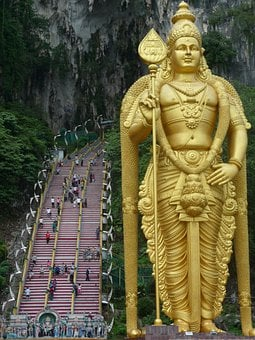
Hinduism - Who Is Lord Murugan?


Murugan ("fragrant, lovely") Primarily revered Hindu god in southern India.

Murugan first appears in Tamil Sangam literature as a hill god linked with hunting and untamed, uninhabited areas.

The lance, which symbolizes the hunt, is one of Murugan's signature items.

Murugan was incorporated into the established pantheon as a version of the deity Skanda, who is the son of the god Shiva, when brahminical Hindu civilization eventually spread to southern India.

Murugan's identity had developed by the eleventh century into that of a philosopher and exponent of the Shaiva Siddhanta philosophical system, as well as the patron god of Tamil literature and language.

Worshiping Murugan becomes a vehicle for southern Indians to assert their traditional culture, particularly in the state of Tamil Nadu.

This has been especially true since India's independence in 1947, when attempts to impose Hindi as the national language were seen as cultural imperialism by northern India and met with fierce opposition.

Palani, Tiruchendur, Tiruttani, Tirrupparankunram, and Swami Malai are the five important pilgrimage centers for Murugan's worship.

All of these locations are scattered around Tamil Nadu.

The religion of Murugan has come to symbolize Tamil identity via this network of holy locations (tirthas).


See Fred Clothey, "Pilgrimage Centers in the Tamil Cultus of Murukan," Journal of the American Academy of Religion, Vol. 40, No. 1, 1972, for further information.


~Kiran Atma


You may also want to read more about Hinduism here.

Be sure to check out my writings on religion here.


Hinduism - Who Was Manikkavachakar?


(9th c.) Tamil poet-saint and creator of the Tiruvachakam ("holy words"), who was a devotee (bhakta) of the deity Shiva.

Along with the Nayanar poet saints, Appar, Sambandar, and Sundaramurtti, he is regarded the fourth major figure in the Tamil Shaivite tradition.

Manikkavachakar's songs are viewed as the climax of the older devotional (bhakti) tradition and provide testament to the depth of his own religious experience.

These hymns also served as the foundation for the Shaiva Siddhanta philosophical school's development, making him a key figure in southern Indian Shaivism.

Glenn Yocum's Hymns to the Dancing Siva, published in 1982, has further material.


You may also want to read more about Hinduism here.

Be sure to check out my writings on religion here.