Showing posts with label Tiruchendur. Show all posts

Hinduism - Where Is Tiruchendur In India?


On the Bay of Bengal in Tamil Nadu, sixty miles up the coast from Kanyakumari, there is a temple and holy spot (tirtha).

Tiruchendur is one of six temples in Tamil Nadu dedicated to the hill deity Murugan, who has been absorbed into the greater pantheon as a version of the god Skanda, Shiva's son.

Five of these temples have been firmly discovered, each of which is associated with a certain place, ecology, and episode in Murugan's mythological career.

In Tiruchendur's instance, it is claimed to be the location where he slew a demon foe, presenting him in his warrior form.

Every other Murugan shrine in Tamil Nadu is claimed to be the sixth of these temples.

Murugan's worship is therefore a symbol of Tamil pride and identity, and since the number six connotes completeness—as in the six directions or the six chakras in the subtle body—it also implies that nothing outside is required.

See Fred Clothey, "Pilgrimage Centers in the Tamil Cultus of Murukan," Journal of the American Academy of Religion, Vol. 40, No. 1, 1972, for further information.

~Kiran Atma


You may also want to read more about Hinduism here.

Be sure to check out my writings on religion here.

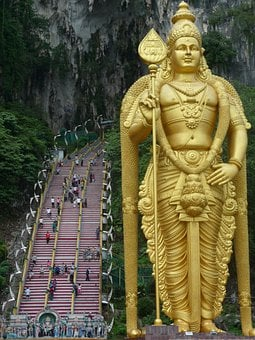
Hinduism - Who Is Lord Murugan?


Murugan ("fragrant, lovely") Primarily revered Hindu god in southern India.

Murugan first appears in Tamil Sangam literature as a hill god linked with hunting and untamed, uninhabited areas.

The lance, which symbolizes the hunt, is one of Murugan's signature items.

Murugan was incorporated into the established pantheon as a version of the deity Skanda, who is the son of the god Shiva, when brahminical Hindu civilization eventually spread to southern India.

Murugan's identity had developed by the eleventh century into that of a philosopher and exponent of the Shaiva Siddhanta philosophical system, as well as the patron god of Tamil literature and language.

Worshiping Murugan becomes a vehicle for southern Indians to assert their traditional culture, particularly in the state of Tamil Nadu.

This has been especially true since India's independence in 1947, when attempts to impose Hindi as the national language were seen as cultural imperialism by northern India and met with fierce opposition.

Palani, Tiruchendur, Tiruttani, Tirrupparankunram, and Swami Malai are the five important pilgrimage centers for Murugan's worship.

All of these locations are scattered around Tamil Nadu.

The religion of Murugan has come to symbolize Tamil identity via this network of holy locations (tirthas).


See Fred Clothey, "Pilgrimage Centers in the Tamil Cultus of Murukan," Journal of the American Academy of Religion, Vol. 40, No. 1, 1972, for further information.

~Kiran Atma


You may also want to read more about Hinduism here.

Be sure to check out my writings on religion here.