Showing posts with label truth. Show all posts

Hinduism - Who Is Varuna In The Hindu Pantheon?


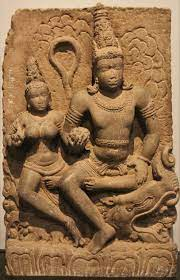
Varuna with his consort Varunani

Who Is The Indo-Aryan Deity Varuna?

Statue of Varuna at the National Museum in Delhi


In the Vedas, the oldest and most authoritative religious texts, Varuna is a deity associated with the sky, with waters, with justice, and with truth.

Statue of Varuna - Lord of knowledge


Varuna belongs to the earliest layer of the Indo-Aryan deities; this is clearly shown by comparisons with the Avesta, an ancient Iranian sacred text that shows many parallels with the Vedas, and with even older epigraphic sources.

As portrayed in the Vedas, however, Varuna’s influence has clearly declined—there are far fewer hymns addressed to him than to deities such as Indra, Agni, and Soma, and he seems to have played a far less important role than these other deities in Vedic religion.

In the Vedas, Varuna is portrayed as the guardian of rta, the cosmic order through which the world proceeds.

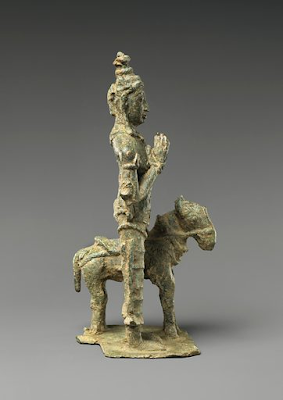
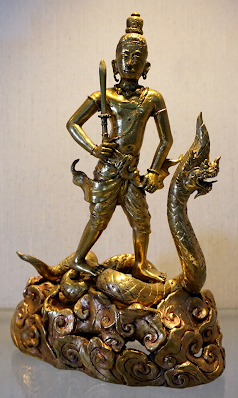
Varuna Riding Naga


As the deity associated with the high heaven, he also watches over the deeds of human beings and punishes them for any transgressions.

The best known hymn to Varuna, Rig Veda 7.86, shows Varuna’s connection with justice, moral order, and the waters.

The hymn is the lament of a person who has committed some offense against Varuna and whose sin has become visible through being afflicted with dropsy, in which the body retains its fluids and swells.

USS Varuna


The speaker begs Varuna to reveal the forbidden act, “committed under the influence of liquor, anger, or heedlessness,” so that Varuna may be propitiated and the sufferer healed.

Despite his virtual eclipse early in the tradition, in the later tradition, Varuna retains his association as the god presiding over the waters.

He is also considered to be one of the eight Guardians of the Directions, each of which is associated with one of eight points on the compass.

Varuna presides over the western direction.


~Kiran Atma


You may also want to read more about Hinduism here.

Be sure to check out my writings on religion here.


Hinduism - What Is The Significance Of Truth In Hindu Philosophy?


The Power of Truth.

Truth, according to traditional Hindu belief, has magical power of its own, a power to which people might turn in times of need.

The famous act of truth, a conditional statement in which the first part is a true statement about one's past behavior and the second part is a request for a specific result (for example, "If I have always given to those who begged from me, may this fire not burn me"), is one method of appealing to this power.

The power of truth was also evoked in ordeal trials, and it was considered as the power that made the ordeal a genuine way of putting individuals to the test.

~Kiran Atma


You may also want to read more about Hinduism here.

Be sure to check out my writings on religion here.

Yogic Philosophy - Is Yoga Considered A Religion?


Some Christians and Jews in the West are worried about Yoga's status as an Eastern religion. 

They are concerned that by doing Yoga, they would be jeopardizing their religious beliefs. 


Is their apprehension justified?

Is Yoga considered a religion? 


The short answer to both concerns is that, rather than eroding their personal faith, Yoga has the potential to strengthen it. 

I'll provide a somewhat more extensive explanation after that. 


Let me start with Christian fundamentalism's extreme perspective, which considers Yoga as a harmful import from the East that should be avoided at all costs. 


  • Yoga is sometimes mixed together with New Age doctrines, which are considered as a threat to Christianity. 
  • True, yoga has always been linked to India's three major religious and cultural traditions: Hinduism, Buddhism, and Jainism. 
  • As a result, numerous Hindu, Buddhist, and Jain principles are interwoven into Yoga's teachings. 
  • The concepts of karma and rebirth, as well as the belief that there are numerous deities in addition to the one ultimate Reality, are the most conspicuous instances, which are typically a stumbling block for Westerners. 
  • To begin with, there have been Yoga gurus who have denied the concepts of karma and reincarnation, and Hindu, Buddhist, and Jain deities may be contrasted to Christian and Jewish angels. 


You do not need to believe in karma or reincarnation to practice Yoga. 


  • You don't have to believe in anything other than the potential of self-transformation, that you can transcend your existing worldview and experience, and, more importantly, that you can transcend your own egocentric way of being. 
  • The premise that you have not yet reached your full potential as a human being is at the core of all types of Yoga. 


Yoga, in particular, aims to connect you to your spiritual core, your deepest essence, and that which or who you actually are. 


  • The many schools of Yoga depict this nature in different ways. 
  • You are free to let your unique experience and realization influence your thinking rather than being forced to believe in any of the established answers. 
  • Yoga has been connected with different philosophical and religious systems throughout the millennia, none of which can be considered to describe Yoga itself. 
  • Yoga, after all, is first and foremost a practical spiritual practice based on personal exploration and verification. 
  • In other words, any theory or intellectual framework is seen as secondary to direct personal experience or spiritual enlightenment. 


As a result, Yoga may and has been practiced by individuals who hold a broad range of views and beliefs. 


  • Some Yoga students believe in a personal God who created the cosmos, while others choose a metaphysics that views the world as illusory and the ultimate Reality as solitary and formless. 
  • Others, such as Theravada Buddhism's yogins, refuse to speculate on metaphysical issues. 
  • As a result, some Yoga practitioners are religious while others are not. 
  • Yoga, on the other hand, is only a tool for delving into the depths of our human nature, for delving into the secrets of the body and mind.


An Exercise In Self-Introspection


1. Consider how you feel about Yoga's original objective of freedom. 


2. Consider if and to what extent you want to use Yoga to change yourself. 


  • Make a note of everything you do to facilitate yogic/spiritual development in your situation. 
  • Then write a list of everything you do that keeps you from making significant changes. 


3. As we progress along the yogic path, great masters' insights may be a significant source of inspiration for us. 


  • Our shared inheritance is the Yoga tradition, a live record against which we may test and analyze our discoveries. 
  • What aspects of Yoga have proven to be especially beneficial to you? 


4. "Freedom is not a method, but a manner of being in the world without being of it," a subtle issue is presented in this statement. 


  • This means that human existence may be lived from the "perspective" of awareness, or, to put it another way, pure Awareness. 
  • According to a variety of traditions, one may stay as the transcendental Witness, which is the Self (dtman). 
  • As a result, the body/mind is no longer identified. 
  • This alludes to the condition of jivan-mukti, or physical emancipation. 


5. Teachers build various frameworks and use philosophical language to transmit their ideas to a particular audience while expounding essential truths founded in personal awareness. 


  • As you read through this Study Guide and The Yoga Tradition, keep in mind whether or not the teachings are context or culture-bound. 
  • In each lecture we look at, try to perceive the dynamics of various parts of yoga practice, as well as the intricacies of spirituality involved. 


6. "All roads lead to the same objective," we frequently hear, but is freedom, the purpose of Yoga, the same in every case? 


  • Or do Buddhist nirvana, Vedantic moksha, Patanjali's kaivalya, and the Bhagavad-brahma-nirvdna Gita's all refer to different realizations? 
  • There is enough evidence to suggest that these names aren't just linguistic variances. 
  • When one contrasts the notion of liberation in theistic schools to that of atheistic systems like Classical Samkhya, this reality becomes clear. 


The seventeenth-century instructor Shrinivasa Dasa, for example, offers the following extremely important statements in his Yatindra-Mata-Dipikd (8. 1 6): 


There are two types of liberation seekers: 


  1. those who seek kaivalya 
  2. and those who want moksha. 

The awareness of one's inner Self as separate from Nature is referred to as kaivalya, and it is reached via the Yoga of knowledge. 

This realization... is without the Lord's realization. 


In contrast to kaivalya, moksha is claimed to be attained via passionate devotion to God (bhakti) or unconditional self-offering (prapatti). 


  • A close examination of the scriptures of various religions reveals even more distinctions in the notions of liberation. 
  • As a result, it seems that certain historians of religion's assertion of the transcendental unity of all faiths is a theological oversimplification. 
  • At the same time, these disparate ideas of emancipation do have a common denominator, namely the realization of a degree of existence that transcends the usual space-time continuum. 
  • However, we must not lose sight of the equally important differences. 


According to the facts, there are genuine distinctions in the condition of liberty, as seen by members of various schools. 


Sages and philosophers may choose to dispute whether these subtleties represent degrees of realization fullness. 


  • What are your own views and sentiments on this crucial theological point? 
  • Do you think there's just one ultimate Reality? 
  • If that's the case, do all sages comprehend the transcendental Singularity in the same manner, and are all discrepancies in their explanations only language differences? 
  • Or do you believe that all such theories are pointless and unworkable?


Yogic Philosophy - The Yoga Of Science


Yoga And Science


Rather than the observable primary reality of existence, the goal of science is search for the truth. 


And, finally, without its translation into the domain of actual life, this search, in my opinion, remains unfinished. 

If not the world, science—that is, scientific knowledge—must undoubtedly change the scientist. 

In the abstract, knowledge is simply a titillation of the mind, a little stimulation of a part of our entire humanness. 


Knowledge must find expression in the body in order to be fulfilled. 


More than that, it must use the force of its truth to transform the body. 

And truth, not knowledge, is the source of all power. 

Manipulative power, such as political leverage or overwhelming influence, is linked with knowledge. 


Truth's intrinsic power, on the other hand, is transformational in the most profound sense. 


It has the ability to reshape a person in the light of truth. 


What is the truth? 

Shouldn't we be talking about truths? 


Truth must be unique in order to be true. 

Always.

A plurality of truths is a logical paradox. 


The practice of speaking about many truths originated from the loss of truth and its replacement with a plethora of facts. However, facts are not the same as truth. 


Only knowledge (prajna) is freeing because it bears the truth (ritambhara). 


Without conceptual blinders, truth is reality. 

To the extent that science's path is illuminated by the ideal of truth, it may lead the scientist, step by step, to the discovery of truth—not just factual truth, but the sort of truth that sees everything in context and maintains that context. 


When considering the broader context of human existence, it is necessary to examine humanity's evolutionary potential, as well as its potential spiritual destiny. 

As a result, science may serve as a stepping stone to Yoga's "evolutionary science," i.e., a spiritual discipline that allows us to realize our entire potential. 


If mastered, yoga's concentration and meditation methods reveal the mind's transcendental potential, allowing us to experience truth at the greatest level, as "ultimate Truth" (paramartha-satya). 


Recommended Reading - Unity of Nature (New York: Farrar, Strauss, Giroux, 1980), by C. F. von Weizsacker. 


East and West Spiritual Technologies, And Evolution 


Modern civilization is moving in the direction of external freedom. 


Free expression of opinion, affiliation, the ability to form personal connections on one's own terms, and the ability to follow a profession based on one's own qualities are all necessary for a productive and happy existence. 

But, in the end, outward freedom is egocentric, and interior freedom should not be overlooked as a spiritual equivalent. 


The defeat of desire, wrath, greed, attachment, pride, and laziness leads to inner liberation. 


The only way to achieve this freedom and give meaning to all forms of external freedom is for reason and love to come together in a happy marriage. 


1. Our modern technology is the result of humanity's desire for self-transcendence. 


  • Modern science and technology, on the other hand, are limited to the realm of relative liberty and happiness. 


2. The East's psychospiritual technique (i.e., Yoga) is aimed squarely at self-transcendence and inner growth. 


  • Answers to our most basic human problems require both wisdom and practical understanding of contemporary science and technology. 
  • The great Yogas of India are known for their wisdom. 

3. When we acknowledge their worth in regard to their respective areas of application, the two traditions, Eastern technology and Western scientific materialism, are complimentary. 


Reality and Reality Models 


1. The ultimate Reality is unfathomable to the human mind. 


  • As a result, adepts develop models to communicate their spiritual realizations to others. 
  • This is a crucial point: all teachings are simply expressions of the Truth, not the Truth itself. 
  • We must view them as models that may aid us in our quest to get a better understanding of life. 


2. Through the euphoric condition, it is possible to perceive things immediately, without the need of the senses (samadhi). 


3. Epistemology is the study of knowledge and the methods of cognition that are legitimate. 


  • One or more of these methods is recognized by India's different philosophical traditions. 
  • Only sensory perception is permitted by materialist schools, such as the Carvakas. 


4. The following three tools of legitimate knowledge (pramana) are recognized by several schools of lndian thought: sense perception (pratyaksha), inference (anumana), and revealed knowledge (shabda) Some of these instruments are given special attention at each school. 


  • Shabda—or apta-vacana—is the testimony of adepts who are able to give witness to the ultimate Reality via direct realization. 
  • As a result, it is often regarded as the most reliable source of spiritual information. 
  • The process of establishing a proper logical link between two things is known as inference. 
  • The process of seeing, hearing, tasting, touching, or smelling is known as perception. 


5. Ontology, or being theory, is concerned with the broad categories of being. 


  • Most schools of Yoga emphasize ontology, relying on the paradigm provided by the Samkhya tradition, which has twenty-five categories, or tattvas, the twenty-fifth of which is the Spirit (purusha). 


6. Verticalism is a kind of worldview that stresses a "Reality" above and beyond the realm of senses and intellect. 


  • Much of Indian Yoga has been influenced by a verticalist or "ascending" tendency. 
  • This has often resulted in a simultaneous retreat from the "lower" reality of the material world, as in the case of Classical Yoga. 
  • "In, up, and out" (internalization, ascension, and withdrawal/transcendence) summarizes the verticalist viewpoint. 


7. Tantra philosophy provides an alternative to the ascending/verticalist paradigm. 


  • Tantra views Nature and Spirit as inextricably linked, and strives for completeness by integrating all levels, from the coarse physical world to the profound center of Being, Spirit. 
  • The intellectual foundations of Tantra forms the basis of advancement in the physical realm. 


8. Symbolism abounds in most of the world's mystical/spiritual literature. 


  • An understanding and study of pervasive intelligence expressed in existence should be our approach to  symbolism in general and the symbolic language used in Yoga literature.


Shamanic Heart, Altered Perception And Consciousness - What We Gain Access To When We Are In Alternate States


When we consciously and deliberately practice altering our states, the information we can access is vast and complex, depending on our intent, the specific practice, the depth we reach, how often we practice, such as when we have a daily spiritual meditative practice, and, if we are skilled, which parts of the brain we deliberately activate. 


As a result, the following can only give an overview of various states without pretending to be comprehensive. 


  • Within altered state experiences, the lines between what is normal and what is abnormal are blurry. 
  • While the descriptions, classifications, and maps we create are essential for our minds to make sense of such situations, they are ultimately simply maps that depict the territory rather than the land itself. 
  • The subconscious, unconscious, and collective unconscious are all forms of the subconscious mind. 
  • We obviously access personal information that is buried and concealed on various levels of the subconscious and unconscious realms in psychological terminology. 
  • Memories and previous experiences, pictures that follow a cognitive process, connections to a subject, strongly held beliefs, powerful emotions, and so on are all examples of this kind of information. 
  • We have access to these because, as previously said, we engage some regions of our brains while slowing down activity in others. If we, for example, stimulate the hippocampus and amygdala, which are involved in memory storage and emotions, we will feel intense emotions associated with certain memories. 
  • We may begin to re-associate the memory with the emotion and vice versa if the memory is detached, in the sense that it lives cognitively just as an experience without emotional connection, or if the emotionality existing in the form of an anxious reaction without a memory being connected to it. 
  • We may access connections we've made through time that are linked to that memory/experience and those emotions if we go a step farther. 


In terms of therapy, the next stage would be to consciously integrate by reactivating our normal frontal lobes by, for example, questioning, comprehending, and rationalizing the experiences we experienced in the altered states. 


  • If we take a broader perspective of awareness, we may access regions of the unconscious – for want of a better term – that include data and knowledge that isn't always based on our own experiences. 
  • Those regions, according to Jung (1977), are the collective unconscious, which contains information that has never been in awareness and therefore has never been acquired individually. 
  • Heredity, whether in the form of genetically given information or, if we want to go even farther, the capacity to plug into and access knowledge that exists beyond the limits of our physical brain, is responsible for the content's existence. 


The collective unconscious, according to Jung, contains pictures, potentials, and predispositions acquired from our ancestors, such as anxieties, attractions, and symbols. 

It is universal, preexisting, and comparable in all people, and it manifests itself in archetypal form for us to see. 


  • Archetypes are universal images that may be recognized nearly everywhere in the globe - with minor changes. 
  • Archetypes, unlike memory memories of previous experiences, are not completely formed mental images. 
  • We convert them into visible pictures since they are rather "complexes." 
  • We can access the meaning we connect with archetypes when we start working with them, which is pretty universal. 


Five major archetypes were identified by Jung: 


1. the Self, the psyche's governing center and a promoter of individuation 

2. the Shadow, which includes characteristics that the ego does not wish to associate with (e.g. anger, fear, brutality, sexual urges) 

3. the Anima, a man's feminine mental picture 

4. the Animus, a woman's male image in her mind 

5. the Persona, which serves as a mask for the image and characteristics we project to the world. 


There are many more archetypes. They occur in fairy tales, myths, legends, and folklore all throughout the globe. 

The infant, the maiden, the hero, the mother, the crone, the wise old man, the wise old woman, the trickster, the mentor, the devil or monster, the redeemer, death, and rebirth are all well-known mythical archetypal themes and characters. 


In shamanic terminology, both the personal and collective unconscious regions are important. 


  • The imagery of a modern shamanic journey, for example, has psychotherapeutic effects similar to those derived from Jung's concept of active imagination and other techniques, in that it creates a situation in which the client initiates a dialogue with archetypal material from his or her own unconscious. 
  • Most western therapists believe that the internal conversation with various characters encountered during a shamanic trip is a kind of contact with archetypal material that aids individuation. 
  • Traditional shamans would disagree, viewing the elements and events in the individual and communal unconscious as objective, actual occurrences – as a reality on another level.
  • Traditional shamans would also refer to some of those figures as ‘spirits,' seeing and feeling them inside the energy field of ‘All there is,' rather than within the limitations of the brain, a concept that, as I shall demonstrate later, may be more true than we previously thought. 


It's worth noting that Jung often referred to the collective unconscious as the objective psyche in this context. 

To put it another way, the proper approach toward inner pictures, happenings, and conversations is to regard them as if they were genuine. 


  • When we get to the level of archetypal imagery, we realize how arbitrary the lines we make may be. 
  • Many therapists, I'm sure, have seen archetypal imagery when clients recount abusive events, particularly sexually abusive ones, especially if they occurred while they were young. 
  • The monster that enters the young kid's bedroom may be based on a nightmare experience, a monster from a TV show the child saw, an image for something completely different, or a description of the child's father who tortured him. 
  • In archetypal form, the tiny infant frequently accumulates frightening memories and experiences that it cannot make sense of. 
  • Although the angel or fairy who soothes the kid is an archetype, it's possible that the child's distress stems from a very genuine event.


You may also want to read more about Shamanism here.

Be sure to check out my writings on religion here.


The Invisible Embrace


💓


"No distance or time can lessen the Love born from within the Heart & the Soul." 

~ Jai Krishna Ponnappan


P.S ~ I've rarely met men who even remotely revere/truly respect the Female gender around these parts. Everything in life seems nothing but a superficial & pretensious transaction where things, services and people are for sale. 

Nevertheless I share the above words in the hope that an Angel or two may take pity on such curious specimens; Advanced primates with seemingly no brain or heart but pure base existence and primitive urges must at the very least try a few of these.  


& For all those Women out there
Who are broken but Whole...


Truth and Love


“When I despair, I remember that all through history the way of Truth and Love have always won. 

Think of it – always.” 


Mahatma Gandhi


P.S ~ Words of Truth make me happy. 

Music ❤ makes me Happy. 

& So does grooming my beard, especially WHEN… I get it Right! 😉

They’re All… Works of Art in my book.

Portrait painting by my friend & fraternal brother Jens Rusch knife painting life joy searching for inspiration


Thank You & Warm Regards
~ Jai Krishna Ponnappan

Samhain blessings


☽O☾

The Rest We Seek

Image result

We bless you, Dear Mother
Loving & Loved.
We bless you, Dear Father
Our keeper of Heavens,
Seeds and Harvest.
As we bless each other
Brothers & Sisters, near & far.


May the beauty of this world
The endless love that created it
Be expressed though our lives
As a blessing to others

& As we reap this harvest
May we then find the rest we seek 
In your blossoming bosom
Now and always


May we love as you love
Deeply... time and time again
May we see this world 
& The light it holds 
Through your eyes this night.


Ushering in a Master of the Divine
Shaping this world among the infinite
May we meet you there,

As you meet us here 
halfway through the night
As the veil grows thin
& we look deep into your eyes
To see that unfading beauty within

We welcome your light
As you awaken our Souls
& blaze through the darkness(of this world)
Now & forever more


Blessed be!!!

~ Jai Krishna Ponnapan