Showing posts with label Vishvamitra. Show all posts

Hinduism - Who Is Vishvamitra In The Hindu Pantheon?


One of the Seven Sages in Hindu mythology, whose names denote exogamous clan "lineages" (gotra; exogamous clans allow members to marry outside their own clan); the others are Gautama, Bharadvaja, Kashyapa, Bhrgu, Atri, and Vasishtha.

All brahmins are said to be descended from these seven sages, with each family receiving their progenitor's name as their gotra name.

Marriage inside the gotra is outlawed in contemporary times, thus these gotra divides are still crucial.

The new bride takes on her husband's gotra as part of her new identity after their marriage.

Vishvamitra is most well-known for his long-running quarrel with the sage Vasishtha, which has resulted in several battles.

The rivalry arises because of the kshatriyas and brahmins' differing social position.

Vishvamitra is a king who visits the woodland ashram of the brahmin Vasishtha with a contingent of retainers.

Vishvamitra is astounded by Vasishtha's cow, the Kama dhenu's capacity to feed everyone when he requests food.

Vishvamitra attempts to purchase the Kamadhenu first, then tries to seize it by force, but Vasishtha's tapas defeats his henchmen (ascetic practices).

Vishvamitra acknowledges defeat and undertakes ascetic activities in order to generate his own strength.

Two of their most famous fights are over King Trishanku and his son, Harishchandra; in both cases, the actual problem is the sages' mutual hatred.

Marriage bans may also be referred to in this context.


Kiran Atma


You may also want to read more about Hinduism here.

Be sure to check out my writings on religion here.


Hinduism - Who Is Vasishtha


Who Is Vasishtha In Hindu Mythology?

Gautama, Bharadvaja, Kashyapa, Bhrgu, Atri, and Vishvamitra are the other Seven Sages whose names mark exogamous clan "lineages" (gotra; in exogamous groups, members must marry outside the group).

All brahmins are said to be descended from these seven sages, with each family's progenitor's name serving as its gotra name.

These gotra divides are still essential in current times, since marriage inside the gotra is prohibited.

The new bride takes her husband's gotra as part of her new identity after her marriage.

Vasishtha is a powerful sage who serves as the guru to the kings of the Solar dynasty, including King Dasharatha and his son, Rama, in the Ramayana, the earlier of the two great Hindu epics.

Vasishtha is particularly well-known for his long-running quarrel with the sage Vishvamitra, which has resulted in several clashes.

The feud's origins may be traced back to the disparity in rank between kshatriyas and brahmins.


~Kiran Atma


You may also want to read more about Hinduism here.

Be sure to check out my writings on religion here.
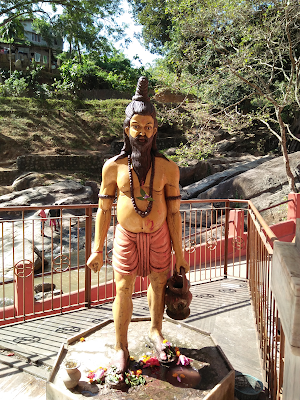
Hinduism - What Is The Mythology Of Vishvamitra, Vasishtha, And Kamadhenu?


Vishvamitra is a king who visits the brahmin Vasishtha's woodland ashram with a contingent of retainers.


When Vishvamitra asks for food, he is astounded by Vasishtha's cow, the Kamadhenu's capacity to feed everyone.


Vishvamitra attempts to purchase the Kamadhenu first, then tries to seize it by force, but his henchmen are thwarted by Vasishtha's tapas' magical abilities (ascetic practices).

Vishvamitra ultimately accepts defeat and undertakes ascetic practices in order to generate his own strength.

Two of their most famous battles are over King Trishanku and his son, Harishchandra; in each instance, the actual problem is the sages' mutual hatred.


Hinduism - Who Is Menaka In Hindu Mythology?


Menaka is a lovely heavenly girl/nymph/celestial maiden (apsara) who is a minion of Indra, the ruler of the gods, in Hindu mythology.

Menaka's main job is to seduce sages who are threatening to dethrone Indra as king of the heavens.

Semen is seen as the concentrated essence of a man's vital energy in traditional Indian culture, and celibacy is viewed as a way to maintain and keep these energies.

Menaka's attracting abilities are employed to seduce these ascetics, reducing their spiritual force.

The sage Vishvamitra, who is twice charmed by her charms, is her most noteworthy companion.

Their first encounter leads in the birth of the maiden Shakuntala, which is honored in the poet Kalidasa's play Abhijnanashakuntala.

Vishvamitra spends 10 years with Menaka during their second liaison before abandoning her for renunciant existence in the bush.


You may also want to read more about Hinduism here.

Be sure to check out my writings on religion here.


Hinduism - Who Is Kashyapa?


Kashyapa is the father of Garuda, the heavenly eagle who acts as the animal "vehicle" for the deity Vishnu, and the chief of the Prajapatis (a class of semi celestial creatures) in Hindu mythology.

Gautama, Bharadvaja, Vasishtha, Bhrgu, Atri, and Vishvamitra are the other Seven Sages whose names signify exogamous clan "lineages" (gotra).

All brahmins are said to be descended from these seven sages, with each family adopting their progenitor's name as their gotra name.

Gotras are still essential in current times, since marriage inside a gotra is prohibited.

The new bride takes her husband's gotra as part of her new identity after their marriage.

Prohibitions against marriage may also be found here. 


You may also want to read more about Hinduism here.

Be sure to check out my writings on religion here.


Hinduism - Who Is Harishchandra In Hindu Mythology?


A ruler in Hindu mythology who is known for his honesty and sincerity.

He has become a metaphor for someone who patiently bears unfair hardship in contemporary Hindu society.

Harishchandra's sorrow stems from a long-running dispute between Vasishtha, his family priest, and Vishvamitra, the sages.

When Vasishtha praises Harishchandra's goodness, Vishvamitra becomes desperate to disprove him.

Vishvamitra, disguised as an elderly brahmin, conjures up a fictional son using his magical skills and convinces Harishchandra to agree to provide whatever is required for the boy's wedding.

Vishvamitra claims Harishchandra's kingdom when the time comes to repay this vow.

Vishvamitra expects the king to refuse this demand, yet Harishchandra fulfills it right away.

When offering a gift to a brahmin, Vishvamitra observes that it is traditional to give a gift of money (dakshina) and requests a considerable quantity.

To acquire the money, Harishchandra sells his wife (Chandramati) and kid into slavery, then sells himself to an outcast who employs him at a cremation yard, where he burns corpses.

Harishchandra's kid gets bitten by a snake and dies after undergoing these hardships for some time.

He doesn't recognize Chandramati when she delivers the corpse to be burnt.

He refuses to bury the kid until the cremation price is paid, claiming that doing so would deprive his master of his due pay.

Chandramati is unable to pay the price due to a lack of funds, and Harishchandra identifies her after hearing her lamentations, making him even more wretched.

The pair ultimately determines that the only way out of their pain is to commit suicide and builds a bonfire on which to burn themselves.

The gods come before them as Harishchandra is ready to fire the pyre, praising his righteousness and dedication to his promise, and Harishchandra's exiled teacher is revealed as dharma ("righteousness") incarnate.

Harishchandra's son is brought back to life, along with his kingdom, and everyone lives happily ever after. 


You may also want to read more about Hinduism here.

Be sure to check out my writings on religion here.