Showing posts sorted by relevance for query Tamil Sangam literature. Sort by date Show all posts

Hinduism - Who Were The Sangama Of Southern India?


    Who Were The Sangama?

    The Sangama Dynasty  is a family dynasty in Ancient India.

    See the Vijayanagar dynasty for further information.


    What Is Sangam Literature?

    Sangam Literature is a kind of literature that originated in India.

    Sangam (sometimes spelt Cankam) means "academy" in Tamil and refers to a collection of classical literature written during the early years of the common period.


    What Were The Defining Qualities Of Sangama Poetry?


    Eight collections of short poems are the most well-known works in Sangam literature.

    Three of these collections belong to the puram ("outer portion") genre, while the other five belong to the akam ("inner part") genre.

    Puram poetry was "public" verse that described kings' exploits, battle, death, and other great acts.


    The Sangam poets distinguished five developed moods in Akam poetry: 

    1. Union, 
    2. patient waiting, 
    3. unfaithfulness, 
    4. separation, 
    5. and hardship.

    Akam poetry was about an individual's inner experience, especially cultured love, of which the Sangam poets distinguished five developed moods: union, patient waiting, unfaithfulness, separation, and hardship.

    Each of these moods has well-developed symbolic connotations, including associations with a certain kind of terrain, time of day and year, flora and wildlife, and different sorts of people; this level of symbolism lends amazing metaphorical richness to these works.

    The akam poems are considered to be the literary forerunners of devotional (bhakti) poetry, which originated in Tamil Nadu.


    References And Further Reading:

    • See A.K. Ramanujan (trans. ), The Interior Landscape, 1994, and Glenn Yocum, "Shrines, Shamanism, 
    • Love Poetry: Elements in the Emergence of Popular Tamil Bhakti," 
    • Journal of the American Academy of Religion, Vol. 41, No. 1, 1973.


    Also refer to, Tamil language and Tamil epics.


    ~Kiran Atma


    You may also want to read more about Hinduism here.

    Be sure to check out my writings on religion here.

    Hinduism - What Is The History Of The Tamil Language?


    Along with Kannada, Telegu, and Malayalam, it is one of the four Dravidian languages spoken largely in southern India.

    Tamil is the most widely spoken language in contemporary Tamil Nadu, one of the "linguistic states" established following India's independence.

    This state was created to bring individuals who spoke the same language and had a same culture together under one administration.

    Despite the fact that all four languages have literary and cultural significance, Tamil has by far the most extensive literary history.

    The Sangam literature, eight volumes of poetry that concentrated equally on the exterior depiction of warfare or the inward description of love, dates from the early years of the common period.

    The three Tamil epics, the Shilappadigaram, Manimegalai, and Shivaga-Sindamani, followed the Sangam literature.

    Between the seventh and tenth centuries, the Alvars and the Nayanars created devotional (bhakti) literature, with the former expressing their devotion to Vishnu and the latter to Shiva.

    Because it used daily vernacular language as a magnificent vehicle for deep religious expression, its devotional poetry was unmatched in Hindu religious history.

    The Alvars' poetry became a foundational book for the Shrivaishnava community, while the Nayanars' poems became a foundational text for Shaiva Siddhanta, and both collections are still essential in Hindu religious life.

    Tamil is still a vibrant literary language and a source of intense regional pride for the people who live there; some of the most violent recent demonstrations in southern India were the so-called language riots, protesting the imposition of Hindi as the government language, which was seen as a deliberate attempt to marginalize Tamil language and culture.

    ~Kiran Atma


    You may also want to read more about Hinduism here.

    Be sure to check out my writings on religion here.


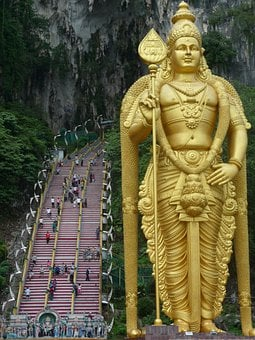
    Hinduism - Who Is Lord Murugan?


    Murugan ("fragrant, lovely") Primarily revered Hindu god in southern India.

    Murugan first appears in Tamil Sangam literature as a hill god linked with hunting and untamed, uninhabited areas.

    The lance, which symbolizes the hunt, is one of Murugan's signature items.

    Murugan was incorporated into the established pantheon as a version of the deity Skanda, who is the son of the god Shiva, when brahminical Hindu civilization eventually spread to southern India.

    Murugan's identity had developed by the eleventh century into that of a philosopher and exponent of the Shaiva Siddhanta philosophical system, as well as the patron god of Tamil literature and language.

    Worshiping Murugan becomes a vehicle for southern Indians to assert their traditional culture, particularly in the state of Tamil Nadu.

    This has been especially true since India's independence in 1947, when attempts to impose Hindi as the national language were seen as cultural imperialism by northern India and met with fierce opposition.

    Palani, Tiruchendur, Tiruttani, Tirrupparankunram, and Swami Malai are the five important pilgrimage centers for Murugan's worship.

    All of these locations are scattered around Tamil Nadu.

    The religion of Murugan has come to symbolize Tamil identity via this network of holy locations (tirthas).


    See Fred Clothey, "Pilgrimage Centers in the Tamil Cultus of Murukan," Journal of the American Academy of Religion, Vol. 40, No. 1, 1972, for further information.


    ~Kiran Atma


    You may also want to read more about Hinduism here.

    Be sure to check out my writings on religion here.


    Pattuppattu


    (from "Ten Songs") A collection of 10 Tamil poetry written in the manner of the Sangam literature's eight anthologies and thought to have been written later.

    The dates of the literature are disputed, although the general view among scholars is that it was produced in the first centuries of the common period.

    The Pattuppattu songs, like the literature, are divided into two categories: puram ("outer portion") and akam ("interior part").

    Puram poetry was "public" verse, depicting kings' exploits, battle, death, and other great feats, while akam poetry was about a person's inner experience, particularly love and sexuality.

    Also see Tamil epics and Tamil language.

    Hinduism - Who Was Avvaiyar?


    Avvaiyar was a Tamil poet who composed and collected works in the early common period (about 100–300 C. E.). 


    • Avvaiyar is noteworthy as a female poet, showing that women of the period were equally involved in a cultured and intelligent society. 


    Related to -  Tamil language, Tamil literature, Sangam Civilization


    You may also want to read more about Hinduism here.

    Be sure to check out my writings on religion here.


    Hinduism - AESTHETICS OR ALAMAKARA SHASTRA


      What Is Aesthetics Or Alamakara Shastra?


      Sanskrit aesthetic theory (alamkara sastra) developed in India as a way to explain the aim of play and poetry, and is known as alamkara (ornamentation/beauty).

      Early theoreticians interpreted alamkara to mean both beauty and beauty achieved via adornment.


      In the first definition, alamkara (virtues/qualities) is innate, but in the second, it is created by the use of words or theatrical gesture to achieve a certain impression.

      However, as with Anandavardhana's theoretical works, a philosophical change happened in this understanding of the connection of alamkara to the guna (c. ninth century).

      He stated that even someone with minimal technical expertise but an intuitive sensibility may be brought to an aesthetic experience (Krishnamoorthy 1979: 123–25).

      He did not dispute the importance of alamkara and guna to aesthetic experience.


      This, of course, implies that there is something intrinsic in the work of art, whether it poetry, theater, or painting, that transcends its mechanics.


      What Is The Theory of Rasa?


      The idea of rasa, which first appears in the sixth chapter of the second-century Sanskrit dramaturgical handbook Natyasastra, is perhaps the most prevalent and influential Indian aesthetic philosophy.


      The term rasa literally means "taste" or "appreciation." 


      In terms of aesthetics, rasa is the consequence of a careful balance of stimulus (vibhava), automatic response (anubhava), and intentional reaction (anubhava) (vyab hicaribhava).


      Rasa is likened to the cooking process, in which the components, each different in their own way, come together to create a singular flavor.

      The flavor is the rasa aesthetic experience, the components are the different bhavas (emotions), and the person who can experience rasa is called as a rasika.


      The Natyasastra lists eight basic rasas, each with its own set of bhavas (emotions).

      To put it another way, if bhava is the feeling, rasa may be thought of as the aesthetic experience of that emotion.


      The eight rasas are listed here, together with their corresponding sthayi bhavas (permanent/stable emotions) (Rangacharya 1986: 38–39).


      • Rasa (Bhava)
      • Srngara (erotic) 
      • Rati (desire) 
      • Hasya (comic),
      • Hasaaaaaaaaaa (laughter)
      • Karuna(compassion) 
      • Soka (grief)
      • Raudra (fearsome) 
      • Krodha (anger) 
      • Vira (heroic) 
      • Utsaha (energy) 
      • Bhayanaka (fearsome) 
      • Bhaya (fear) 
      • Bibhatsa  (loathsome) 
      • Jugupsa(disgust) 
      • Adbhuta  (wonder) 
      • Vismaya (astonishment) 


      When rasa theory is applied to an Advaitic philosophical philosophy, a crucial ninth rasa, Santa (tranquility), is introduced.


      It was just recently inserted into the Natyasastra text, and it is commonly attributed to the eighth-century philosopher Udbhata.


      Santa, on the other hand, is not merely another rasa; it is the basic state of thought from which all other rasas are derived (Krishna moorthy 1979: 206–10).


      Another key notion is sadharanikarana (universalizing emotion), which was first proposed by Bhatta Nayaka (ninth century) and further expanded by Abhinavagupta (tenth century) in his commentary on the Natyasastra, Abhinavabharati.

      Abhinavagupta is largely speaking in the context of Natya when he comments on Bhatta Nayaka's notion offspring sadharanikarana (drama).

      Natya refers to both the text itself and the actual performing that gives the text meaning.

      Unlike emotions that one encounters in reality, which link one to the world, the emotions that occur as a reaction to art (or art-like experiences) lead readers/audience to transcend their subjectivity and individuality.

      According to Abhinavagupta, a rasa experience is impossible without sadharanikaran. (Krishnamoorthy 1979: 214–15), and hence aesthetic experience correlates to the yogin's mystical bliss.


      What Is Bhakti Rasa?


      The rise of bhakti as a significant literary and theological movement has led to its classification as a rasa.

      Bhakti rasa became the dominating and preeminent metaphor of divine experience, particularly within the intellectual circles of Vallabha, Caitanya, and the Gosvamis.


      Bhakti was originally intended as a bhava, not a rasa.

      However, two thirteenth-century interpreters on the Bhagavata Puran, Vopadeva and Hemadri, not only promoted bhakti as a rasa, but even replaced Santa to argue for it as the rasa par excellence.

      Instead of Santa, the other nine rasas are now variations of bhakti.

      The sensation of happiness created by listening, reading, and participating in some manner in the exploits of God and his followers is a basic description of bhakti rasa.

      Other Vaisnava schools, especially Caitanya, Vallabha, and the Goswamis, have significant discrepancies in the formulation of bhakti rasa, and these schools have significant disparities among themselves.

      Sringara or madhurya (sweetness) was the most effective medium for approximating the ecstasy of mystical connection for them (Krishnamoorthy 1979: 198–201).


      What Is Aesthetic theory in Tamil Literature And Philosophy?


      The complimentary ideas of interior/exterior, public/private worlds, and inner and outer in Tamil aesthetic theory are referred to as akam (inner) and puram(outer).


      It grew up alongside what is known as the Sangam/Cankam era of poetry (first to third centuries).

      Puram poetry represented monarchs, battle, and ethics, but akam poetry dealt with love, desire, and yearning.


      The universe and emotions were divided into five landscapes (tinai) in the akam world, each of which symbolized a stage in the growth of love.


      The hero, heroine, her friend, his friend, and so on were all anonymous and archetypal in the akam world.

      The pur.am poetry, on the other hand, included named kings, 'real' events, and bards touring the countryside in quest of a wealthy patron.


      Cankam poetry's aesthetic norms had a big effect on emerging Tamil bhakti poetry (sixth to ninth centuries).

      These traveling poets stole the structures and genres of the previous literary era to convey a new religious sensibility.

      For some ways, bhakti religion brought in a new literary form.

      Although identifying the hero (god) and heroine (the poet in his/her persona) broke a basic aesthetic value, the bhakti poem used the form of the nameless hero and heroine of the akam poems.

      In addition, the poets elevated the god to the status of monarch in their newly created pur.am poetry, transforming the bard-royal connection into that of the devotee and his chosen deity.

      The shattering of the invisible and impassable barrier between the poet and the imagined poetic environment was perhaps the most profound aesthetic change of these new poems.

      By identifying their characters and personalizing their poetic narratives, the new bhakti poems brought the listener into the poem in a manner that the antecedent akam and pur.am poems could not (Selby 2000: 26–35).


      ~Kiran Atma


      See also: 

      Abhinavagupta; Advaita; Bhakti; Caitanya; Drama; Gun.as; Kashmiri Saivism; Languages; Poetry; Puranas; Sanskrit; Vaisnavism; Vallabha; Yogı Archana Venkatesan


      References And Further reading:


      • Krishnamoorthy, K. 1979. Studies in Indian Aesthetics and Criticism. Mysore: Mysore Printing and Publishing House.
      • Rangacharya, Adya. 1986. Natyasastra (English Translation with Critical Notes). Bangalore: IBH Prakashana.
      • Selby, Martha Ann. 2000. Grow Long Blessed Night: Love Poems from Classical India. New York: Oxford University Press.
      • Tapasyananda, Swami. 1990. Bhakti Schools of Vedanta: Lives and Philosophies of Ramanuja, Nimbarka, Madhava, Vallabha and Caitanya. Madras: Sri Ramakrishna Math.