Showing posts with label Naga. Show all posts

Hinduism - Who Is Vasuki In Hindu Mythology?


Who Is Vasuki?

A renowned Naga from Hindu mythology (mythical serpent).

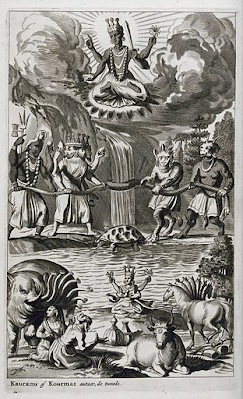
Vasuki's most well-known legendary role is in the narrative of the gods and demons churning the Ocean of Milk in search of immortality's nectar (amrita).


The deity Vishnu acts as the churning-base in the shape of his Tortoise incarnation, Mount Mandara serves as the churning-stick, and Vasuki, with his immense length, serves as the churning rope.

They tug Vasuki back and forth, with the gods on one side and the devils on the other, until the sea of milk yields up its riches.


~Kiran Atma


You may also want to read more about Hinduism here.

Be sure to check out my writings on religion here.

Hinduism - Who Are The Suryapraksha Among The Dashanami Sanyasis?


("the sun's effulgence") The Mahanirvani Akhara, a subgroup of the Naga class of the Dashanami Sanyasis, is known by the name of the banner that serves as their symbolic insignia.

The Nagas are Shiva followers (bhakta) who are organized into several akharas or regiments, similar to an army.

The Nagas' major vocation until the early nineteenth century was as mercenary troops, while they also had significant commerce interests; both of these have mostly vanished in modern times.

This specific banner—one with strong links to a martial identity—is one of the traits that identify the akhara's organizational identity.


You may also want to read more about Hinduism here.

Be sure to check out my writings on religion here.


Hinduism - What Is The Niranjani Akhara?


Niranjani Akhara  is the name of a subgroup of the Dashanami Sanyasis' Naga class; a specific sort of renunciant ascetic.

The Dashanami Sanyasis are Shiva worshippers (bhakta) who are divided into akharas or regiments in the manner of an army.

The Dashanami Sanyasis' major occupation until the beginning of the nineteenth century was as mercenary warriors, while they also had significant trading interests; both of these have virtually vanished in modern times.

The Niranjani Akhara is one of the seven primary Dashanami Sanyasi akharas, and it is one of the most powerful, along with the Mahanirvani Akhara.

Their contrasting positions in the bathing (snana) processions during the Kumbha Mela festivals demonstrate this power: at Haridwar, the Niranjani Akhara goes first, followed by the Mahanirvani; in Allahabad, the sequence is reversed.

The Juna Akhara, rather than being a subsidiary of the Niranjani Akhara, became a distinct procession in 1962.

The Juna Akhara will lead the Sanyasi processions for bathing on the Shivaratri festival, followed by the Niranjani and Mahanirvani Akharas, according to the provisions of the 1962 agreement.

For the other two important bathing days, the Niranjanis would be first, followed by the Juna and Mahanirvani Akharas.

The Niranjani Akhara's ability to hold the top spot is mostly due to their local power: the Niranjani Akhara was formerly highly strong in Haridwar, where it still controls major land.

However, the Mahanirvani Akhara was located in Allahabad.

Another indication of the Niranjani Akhara's standing is that it has the Ananda Akhara as a subsidiary organisation.

Each akhara has distinct characteristics that determine its organizational identity, particularly distinctive tutelary deities.

Skanda, the son of Shiva and Parvati and the heavenly general leading Shiva's supernatural army, is the tutelary god of the Niranjani Akhara.

The choice of a heavenly warrior shows the akhara's power and previous military prowess, in addition to functioning as an identifying marking.


You may also want to read more about Hinduism here.

Be sure to check out my writings on religion here.


Hinduism - Who Are The Naga In Hindu Mythology?


#

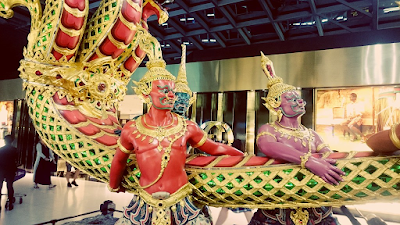
Naga is a Sanskrit  word for "noble" (2) The Nagas are a group of minor divinities who take the shape of serpents in Hindu mythology.

Vasuki is their ruler.

Nagas are often considered to be the gods of a given location in popular Hinduism.

Nagas are said to reside in springs, ponds, and other tiny bodies of water, and are often connected with fertility and fecundity.

Nagas are often depicted as minor protecting deities in Buddhist and Jain imagery.

A sitting person shad owned by a "umbrella" of Nagas is frequent.

Although this is rare in Hindu imagery, it is possible that remains of this may be seen in the iconography of the deity Shiva, who is often pictured wearing snakes as decorations and holy thread.


~Kiran Atma


You may also want to read more about Hinduism here.

Be sure to check out my writings on religion here.


Hinduism - Who Is A Naga?


Naga is a Sanskrit root word that means "naked." Any fighting or militant ascetic is referred to as a militant ascetic.

Companies of fighting ascetics were originally chartered by ascetic orders to defend their members and their belongings.

The Dashanami Sanyasis' Naga orders were worshippers of the deity Shiva, while the Bairagi orders were devotees of the god Vishnu.

These Naga ascetics emerged into strong military and commerce powerhouses in northern India throughout the eighteenth century.

Naga ascetics have created their own small kingdoms on various occasions.

In many other cases, whether as individuals or as mercenary warriors in the service of a ruling king, they had a significant impact on the northern Indian economy and politics.

Because many of these ascetics would go into war with just their weapons, their moniker was a literal representation of their activities.

Their ash-streaked bodies and matted hair made for a terrifying image.

The military prominence of India has waned as the country's socioeconomic and political situations have altered.

These Naga ascetics' associations (akhara) still exist, however they are now most significant in regulating the sequence of bathing (snana) during the Kumbha Mela.

The ascetics' own stories are replete with tales of sectarian struggle (Shaivas vs.

Vaishnavas); a solid indicator that the Shaivas achieved ascendancy is that they had precedence in bathing during the Kumbha Melas.

For more information, see Jadunath Sarkar's A History of the Dasanami Naga Sanyasis, published in 1958; David Lorenzen's "Warrior Ascetics in Indian History," published in the Journal of the American Oriental Society, Vol. 98, No. 1, 1978; and James G. Lochtefeld's "The Vishva Hindu Parishad and the Roots of Hindu Militancy," published in the Journal of the American Academy of Religion, Vol. LXI


~Kiran Atma


You may also want to read more about Hinduism here.

Be sure to check out my writings on religion here.