Showing posts sorted by date for query Hindu spirituality. Sort by relevance Show all posts

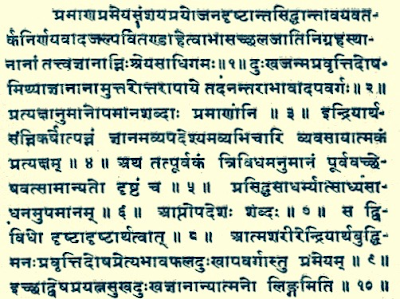
Hindu Pramanas


    A tradition might be critically examined from the inside out or from the outside in. I'll approach it the first manner in this essay. 

    Raising the kinds of questions I'll be asking already suggests a certain detachment from that tradition, but I do it with the intention of promoting conventional ways of thinking rather than pointing out any flaws or limitations it may have. 

    One faces the danger of becoming an overly quick, superficial, or even haughty critic of a long and revered tradition if they live outside the place where that tradition arose and still has strong roots and are exposed to a strong and chronologically and culturally more relevant style of thought. 

    One develops the impression that they are liberated, free of every tradition, and may thus criticize their own. 

    But if that illusion of freedom is false, then criticism is only surface-level. 

    The critic will be forgetting what Gadamer so vividly taught us if he asserts that he is free from all traditions and that he is instead thinking within a new tradition, such as the tradition of (modern) rationality. 

    I will only indirectly discuss the texts that these schools get their inspiration from while discussing the Indian philosophical heritage. 

    Instead, I will focus on the Indian darsanas, the traditional philosophical schools. 

    This choice, which is supported by the use of antiquity, gives us a less unclear discourse to consider and enables us to avoid numerous common mistakes. 

    When discussing Indian philosophy, it's typical to argue, for instance, that it is profoundly spiritual, that its aim is not only intellectual gymnastics but rather the spiritual alteration of one's character, and that philosophy is a tool for achieving moksa, or spiritual emancipation. 

    Such broad assertions are, to put it mildly, quite deceptive; in a well-known interpretation, they may even be untrue. 


    Characteristics of Indian Philosophy


    The following observations might pave the way for a more thorough examination of the characteristics of Indian philosophy:


    1. First and foremost, there is no denying that the Upanisads have a strong spiritual motivation: it is said that realizing the atman will end all suffering in this world and lead to a state of spiritual emancipation (whatever the latter may mean). 

    Even though the darsanas attribute their beliefs and doctrines to the Upanisads, it is sometimes mistaken to fail to discern between their purported spirituality and that of the Upanisads. 

    2. Second, contemplating spiritual issues is not in and of itself spiritual.  This assertion merely serves to reaffirm the kind of thinking it is, not to diminish it. 

    Quâ thought is neither spiritual nor non-spiritual; it may be comprehensive or shallow, daring or conventional, logically rigorous or lacking in rigor, critical or creative. 

    Consider the related statement that perception is not a function of thought. 

    3. Another point often overlooked by proponents of the spiritual nature of the darsanas is that although some of them, at least, acknowledge sabda as a pramana or method of real knowledge, they do not associate sabda with any particular experience. 

    Those who seek to claim that the identification of Sabda as a Pramana is equivalent to agreeing to the spiritual experiences of the "seers" an authoritative position misinterpret this issue, about which the philosophical tradition had considerable clarity. 

    I'll come back to this perplexity later. 


    Cliches like the idea that Indian philosophies rely more on intuition than intellect exhibit the same kind of misconception. 

    Apart from the fact that the terms "intuition" and "intellect" have multiple and overlapping usage, I want to remind individuals who like such clichés that none of the darsanas use the word "intuition," which is a pramana. 

    Without going into any more detail, let me go on to the flattering remarks I want to make. 

    I'll categorize my comments into three groups: those about pramana, or real cognition's methods, those about prameya, or its objectives, and those about the theory's general position, goal, and relationship to other lines of investigation. 


    The Purpose Of Philosophical Theories.


    A philosophical theory must provide a detailed explanation of how things are, but it must also support that description with a theory of evidence, logical justification, and critical evaluation. 

    It must have a philosophy of those theoretical procedures in addition to using facts, reasons, and critical evaluations. 

    It must provide universal responses to issues like: When is a cognitive assertion true? What kind of evidence are appropriate in determining if a cognitive assertion is true? What kinds of reasons for holding certain ideas are acceptable? What standards are acceptable for seriously evaluating competing claims? What are the relative strengths and weaknesses of the criteria when they conflict? The pramana theory focuses on solving these problems. 

    The fact that all of the darsanas developed their own theories of pramana at some point throughout their evolution is a unique indication of the high degree of intellectual complexity of the darsanas. 

    As is fairly well known, these theories varied not just in terms of how pramana was defined (and the accompanying idea of prama, i.e., actual cognition), but also in terms of how many pramanas there were and what characteristics each one had. 

    Here, I want to call attention to a few standout characteristics that come up in these debates and shed a little, if any, light on the Indian conception of reason. 

    Let's start by pointing out a significant discrepancy in locution, which is not just a question of locution but rather indicates serious fundamental problems. 

    Until recently, it was common in the Western philosophical tradition to question whether knowing comes from reason or experience. 

    The solutions provided by the rationalists and the empiricists were different. 

    These responses, in their different iterations, guided Western philosophy's development. 

    The concepts "reason" and "experience" don't have direct equivalents in Sanskrit philosophical jargon, and the epistemological problem has never been discussed in such broad terms. 

    On the other hand, the issue of whether perception is the sole pramana or if anumana is a pramana was posed, and it is possible that this question will be misunderstood for the one that was just presented in the Western tradition. 

    Neither "perception" nor "anumana" are interchangeable with "experience" or "reason," respectively. 

    Every philosophical school that acknowledged perception as a pramana did so, but many of them did not limit perception to sensory perception, nor did they limit sensory perception to the realm of perceptible characteristics, like color, and material things, like sticks and stones. 

    The ego and its attributes, such as pleasure, suffering, desire, and cognition, universals, such as redness, natural-kind essences, such as cowness, and relations, such as touch and inherence, were among the objects that were considered to be sensually sensed (of a quality in a substance; of a universal in its instances). 

    Anumana, or inference, derives from perception, which makes it obvious that it differs from reason (as used by rationalists). 

    No school of Indian philosophy, excepting Buddhism, assigned inference a "constructive" function. 

    It is aware of what is otherwise knowable. 

    Perception is always given importance. 

    There are no rationalists in India. 

    Unlike "experience" and "reason" in traditional Western philosophy, neither perception nor inference were used to identify any particular mental capacity. 

    In one instance, perception was the consequence of the same abilities or cognitive tools acting in a different way; in another, inference was the result. 

    I've elaborated on this topic to warn against the tendency to identify close relatives of Western epistemologies in pramana theories. 


    What Is Pramana?

    The words that came before point to another aspect of the pramana ideas. 

    A pramana is the particular cause of a real cognition or irreducible inherently. 

    There are two distinct types of justifications for a pramana not being accepted by a certain school. 

    1. Some Buddhists do not consider inference to be a pramana for this reason: an inferential cognition perceives its object as an instance of a universal rule and not in its uniqueness, and is thus not true to its object's own nature. 
    2. Another reason is that the type of cognition it causes is simply not true cognition. However, there are many more explanations for why a purported pramana is not really one. 

    The Vaisesikas stress that the supposed linguistically created cognition is not of an irreducible kind, but rather reducible to inference. In doing so, they do not dispute the truth of the putative linguistically generated cognition. 


    What Constitutes A Pramana?

    A pramana hypothesis so makes the following three claims: 

    (1) Some cognitions are true, or prama; 

    (2) Some of these true cognitions fall under a type that cannot be reduced to any other type; and 

    (3) True cognitions of such an irreducible type are brought about by a particular collection of causal circumstances. 


    As a result, the pramana theory incorporates a kind of causal theory of knowledge:1 a valid cognition must not only be true to its object (arthavyabhicarin), but it must also be formed correctly, that is, by the proper causes. 

    This may be stated in terms of current philosophy as follows: S has a cognitive state of the type "p" if this cognitive state is true and if it is produced in the appropriate manner. 

    This last explanation in terms of a mental state brings me to the third aspect I want to highlight. 


    Pramanas As Causes And Defenses For Cognitive Experiences.

    The dualism of mind and matter, the subjective and the objective, has divided Western thinking since at least Descartes, in addition to the competing claims of reason and experience. 

    The separation between the private and public is one of the offsprings of the latter division. 

    This has become known as the psychologism issue in more contemporary philosophical thought. 

    The ghost of psychologism has haunted epistemology and theory of logic, and both fields have made efforts to exclude any mention of inner mental states from their language. 

    Pure objectivism, whether of the Platonic or physicalist kind, has been the result. 

    In contrast, Indian epistemologists have openly employed "mentalistic" discourse and haven't given much thought to issues with psychologism, private language, etc. 

    You might just charge them with being uncritically naive. 

    But given their sharpened critical faculties, it is necessary to look elsewhere for the causes. 

    It is generally known that for the majority of Indian philosophers, the mind (if manas is to be interpreted that way) is more of a delicate kind of prakrti or matter, an unconscious inner sense organ, rather than a space for personal experiences. 

    Only the self, or atman, has the ability to "perceive" the thoughts and other experiences that belong to them (if self-manifesting, then so only to the owner). 

    However, it does not necessarily follow that no one else can know them through any of the pramanas other than perception if S is the only one with an internal perception of his experience. 

    Additionally, these episodes have their ideal purposeful contents, which numerically unique episodes belonging to different owners and occurring at various temporal locations may share. 

    This is true even if they are owned by the same person. 

    I've shown in other places how, given this idea of "mental episodes," it is possible to create a logic of cognitions with the proper logical rules for inference. 

    Therefore, discussing a cognitive experience should not raise the specter of psychologizing. 

    The causal story that permeates Indian epistemologies was mentioned earlier. 

    It is now able to take a closer look at it. 

    It has become customary to clearly distinguish between questions of causal origin and questions of epistemic justification, possibly since Kant (quaestio factis). 


    Causal Theory Of Knowledge.

    A causal theory of knowledge has only recently become very popular, but causal theories of knowledge must be able to accommodate justificatory concepts like truth and logical validity. 

    Indian epistemologies might be used as a valuable example in this respect. 

    The pramanas act as both causes and defenses for cognitive episodes, as B. K. Matilal emphasized in his most recent book on perception. 


    This, in my opinion, was made possible by first separating out non-controversial instances of true cognitions from similar instances of false cognitions, searching simultaneously for

    (1) the marks that distinguish the former from the latter, and 

    (2) the distinctive causal conditions that produce the former and not the latter, 

    and finally combining (1) and (2) in the definition of pramana. 


    The causal conditions producing cognitions (of a certain type) and those producing true cognitions (of that type) coincide in theories that view truth as svatah. 

    The logician-cum-epistemologist believes that causal theories are problematic since they are infamously reductionistic. 


    When Causal Theories Suffice.

    According to Indian tradition, which saw them as descriptive and consistent with cognitions' distinctiveness and claim to reality. 

    There are two aspects to this liberalism: first, whereas the causal laws used by Indian epistemologists are formulated in terms of such heterogeneous elements as physical contacts, revived memories, and desires to have a certain kind of knowledge, for example—if needed, even activation of traces of past karma and the pervasive passage of time—reductionist causal laws are physicalistic and oriented to the prevailing physical theory. 

    Second, such a causal story is descriptive rather than explanatory because it is written to conform to the intuitive requirements of a cognitive event rather than to the limitations of an existing physical theory. 

    The general restrictions resembled those of a significant ontological theory. 

    Before moving on to the prameya theory, or ontology, I will only make two more remarks about the pramana theory. 

    In that order, these two comments will address anumana (or inference) and sabda (word). 

    In the secondary literature, it has been extensively discussed how the Indian theory of anumana is nonformal (it tells a story about how inferential cognition arises) and psychological (it requires an instance where the universal major premise is satisfied). 

    Both descriptions are accurate, but unless properly understood, they run the risk of misleading. 

    I've already discussed how Indian thought combined logic and psychology. 

    This viewpoint is well shown by the theory of inference. 

    The reconciliation of psychology and logic was achieved through both the logicization of psychology and the psychologization of logic: 

    the former by assuming that the psychological process of reasoning conforms to the logical (any apparent deviation, such as in allegedly fallacious reasoning, being due to misconstrual of the premises); and the latter by turning logic into a logic of cognitions rather than of propositions. 

    The Indian theory of anumana is not ignorant of formal validity, though. 

    In actuality, a valid Nyaya anumana can be abstracted from a valid mood. 

    The merely formally valid inference, such as in tarka or counterfactuals, was ignored because the focus was on cognitions (rather than sentences or propositions), and anumana as a promana, as a source of true cognition. 

    This brings me to the idea of the word, or sabda, as a pramana, or a source of genuine cognition. 

    The deeper roots and true pillars of the Hindu tradition are actually found here. 

    The Indian epistemologies already have a novel feature in the simple recognition of sabda as a pramana. 

    Perception, reasoning, introspection, and memory are among the types of knowledge that are acknowledged by Western epistemologies. 

    Many philosophers today emphasize the crucial part that language plays in forming our knowledge. 

    But as far as I'm aware, no one regards language—or verbal utterance—as a stand-alone method of learning about the outside world. 

    And yet, how much do we really know only by listening to people, reading books, and other things—not to mention our religious and moral convictions that come from studying the scriptures? Indian epistemologies acknowledged sabda (listening to a competent speaker's utterances) not only as a pramana but also as the key source of our cognitions about all those things that go beyond the bounds of what is feasible for sensory experience. 


    The following are some features of the sabda-pramana theory that I want to highlight. 


    1. First off, sabda, as a pramana, is not just a word; it is a sentence, and that sentence is spoken, not written. 

    Without a doubt, the spoken and the heard take precedence over the written. 

    2. Second, most Indian theorists place more emphasis on imperative than indicative phrases when it comes to language development. 

    The purpose of the sentence utterances is primarily—if not exclusively—to give orders, recommend actions that should be taken or avoided, and other similar tasks, rather than to state facts. 

    3. Thirdly, most Indian theorists adhere to a pure referential theory of meaning (both for words and for sentences) and lack a concept of sense as opposed to reference. 

    (Several individuals have attempted to demonstrate where to look for such a theory of sense since I made this diagnosis 20 years ago. 

    Mark Siderits' attempt is the most convincing of these attempts. 

    I believe my general diagnosis is accurate, even though Siderits is correct in tracing a sort of sense theory to the Buddhist apoha theory.) 


    The difference between understanding and knowing can be blurred in the theory of sabdapramana thanks to a direct referential theory. 

    The Nyaya literature is full of translations of meaningless phrases like "hare's horn," but the real obstacle to the theory is the lack of a tenable explanation for what it means to comprehend a false sentence. 

    If the Naiyayika are to be consistent, abdapramana must be fundamentally true. 

    False sentences are unable to produce understanding (sabdabodha), let alone prama. 

    However, theoretically speaking, sabdabadha and sabdajanyaprama are identical. 

    It is all too clear that this identification creates enormous problems. 


    4. Fourthly, the claim that sabda is an irreducible pramana is most strongly supported in the field of what should and shouldn't be done. 

    If factual facts may potentially be proven by observation or some type of reasoning, it is reasonable to assert that the only way we can know what is right and wrong is through vocal instruction, whether it be written or spoken, from moral authorities, wise people, or the scriptures. 

    The assertion that the sacred, well-known scriptures (the Vedas and the Upanisads) are apauruseya, or that they were not written by any human author, is a significant one that solidly supports tradition. 

    This grants them an authority that no text by a human author could support—one that is free from any possibility of fault and cannot be changed. 

    At the conclusion of this article, I will revisit the idea of "apauruseyatva." 


    Pramana Theories.

    What kinds of prameya theories, or potential sources of true knowledge, did Indian philosophers hold? 

    What can be done at this point, given the wide range of ontologies—from the pluralism of Nyaya-Vaisesika to the monism of Advaita Vedanta—is to call attention to some important aspects of those ontologies. 

    First of all, it should be recognized that these ontologies do not accept any abstract entities of the kind that Western ontologies do. 

    We have Fregean senses (such as propositions), numbers, and universais among the common abstract objects. 

    I've already stated that, in my opinion, there are no fully developed Fregean senses. 

    Numbers are reduced to the characteristics of sets (gunas). 

    Although universals are widespread, they are not the kind of rarefied beings that can only be understood through the use of reason, as they are understood in the Western metaphysical tradition. 

    They are perceived through the same sense organ that their instances are, making them somewhat more concrete entities. 

    There are also no purely hypothetical possibilities. 

    It is not surprising that these last creatures are absent because, contrary to Indian thought, God's mind, which serves as their habitat in Western metaphysical tradition, does not have the ability to create something out of nothing. 

    Some standard concepts of necessary truth and its opposite contingent truth simply cannot find any formulation in the Indian systems due to the lack of possibilia and abstract entities such as propositions. 

    We therefore have descriptions of what the world actually is, but not of what might have been or what might not possibly have been. 

    Remember that the typical expression of vyapti is extensional rather than modal ("It is impossible that..."): "It is never the case that in all those loci where smoke is present, fire is absent." The fact that science and metaphysics have stood sharply apart since the beginning of metaphysics in Aristotle is one reason why the metaphysical scheme in traditional Western metaphysics claimed a sort of necessity over and against those features of the world that the sciences study. 

    According to this argument, metaphysics is not concerned with beings but rather with being quâ being, which is defined in a number of well-known ways (for example, as the highest being, the most general predicates or categories, or the definition of the word "being"). 

    Science and metaphysics are still intertwined in the minds of Indian metaphysicians. 

    Both both out to comprehend how the universe is organized; the main difference is in the generality of their approaches. 


    Advaita Vedanta As An Exception.


    The only exception to this rule is Advaita Vedanta, which holds that since there is only one Being at work beneath all things, metaphysics—if that is what para vidya needs to be called, which is highly dubious—is the study of that Being. 

    If creation from nothing, and thus creation in the strict sense, has no place in Indian thought, then this is not merely a peripheral phenomenon for the darsanas; rather, it determines some very central features of not only the Indian cosmologies but also of the metaphysical concepts of God, substance, time, and negation, as I believe it can be demonstrated. 

    Unfortunately, I am unable to look into that issue at this time. 


    The Pramana-Prameya Structure

    In this final and concluding section, I'd like to discuss the entire pramana-prameya structure, or the philosophical endeavor as it is represented in the darsanas. 

    The Indian philosophers were working on extremely complex philosophical issues, but they weren't explicitly and consciously concentrating on the nature of their work. 

    It is normally in reaction to the skeptical criticisms of a Madhyamika that occasionally they would, while justifying their business, comment on the nature of what they would be doing. 


    Without delving into linguistic specifics, let me mention some of the important points. 


    1. The Madhyamika critique includes an ontology critique in addition to an epistemology critique. 

    The critic argues that they are dependent on one another. 

    Without first deciding what needs to be known, you cannot determine what the pramanas are. 

    And until you have the knowledge necessary on hand, you cannot answer the second question. 

    So where do you start? Why not abandon the whole endeavor if the cycle cannot be broken?


    2. In response to this challenge, the pramana-prameya theorist has stated, in brief, that it assumes an unnecessarily strong reading of the unity of the two parts of a darsana. 

    A pramana's relationship to its prameya is not one-to-one. 

    More than one pramana can have knowledge of the same thing. 

    Consider the Nyaya and the Vaisesika for an example of how one and the same ontology system can be made to work with various epistemologies. 

    By defining both and creating a many-one or one-many relation between terms on each side, it is possible to overcome the mutual dependence that jeopardizes the relationship between cognition and object in general. 


    3. According to (2), a darsana is not a seamless whole that cannot have portions removed from the context of that system. 

    My interpretation conflicts with the traditionalists' interpretation, which treats each darsana as a distinct viewpoint. 

    The Russian immigrant David Zilberman held this comprehensive view of a darsana, which I reject here. 

    His untimely death was a serious loss to Indian philosophy. 


    4. Although it is not stated explicitly, practice suggests that this is frequently the case, the reflective question of what kind of knowledge a philosophical system itself yields (or amounts to) and whether it can be appropriated into one or more of the pramanas recognized by the system was chosen. 

    The reason was a failure to recognize that philosophical knowledge is a type of knowledge that is, quâ knowledge, distinct from the types of knowledge that are thematized within the system. 

    This was already alluded to earlier. 

    In light of the purely referential theory of meaning, an alternative solution that would have involved drawing a distinction between understanding and knowing (where philosophy produces understanding but not knowledge) was not feasible. 

    The knowledge of brahman is such that both the knowledge and the entity of which it is knowledge are thematized within the system, according to the Vedantin, who claims that this knowledge leads to moksa. 

    What kind of cognition is meant when the Nyaya Stra claims that understanding the sixteen padarthas results in the highest good? Are there one or more pramanas involved? It appears that the answer is "yes." 


    5. Students of the darsanas frequently ponder where the framework (the list of pramanas and prameyas) that the later authors continued to refine was derived by the early masters, the authors of the stras and Bhasyas. 

    It does not allay that anxiety to say that they elaborated a way of seeing using the verbal root "drs" (= to see). 

    In any case, it is untrue that the later writers merely improved and clarified the framework put forth by the forefathers. 

    The more typical answer was to trace the framework back to the sruti, although they did tweak and modify it within reasonable bounds (which also argues against a strong holistic interpretation of the darsanas) (the heard texts with no human author). 

    Think about the intellectual phenomenon whereby philosophical systems as different as Vedanta and Nyaya claimed sruti affiliation. 


    So how should the nature of sabdapramana be understood in order to make sense of this paradoxical situation? 

    The nature of sabdapramana as applied to sruti should, in my opinion, be understood for this purpose in a way that is implicit in the tradition's understanding of itself but is not explicitly stated as such. 

    In my interpretation of the function of sruti in relation to philosophies, I deviate from the conventional wisdom in this area. 

    The sruti's apauruseyatva does not, in my opinion, imply that the texts are not composed at all or that they represent some extraordinary, mystical experience. 

    Not the first, both because there is sufficient internal evidence that the texts were written and because a literal interpretation would be absurd. 

    Not the second, because in my opinion, sentences express thoughts rather than experiences. 

    Although this is not the appropriate time, I would like to defend the last thesis. 

    Setting aside these two frequently accepted views, I want to offer the following. 

    First, considering the authors' intentions is completely irrelevant and useless when attempting to understand the sruti texts. 

    Insofar as they are readily available to us and serve to define the tradition for us, the texts, or the words themselves, are primary. 

    We interpret those words by using them to describe our experiences, the outside world, and ourselves. 

    While conventional wisdom assigns the sruti's words whatever meaning it deems appropriate, I leave room for interpretation. 

    It is this fluidity of meaning, this unending potential of interpretation, the ongoing challenge they offer to us, which sets the words of the sruti apart from those of smrti . 

    They are fundamental not because they represent facts which are unassailable, but because they describe the framework within which the Hindu philosophers posed questions, comprehended their concerns, and judged their replies. 

    In this sense, sabda (like sruti) is not itself a pramana , but underlying the latter's uses. 

    Apauruseyasruti is not the highest pramana , infallible and risen above all the others. 

    Instead, it is the origin of all questions and worries (source, not solution) for which the various pramanas show a unique philosophical relevance. 

    So, who is adopting that tradition in their thinking? My response is that sharing the concerns as sources of philosophical issues is what is required, not thinking traditionally or adhering to any or all of the schools' responses. 

    Thus, rather than defining the tradition in terms of beliefs, I describe it in terms of concerns.


    ~Kiran Atma


    A Rediscovery And Rebirth Of India


    Om Asato maa sadgamaya, tamaso maajyotirgamamaya, 

    Om mrityor-maa amrutam gamamaya. 

    Shaantih Shaantih Shaantih |||. 


    Lord, guide me from the imaginary to the actual. 

    Bring me to the light, please. 

    Bring me to immortality from the grave. 

    May there be absolute, unbroken peace. 


    ~ An incantation in Sanskrit taken from Brihadaranyaka Upanishads 1.3.28. 


    In every realm Gatekeepers inadvertently act as barriers that create separation. Gatekeepers invariably become the enemies of existence awaiting eternity's Destruction. 

    Rulers, Governments, Organizations, Financial Entities, and the chaos and cacophony that define them, now are the gatekeepers of the quality of Your Life on Earth. 

    This speck of a planet we advanced primates call home is overrun by gatekeepers.

    Gatekeepers remind me of Jaya and Vijaya, of Hiranyaksha and Hiranyakashipu, of Ravana and Kumbhakarna. Memories are all that's left(of them).


    Jaya, one of the gatekeepers of the deity Vishnu's celestial home Vaikuntha, is cursed, along with his brother Vijaya, to be born three times as a demon (asura) and destroyed by Vishnu each time.

    When they prevent Sanaka from seeing Vishnu, he bestows this curse on them.

    The two are born as Hiranyaksha and Hiranyakashipu, who are slaughtered by the Boar avatar and the Man-Lion avatar, respectively, in their first incarnation.

    Ravana and Kumbhakarna are their second incarnations, and both are destroyed by Vishnu's Rama avatar.

    They reincarnate as Shisupala and Dantavaktra in their last incarnation and are murdered by Vishnu's Krishna avatar.

    They return to their responsibilities as Vishnu's Guardians and Gatekeepers after the curse's criteria have been met.


    Since the beginning of time, people have been to India from all over the globe. 

    They have arrived as nations such as the Greeks, Romans, Persians, Arabs, Portuguese, French, Dutch, and British, as well as as ethnic groups and individuals such as Hiuen Tsang, Mark Twain, Annie Besant, Romain Rolland, and Walther Eidlitz. 

    They all had one thing in common: they all came looking for money and commerce, some looking for safety from persecution, some looking for spiritual enlightenment. 

    Their lives were irrevocably altered by India. In the West, the name "India" conjures up images of snake charmers, pagan gods, cows, castes, and Gandhi. In the East, it conjures up images of Buddha, curries, and elephants. 

    Why is it the case? What influences the unfavorable and often biased opinions of India? Who was behind these outrageous fabrications, and why? It's crucial to travel through time to learn about an old place, its people, their beliefs, the religion, and the interactions of its residents with the rest of the world that have influenced outsiders' impressions in order to comprehend these things. 

    India has unique physical, cultural, and magnificent natural limits, with a geographical mass the size of Europe minus Russia. 

    Strategically situated between China and the rest of the Western world, it is home to 1/6 of mankind. 

    Three major rivers—the Indus, Ganga, and Brahmaputra—water the area whose limits extend from the Himalayas, known as the "abode of snow" for its massive mountain range. India is a triangle-shaped country that stretches from the high Himalayas to the pleasantly warm Indian Ocean. 

    These geographic divisions have promoted amazing cultural variety and unity. The Hindu religion, which is followed by 850 million people, as well as its offshoots such as Buddhism, Jainism, and Sikhism, were both developed in India, the most varied country in the world. 

    Additionally, it has one of the world's fastest expanding economies right now. 

    For thousands of years, connections between civilizations and countries have been centered on religion, commerce, and conquest. 

    The same is true of India. Men from many different countries have been inspired by the grandeur and prosperity of classical India. Indian concepts of the soul and its reincarnation were ingrained in Pythagoras and his contemporaries. 

    On his return trip from the Mongol court of China, Marco Polo, who had previously been to India, proclaimed it to be "the finest and wealthiest nation in the world." Alexander of Macedonia, a Greek, was the first to set foot on Indian soil in 326 B.C., followed by the Huns, the Arabs, the Turks, and the Afghans in 963 A.D. 

    The Arabs have always engaged with India's prosperous commercial ports and cities. 

    Beginning in 1526, the Mongols—Genghis Khan's descendants—conquered and ruled over a large portion of India. 

    Beginning with the Portuguese in 1498, the Europeans were the last to arrive in India. 

    Along with the Dutch (1639), the British (1609), the Danes (1616), the French (1664), and the Danes traveled to India's coasts in search of her fabled riches and resources. The British first arrived as merchants but lingered for over 200 years to control and plunder. 

    India was reportedly visited by the first Greek, Scylax of Caryanda, in 510 BC. Since that time, Europe is aware of several reports and facts about India. Greece received several translations and writings of Indian philosophy. 

    For instance, both civilizations had a reverence for the gods of heaven Varuna or Ouranos and morning Ushas or Aurora. After the rise of Islamic dominance in the seventh century, this tight communication between India and Europe came to an end. 

    Numerous Sanskrit literature, notably The Mahabharat and The Bhagavad-Gita, were translated into Arabic during the subsequent Islamic assaults. According to legend, the fourth Caliph said that India is the country where books were first written and where wisdom and knowledge originated. 

    The Upanishads were translated from Sanskrit into Persian by Dara Shikoh under the title Sirr-ul-Akbar during the Mongol era, when Islamic culture was being imposed, and it was in this form that European academics first encountered them. 

    Sanskrit translations of Hindu texts into English were undertaken by the British, first by Charles Wilkins with his translation of "The Bhagavad Gita," then by Sir William Jones and several other translators. 

    The majority of the Western world's present knowledge of Hinduism is based on translations of Hindu texts made in the second half of the eighteenth century in English, German, and French. Numerous Europeans were concerned about losing their sense of cultural identity as a result of the discovery of Sanskrit and the influence of Indian thinking on the intellectual life of Europe. 

    Such foreigners are the ones who offer the names Hindu and India. 

    The word "Hindu" as we use it now has Persian roots. Indians were known to the Persians as residents of the region around the Sindhu (Indus) River. Hindu was given the name by the Persians who softened the S to an H. The term Indus was transformed to Indoi by the Ionian Greeks, who learned about India from the Persians, and the country of Indus became known as India. 

    India's ancient past is very vast and all-encompassing and is buried in the prehistoric obscurity of time. 

    Her history is amazing in terms of its breadth, splendor, and trials. Its religion, Hinduism, also known as Sartatan Dharma, has a long and distant history that spans many yugas of time. 

    A time frame so incredible that it has never been equaled by a European notion. The only revelation whose principles are entirely consistent with contemporary science is the slow and gradual construction of the cosmos. We are now living in the Kaliyuga, also known as the era of Kali, as per Vedic traditions. 

    The fourth and last yuga (age) in the cosmic calendar, after Satya, Treta, Dwaparyuga, and Kali, is known as Kali yuga. According to legend, the Kaliyuga lasted for 432,000 years, the Dvaparayuga for 864,000, the Tretayuga for 1,296,000, and the Satyayuga for 17,280,000. 

    The world's oldest civilization, Hinduism, has an astonishing level of continuity. Her historical records date back to the year 5000. Even now, the intricately carved temples of her mature and stable civilisation show a beauty of times past. 

    Time was fittingly deified as Mahakala, Great Time, in her rich and ancient history. Hinduism firmly believes in either emptiness or infinity. The Vedic sages of India had no qualms about the vacuum or the limitless. 

    Given this notion, it is only fitting that the concept of the mathematical "zero" or "sunya" was invented by the Hindus. Hinduism, also known as Sanatan Dharma, is more of a way of life than a religion. 

    It is not a structured religion, has no founder or notable historical figure, lacks a centralized authority, and is hence surprisingly non-dogmatic. 

    It has always placed a greater emphasis on behavior and experience than it has on doctrine, and on intuition rather than reason. It is a religion based on several texts rather than just one. It is a revelation-based religion. 

    Since the word "Sanatan" means "eternal," its roots are independent of human history and experience, and its truths have been revealed by the hand of God. 

    Hinduism has more old and extensive texts than any other existing religion. Since they were initially told orally and developed over thousands of years, it is challenging to date these texts. 

    Hindu texts fall into two categories: Smriti, which is memorized, and Shruti, which is heard. The Upanishads and Vedas are regarded as Shruti. 

    The Dharma Shastras, Nibhandas, Puranas, the Mahabharata (The Bhagavad Gita), the Ramayana, Agamas or Tantras, Darshanas, and Vedangas are among the texts that Smriti mentions (Upa Vedas). 

    The Vedas (Book of Knowledge), one of the world's oldest written holy writings, are considered to be India's greatest heritage. They are an extraordinary and remarkable collection of poetry, philosophy, and hymns. 

    Since they were discovered via the Vedic rishis' intuitive vision, they are regarded as having divine origins. The four Vedas are the Atharva, Yajur, Sarna, and Rig. With its comprehensive inquiries into the origin and nature of the cosmos, the "Hymn of Creation" in the Rig Veda offers the most sophisticated theory of creation. 

    The song continues by stating that neither death nor immortality, neither day nor night, existed in the beginning. There was nothing but vacuum and formlessness. Then desire, the spiritual embryo and seed, emerged. 

    But from whence did it really come into being, and who is able to establish its origin? The creation of the gods is later than that of our planet. 

    So, from whence did it originate in the first place? The Upanishads are the last section of the Vedas, and they include mystical and intellectual explorations in search of the divine within. 

    As they investigate the unity of man and God, they represent the climax of Vedic teachings and one of humanity's most profound inquiries. 

    The adage "tat twam asi," "Thou are that," refers to the atman, or "breath of the Absolute," which is present in all living things and is what is really genuine and what the actual truth is. 

    The Bhagavad-Gita, also known as The Song of the Lord, is a chapter of the Mahabharata, a Hindu epic. 

    It is one of the most significant and well-known religious writings in India and has 18,000 stanzas. It is a conversation between Lord Krishna and Aljuna just before the start of the Great War of the Mahabharata. It is a philosophical song that perfectly explains Hindu ideology. 

    The Bhagavad Gita is a very idealistic text that emphasizes absolute tolerance: "Whichever devotee desires to worship whatever heavenly form (rupa) with intense devotion, I, truly, render that faith of him steadfast." The Mahabharata has 100,000 stanzas, whilst The Ramayana's epics are divided into 24,000 stanzas. 

    The Mahabharata is an insightful account of a crucial chapter in Indian history. 

    New archaeological investigation has shown that the fabled city of Lord Krishna, Dwaraka, was indeed a historic location, notwithstanding disagreements about the times and locations. 

    The religious practices and architecture of Indo-China, Indonesia, Cambodia, Thailand, and other locations have absorbed elements of India's poetic and creative culture, especially the protagonists of the epics Krishna and Arjuna. 

    Sanskrit, an ancient Indian language, is used in Hindu sculptures. The classical language of Hinduism was Sanskrit, which has the meaning "cultured" and is also the oldest and most orderly language in existence. 

    Actually, its breadth and adaptability make it the perfect language for today's computer software development. Additionally, Panini's grammar of Sanskrit is the world's smallest and most comprehensive grammar. 

    Hindu texts were transmitted verbally from the sages to their pupils for a very long time. Maharishi Ved Vyasa subsequently collected these and placed them in literary form in Sanskrit. Hinduism is not a set ideology; rather, it is always evolving and changing. 

    It has grown into a huge, intricate tangle of customs and philosophical ideas that is constantly expanding. It is a religion that is always changing, and because of this, it has grown very diverse and rich, like an elaborate tapestry with many different colors. 

    Hinduism is flexible, diversified, and open to accepting various faiths. Dharma is an all-encompassing cosmic rule that controls every aspect of the cosmos, including every single soul. It is the most fundamental law of the universe and the basis of all things. 

    Our lives are governed by the rule of karma, a natural law similar to the law of gravity. Karma is influenced by personal behavior. You get back what you put in. Thus, the interaction of cause and effect is the web of Karma. 

    It is the natural result of our prior deeds. Samsara, the cycle of birth, life, death, and reincarnation, is the outcome of this. The emancipation from this cycle is the aim of all Hindu philosophy. These ideas make it difficult for most Hindus to understand the Western concept of a single existence. 

    Contrary to common opinion, Hinduism is a monotheistic religion because it honors the unity within diversity of the divine. There are several ways to reach God, and each one is as legitimate. There are no heretics or unbelievers in this good religion. 

    The everlasting goal of India was to unite all of creation under one human identity. All life and all pathways are thus sacrosanct. In the holistic religion of Hinduism, all life—including that of humans, animals, and plants—is revered. 

    Hinduism has always been an ecologically conscious religion, and like a rainforest, it has continually renewed, developed, and changed over the centuries. Hinduism may place the most emphasis on environmental ethics of any religion. 

    With its notions of ahimsa, there is a special sensitivity to not just the human world but to the whole natural world (non-violence). Because of the pervasive concern for life, India (Bharat Mata) as a whole is regarded as holy. In actuality, Lord Vishnu's spouse is personified as Mother Earth. 

    India, a holy nation sandwiched between the Himalayan Mountains and the Indian Ocean, has a long history of coexisting peacefully and developing into a wonderful civilization. 

    The whole nation, including its seven sacred towns, like Dwaraka, its seven sacred rivers, like the Ganga and the Saraswati, and its seven sacred mountains, like the Himalayas and Arunachal, are revered as holy places of pilgrimage. 

    There is little doubt that Classical India was a wealthy civilization with thriving trade relations with many regions of the globe, including Southeast Asia. Students anxious to get a top-notch education flocked to her universities, including Taxila and Nalanda. 

    India has been praised for her wealth from ancient times. She had always been the center of attention, drawing both Asian and European admirers who lusted for her sparkling riches. All conquerors, including Alexander, aspired to possess India, and she was their ultimate goal. 

    Indian civilization, including mathematics, medicine, and other fields, entered the West through the Arabs. As the fabled and wealthy "golden bird" of the East, India was often targeted by the West over her northern boundary. 

    The defenseless, women, aged, priests, and the captured population could not be killed, and the rules of battle in Hinduism were exceedingly chivalrous and merciful. Numerous ethnic groups found refuge in tolerant, kind India, yet during religious fervor, many Hindus were massacred, slain, and sold into slavery. 

    Before the beginning of the Muslim invasion and the beginning of European empire, religious intolerance was scarcely ever seen in ancient India. 

    India was one of the most developed civilizations ever on the eve of the Muslim conquest in the Illth century A.D. 

    India had a deeply inventive culture. 

    Her building was intricate and mesmerizing, and her sculptures were lovely, sumptuous, and sensuous. 

    Her temples were desecrated, pillaged, and burned during the reign of Islamic dominion, and her collected valuables were stolen by ferocious hordes. 

    They slaughtered, pillaged, and demolished magnificent and valuable buildings of great architectural beauty, such as Somnath temple, which is revered to all Hindus, while announcing a "holy war" or "jihad" against unbelievers. 

    This historic nation of culture, chivalry, and beauty was left broken, wounded, and suffering after such an unimaginable atrocity. Rarely in human history have there been such deadly fury, such brutal killing, and such senseless obliteration of a great and developed culture. 

    Even under such terrible, horrifying, and deadly circumstances, tolerant Hindus reverted to following their Vedic forefathers' habit of seeking out that Supreme Reality. In such a situation, the majority of ancient civilizations would have crumbled under repeated fierce assaults on their lands, but not India. 

    Hinduism is a deeply spiritual culture that has survived despite the perversion and brutality of the Islamic invasion. India is still the only ancient civilization remaining in existence despite waves of attacks from Islam and Christianity. 

    All of the others have vanished. Invaders and her tormentors have been brutally attacked by NDIA, but she has elegantly resisted them like a beautiful and noble goddess. Her perseverance and steely will to live are astounding given her experience. 

    Ancient India was not subject to ongoing persecution or religious wars. 

    Then, in 1498, the devotees of that one envious God were once again on the march, this time represented by the Portuguese. 

    In Goa, the Hindus were subjected to the Inquisition, which was instituted by conquerors armed with guns and the gospel truth. 

    Hindu festivals and devotion were outlawed, and lavishly decorated temples were destroyed. 

    The Portuguese, who held the supremacy of their religion in high regard, brutalized and tortured the Hindus in an effort to convert them to Catholicism. 

    The British followed closely behind the Portuguese. Under British Rule, Hindus did not fare much better. Theological imperialism was introduced by the British. 

    Because they ruled India via Indology, they were more crafty than the Portuguese. The goal, like with all imperial exploits and empires, was to portray India's indigenous culture as barbaric, impoverished, and worthless. 

    In order to convert Indians to Christianity and maintain governmental authority over their colonies, the study of Hinduism was conducted. Indology has evolved into a preferred tool for the attack on India's spiritual and cultural roots. 

    The effect of a cultural bomb is to annihilate a people's belief in their names, in their languages, in their environments, in their heritage of struggle, in their unity, in their capacities, and ultimately in themselves, according to Kenyan Ngugi WaThiong'o (1938), author of Decolonising the Mind: The Politics of Language in African Literature. 

    The British, like the Portuguese, felt that their religion was supreme and that they were bringing civilization to the barbarians. 

    By methodically stealing India's vast riches and resources while disguising their actions under the "White man's burden," they overnight transformed India into a Third World nation. 

    With their Victorian morality and anti-colonial resentment, the British began researching and translating Hindu texts into English as a way to discredit and weaken Hinduism. 

    There have been attempts to portray Hindu philosophy as animistic, a relic, a museum piece, a source of gross paganism, and thus, as a source of primal barbarism. 

    The translation distorted Hindu philosophy, history, and culture, which has seriously harmed Hindus' sense of self-worth. The goal of studying indology was to persuade the educated Indians to reject their traditional identities and cultures in favor of supporting the British Empire. 

    An entire generation of mentally colonized "brown sahibs" who were and still are alienated from their own cultural heritage resulted from this Anglo indoctrination in India, which proved to be so successful. 

    The British adopted a strategy of divide and rule in order to maintain their colonial control over their "jewel in the crown," India. They are said to be the ones who first proposed the racist, out-of-date Aryan invasion thesis. 

    This notion implied that the Hindu texts were not really indigenous to India and that Indians were unable to create their own religion. The European concept of its own superiority would have been crushed if it had been believed differently. 

    This supported the British Raj in India. Surprisingly, there were many people in the West who were incredibly fascinated, were open-minded and sincere in their spiritual search, and many who did acknowledge the metaphysical loftiness and nobility of Hindu thought during the early 19th century, while pioneers in Indology were busy tearing down, denouncing, and discrediting anything Indian or Hindu as primitive theology. 

    Some people were mesmerized by her famed and enormous epics, like the Ramayana and the Mahabharata. Jules Michelet, who was becoming quite lyrical, described the Ramayana as "a divine poem, an ocean of milk." German poet Henrich Heine once referred to the spiritual treasures of India in a statement "The treasures of India have been transported home by the Portuguese, Dutch, and English in their large ships for a very long time. 

    Germany would follow suit, but hers would be troves of esoteric wisdom." The profound thought of India was discovered by Europe in the 19th century to their astonishment. 

    The Upanishads (Oupnekhat) were translated by Anquetil-Duperron from a Persian version written by Dar a Shikoh, the son of Mughal Emperor Shah Jehan. 

    A cultural practice that dates back to the furthest antiquity and has since been lost in the mist of time intrigued Europeans. Immanuel Kant's idealism has numerous similarities with the Upanishads, as Duperron has noted. 

    The greatest thinkers in the West, including Voltaire, Michelet, Thoreau, and Emerson, have all sipped from the nectar of Hindu philosophy. As soon as they experienced it, their love for Indian philosophy persisted. 

    Some were drawn to the Hindus' "wonderful power of abstraction," while others were frequently drawn to Vedanta's sublime teachings and supreme glory. Many expressed their admiration for the illuminating literary gems of Hinduism, such as the Bhagavad Gita, the Vedas, and the Upanishads, quite vociferously. 

    The spiritual thinking and wisdom of Ancient India, despite the wars and empire, gave the West a significant cultural boost. In particular, the depth of India's influence on the Western imagination and on English Romantic poetry in particular, offered a major cultural stimulation. 

    By emulating and adopting some of these concepts and theories into their own work, academics, poets, artists, philosophers, and scientists have all given the greatest tribute to India's magnificent philosophical, religious, creative, linguistic, and cultural creativity. 

    For his poem Leaves of Grass, Walt Whitman, for instance, drew inspiration from the Bhagavad Gita. 

    When writing the What the Thunder Said section of the Waste Land, T. S. Eliot drew inspiration from the Bhagavad Gita and the Upanishad. The Bhagavad Gita, described by Count Maurice Maeterlinck as "a glorious bloom of Hindu spirituality," was written. 

    In 1797, Johann Wolfgang von Goethe showed his respect for Kalidasa by basing the prologue of his play Faust on that of Sakuntala. Even Victor Hugo, the renowned French author and creator of Les Misérables, expressed awe and respect for the vastness of the universe as it was described in the Indian epics. 

    He turned the Kena Upanishad story into verse in his poem Suprematie.a Legend o/the Ages. 

    The Bhagavad Gita is a gem among world scriptures because of its majestic beauty. 

    The Gita was deemed by Wilhelm von Humboldt to be "the most beautiful, and maybe the only pure intellectual song, existent in any known dialect." The world has to offer is "the deepest and loftiest thing," too. 

    Even the renowned composer Ludwig van Beethoven was impacted by this unrestrained passion with India. His musical writings include snippets from the Gita and the Upanishads. In contrast to the West, science and religion are not mutually exclusive in India. 

    Science is seen as a component of the same quest for truth that Vedic rishis imagined in order to comprehend the cosmos and the outside world. With ideas that are both mystical and alluringly scientific, ancient Vedic spiritual beliefs have influenced contemporary science. 

    For instance, Anand a Coomaraswamy's description of The Dance of Shiva (Nataraja) is as follows: "is the most accurate depiction of God's cosmic activity that any form of art or religion can claim. 

    The idea itself is a synthesis of art, science, and religion." Numerous scientists, including J. Robert Oppenheimer, Frijof Capra, Schrodinger, Carl Jung, and others, have often consulted the Upanishads and the Bhagavad Gita in search of new insights. 

    Ancient Hindu sages had developed a universe theory of enormous proportions that was startlingly modern in scope. Their amazing estimate of the age of the cosmos agrees exactly with modern science. 

    Huston Smith has noted on the astounding Hindu view of the age of the Earth: "India was already picturing ages and eons and galaxies as numerous as the sands of the Ganges while the West was probably still thinking of a world that was just 6,000 years old. 

    Modern astronomy can effortlessly fit into the folds of the Universe due to its size." Such uncompromising, radical, and bold theories had no effect on the foundation of India's ancient Vedic society. 

    From the early Vedic period to the present, India has never practiced book burning, executed heretics, imprisoned scientists in dungeons, or housed dissidents in insane asylums. 

    Numerous adherents of Hinduism, from tired old men to lonely old women, have found solace in the religion's lofty philosophy. The great German philosopher Schopenhauer exclaimed, "It has been the solace of my life, and it will be the solace of my death," after reading the Upanishads. 

    Many concepts and theories that have only recently started to be investigated in the West were anticipated by Indian sages. India and her ideas introduced the West to a philosophy of before unseen intricacy and innovation. 

    Hinduism has always been known for its unending tolerance. The priceless proclamation "eko sat vipra bahudi vedanti" found in Hindu scripture (one truth, but discerned differently by the wise). 

    This exquisite tolerance is evidence of a sophisticated, old society. Hinduism is notable for its positive beliefs and the fact that those who do not practice it are not regarded as heretics or infidels, making it a religion for rational thought. 

    All roads lead to the peak, India's serene boldness of intuition has boldly declared (God). The only major global religion to openly and definitely declare that "Tmth is One, the Wise call it by diverse names" is Hinduism. 

    When Europeans first encountered India during the early years of British colonialism, they saw Hinduism through the prism of their own religion and culture and came to an unfavorable and frequently hostile conclusion. 

    The British made a valiant effort to depict Hinduism negatively as superstitious, primitive, and idolatrous in order to maintain their authority. Defaming Hinduism became a goal of the imperial mission to maintain their power. 

    Some evangelical Europeans desired to mold India after their own Christian ideal. They then went on to translate Hindu scriptures in order to aid Hindu conversion to Christianity. 

    With the exception of individuals like Sir John Woodroffe, Annie Besant, and Sister Nivedita, the British invaded and conquered India, plundering her earthly richness but failing to understand India's great spiritual treasure. 

    Ancient India continues to be the world leader in matters of the spirit and the soul despite trauma and tribulations, conquest and colonization, invasion and fanatical zeal. Hinduism is now a vibrant phenomenon and a widely practiced religion. 

    In search of their spiritual home, China, Japan, Tibet, Thailand, Cambodia, Burma, and Sri Lanka have all looked to India. 

    It is unquestionably necessary to examine Hinduism in the age of globalization with clean, unblemished eyes, from a fresh angle, and possibly through the lenses of what some Western and Eastern intellectuals, philosophers, writers, and scientists have observed and documented. 

    It is time to let go of our past biases, prejudices, and chauvinistic attitudes in order to learn about other people's cultures and religions, including the ancient spiritual splendor of India. 

    The history and culture of India need to be read again. 

    Beyond the present glaring clichés of "cow, curry, and caste," beyond "heathen gods," "sati," and "idol worship," it is essential and crucial for Hindus and Non-Hindus to understand what insightful minds have to say about Hindu texts and her noble philosophy. 

    We need to find out what exactly about Hindu philosophy appealed to these intellectuals from around the world. 

    Why did Western free thinkers delve so deeply into India's spiritual heritage while others robbed her of her material wealth? 

    Why are the similarities between Hindu chronology and time scales developed by ancient Indian sages so intriguing to Western scientists? 

    Why did Bhagvad Gita's spiritual teachings and lofty magnificence cause Western philosophers and poets to become so moved and spellbound? 

    How did the most profound metaphysics ever known to mankind affect a great number of academics and thinkers around the world? 

    Most importantly, why is Hinduism still perpetuated as an illogical, backward, absurd, and unreasonable religion despite their fascination, reverence, admiration, and appreciation for it? 

    It seems somewhat weird in today's society of plurality and religious variety. 

    This essay's goal is to give readers a new perspective on Hinduism by using the insights of luminaries who lived in various eras and climates up until the present. 

    The goal is to eliminate the bias and prejudice against Hinduism that has existed for many years. Additionally, it aims to dispel myths and misunderstandings about Indian customs and instill pride in the country's rich cultural legacy. 

    The wise men who have come before us have expressed reverence, respect, and appreciation for Hinduism in their quotes. In a manner, this is also a testament to their liberalism, their open minds, and their sincere efforts to reconcile our chaotic environment with our shared spiritual destiny. 

    This reminds us of a wide range of quotations and thoughts from eminent thinkers, scientists, writers, philosophers, intellectuals, and professionals from all walks of life, both in the West and the East. 

    Many of them have been influenced by the Vedas, Bhagavad Gita, and the Upanishads. 

    Thus, they were naturally drawn to the vast, imaginative, and speculative genius of the Hindus. 

    Hinduism, a religion with a worldwide outlook, provides lessons in tolerance, open-mindedness, and freedom at our time of spiritual crisis, theological imperialism, senseless terrorism and violence, exclusivism and intolerance, religious superiority, and superficial spirituality. 

    It extends a respectful hand to other religious traditions and recognizes the validity of all paths. 

    A grand visual environment for its followers has been produced as a result of its profound imagination, which has given the world a rich variety of deities (gods and goddesses). 

    Hinduism offers the much-needed spiritual democracy that allows us to worship whichever god we see fit. Due to its old civilization and developed culture, Hinduism is a global religion with a wide base that can respectfully welcome all other religions. 

    Even if the great Mayan and Aztec civilizations, the pyramids of ancient Egypt, Classical Greece and Rome, and the desert wind-eroded Egyptian monuments are all long gone, an unbroken line of Indians are still reciting the Vedas today. 

    In the wise words of J Donald Walters, Hinduism may be regarded as "the most spiritually grounded civilization in the world." Hinduism offers hope to a conflict-ridden, benighted, and trouble-weary world with its profound scriptural words: "In an age of commingling of nations and global economies, in an age of jihad and inane and aggressive evangelism, in an age of militant and uncompromising intolerance, and in a world increasingly subsumed by religious fanaticism" "streams that come from hills on all sides flow into the bosom of the great sea. 

    Their names as different as their sources, And thus in every place do mankind kneel down To one mighty God, though known by many names".


    ~Kiran Atma