Showing posts sorted by date for query Vasuki. Sort by relevance Show all posts

Hinduism - Who Is Vasuki In Hindu Mythology?


Who Is Vasuki?

A renowned Naga from Hindu mythology (mythical serpent).

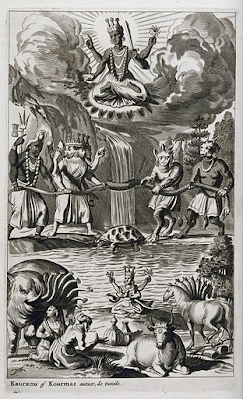
Vasuki's most well-known legendary role is in the narrative of the gods and demons churning the Ocean of Milk in search of immortality's nectar (amrita).


The deity Vishnu acts as the churning-base in the shape of his Tortoise incarnation, Mount Mandara serves as the churning-stick, and Vasuki, with his immense length, serves as the churning rope.

They tug Vasuki back and forth, with the gods on one side and the devils on the other, until the sea of milk yields up its riches.


~Kiran Atma


You may also want to read more about Hinduism here.

Be sure to check out my writings on religion here.

Hinduism - What Is The Tortoise Avatar?


The deity Vishnu's second avatar or incarnation.

The Tortoise avatar, like all of Vishnu's avatars, was born at a period of crisis and was tasked with restoring cosmic balance that had been thrown out of whack.

The philosopher Durvasas, who had cursed the gods to become human and their celestial lustre to fade, was the root of difficulty in this instance.

To counter this, the gods and demons agreed to jointly churn the Ocean of Milk in order to acquire the nectar of immortality, which would be distributed evenly.

The churning picture above is based on ancient dairy procedures, in which the person churning rotates a churning paddle with a string.

The churning, on the other hand, is on a cosmic scale in this case: Mount Mandara, the earth's center mountain, is the churning stick; the celestial snake Vasuki, who encircles the globe, is the churning string; and Vishnu himself, in the shape of a tortoise, descends to the ocean's depths to provide a secure basis for the churning stick.

Vasuki is dragged back and forth by the gods and demons, spinning the mountain and churning the Ocean of Milk.

The Ocean of Milk is separated into numerous components, both good and negative, as a result of the churning.

The deadly halahala poison, for example, is neutralized by Shiva holding it in his throat.

The Kaustubha gem, the wishing cow Surabhi, the goddess Lakshmi, and eventually the god's physician, Dhanvantari, who comes from the sea with the jug carrying the nectar of immortality, are among the other items.

The demons seize the pot of nectar and attempt to flee, but Vishnu disguises himself as the enchantress Mohini and tricks the demons into returning the jug to her.

She hands the pot over to the gods, who flee with the demons hard on their tails.

According to more recent traditions, the gods stop at four different holy places on earth during their flight—Allabad, Haridwar, Ujjain, and Nasik—over the course of a twelve-day (divine) period; this latter incident is cited as the charter myth for the twelve-year celebration of the Kumbha Mela at these sites (because a divine day is believed to equal a human year).

The gods eventually escape their pursuers and divide the nectar among themselves, but they are unaware that the demon Sainhikeya has disguised himself among them.

The sun and moon alert Vishnu, who uses his discus to chop off the demon's head as the monster starts to drink.

Because they have come into touch with the nectar, Sainhikeya's two parts become eternal, and both half are regarded malicious celestial beings: the head as Rahu, the body as Ketu.

Rahu has a special dislike for the sun and moon, whom he blames for his death, and wants to devour them anytime he encounters them in the heavens.

He always succeeds, but they escape unhurt through Rahu's severed neck since he no longer has a body to digest them.

This is, of course, the traditional explanation for solar and lunar eclipses; the malevolent Rahu's relationship with eclipses has led to eclipses being regarded as particularly unfavorable occasions.

See also churning of the ocean.

~Kiran Atma


You may also want to read more about Hinduism here.

Be sure to check out my writings on religion here.
Hinduism - Who Are The Naga In Hindu Mythology?


#

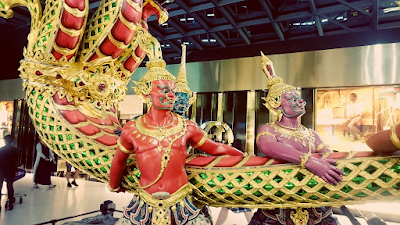
Naga is a Sanskrit  word for "noble" (2) The Nagas are a group of minor divinities who take the shape of serpents in Hindu mythology.

Vasuki is their ruler.

Nagas are often considered to be the gods of a given location in popular Hinduism.

Nagas are said to reside in springs, ponds, and other tiny bodies of water, and are often connected with fertility and fecundity.

Nagas are often depicted as minor protecting deities in Buddhist and Jain imagery.

A sitting person shad owned by a "umbrella" of Nagas is frequent.

Although this is rare in Hindu imagery, it is possible that remains of this may be seen in the iconography of the deity Shiva, who is often pictured wearing snakes as decorations and holy thread.


~Kiran Atma


You may also want to read more about Hinduism here.

Be sure to check out my writings on religion here.


Hinduism - Who Is Jaratkaru?


 A sage in Hindu mythology who is known not just for his austerity and wisdom, but also for illustrating the value of male children in Hindu society.

Jaratkaru has been a lifetime ascetic who refuses to marry until he has a vision of his ancestors dangling above one of the hells by a grass rope through which a rat (time personified) is slowly eating.

Jaratkaru's ancestors tell him that since he hasn't had a son, the lineage, as well as the ceremonies done for the dead in that lineage, would stop with him, and they will all go to hell.

They tell Jaratkaru to marry and have a son in order to avoid tragedy.

Jaratkaru is first opposed to the notion, but subsequently states that if a lady called Jaratkaru is discovered and brought to him as alms, he will marry her.

His plight finally reaches Naga (snake) king Vasuki, who also has a sister named Vasuki.

Jaratkaru agrees to marry her on the condition that if she displeases him, he would leave her.

Given Jaratkaru's austere history, it's hardly surprising that their relationship did not work out.

After a few months of marriage, his wife must choose between letting Jaratkaru to sleep through sunset, which would cause him to miss his evening prayers, or waking him and risking his displeasure.

Jaratkaru is dissatisfied with her and departs despite her entreaties, so she picks the latter.

The sage's obligations are thus completed when Jaratkaru's wife gives birth to a son, Astika.


You may also want to read more about Hinduism here.

Be sure to check out my writings on religion here.