Showing posts sorted by date for query magical power. Sort by relevance Show all posts

Parapsychology - Who Was Frater Achad?


Charles Stansfeld Jones (1886–1950), a British magician and novelist who resided in Cana cay and formed the Fellowship of Ma-Ion, used this mystical name.

He was a disciple of the magician Aleister Crowley, who named him his magical child.

Jones is to be differentiated from theosophical writer George Graham Price, who channeled two popular writings under the alias Frater Achad, Melchizedek Truth Principles (1963) and Ancient Mystical WhiteBrotherhood (1971).

Apart from channeling the two works, nothing is known about Price's life.


Bonner, Margerie Lowry said that while working on Under the Volcano, he started to research the theosophists' canon, which included P.D. Ouspensky, Swedenborg, Blake, James, Böhme, and Yeats, as well as A.E. Waite, Eliphas Levi, Madame Blavatsky, and, by chance, Frater Achad. 


Charles Stansfeld-Jones – a white magician and author of Cabbalistic books and treatises under the name Frater Achad – appeared at Lowry's Dollarton shack and began a long friendship with him, during which time Lowry experimented with astral body projection, the I Ching, and Yoga, and studied the Tree of Life, a reproduction of which was hung on a wall in the shack. 


Lowry discontinued his research after months of immersion for fear of "opening doors that should stay locked." [Originally published in Perle Epstein's The Private Labyrinth of Malcolm Lowry. 

Holt, Reinhart, and Winston, New York, 1969.] While Lowry finished the first draft of Under the Volcano in 1940 before meeting Stansfeld-Jones, he subsequently claimed that he met a Cabbalist at a "critical and serendipitous time in the composition of the novel." Since the receiving of the Book of the Law, Achad has been regarded as the most notable Catholic Thelemite. 


This is because Frater Achad converted to Roman Catholicism in 1928, 19 years after entering the A.A. as a Probationer. 

Achad's claim to fame as a Thelemite—and the reason orthodox Thelemites must contend with him even if they believe his curious researches are mistaken or dangerous—is that he discovered the qabalistic "key" to the Book of the Law, prompting Aleister Crowley to rename the book Liber AL vel Legis instead of Liber Legis. 

This finding was recounted in Achad's magical notebook, Liber 31, which was eventually released. 

Crowley used this insight to consecrate Achad as his magical son, as prophesied in the Book of the Law, and to acknowledge his claim to the Thelemic grade of Magister Templi, or "Babe of the Abyss." However, by the 1920s, Crowley had become disillusioned with his son and successor due to some Achad writings. 

Achad's experiment with changing the courses of the qabalistic Tree of Life was documented in his 1922 Q.B.L.; or the Bride's Reception. 


The Egyptian Revival, published in 1923, and The Anatomy of the Body of God, published in 1925, continued Achad's work. 

To put it plainly, Crowley thought such attempts were foolish. 

Achad was also a member of the Worldwide Brotherhood, an esoteric group that claimed to share universal religious and philosophical knowledge, as well as a "true transcript" of the objective cosmos, by this time. 

Many occultists, including Crowley, thought the convoluted UB system was a "scam" or, worse, a cover for the Catholic Church's infiltration of occult organizations (for more on the UB, see the recent article in the O.T.O. anthology Success is Your Proof). 


Many high-ranking members of the UB converted to Catholicism when it was founded by Merwin-Marie Snell, a Catholic comparative religion professor. 

Crowley and Achad ultimately lost communication, and Achad was expelled from the Order of the Temple. 

Jones, on the other hand, never stopped thinking about his status as Crowley's magical offspring, and Thelema's revelations remained a major element of his spiritual worldview. 

Following Crowley's death, Achad corresponded with Crowley's executor Gerald Yorke in a lengthy series of letters. 

The letters "announced the arriving of the Aeon of Maat" in April 1948, and "from this point onwards the communication contains information recording the development of the new Aeon which Jones had discovered, and exploring its consequences and implications," according to Starfire. 
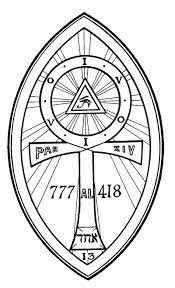


An Aeon is governed by a central spiritual idea or formula as well as the god-form that personifies that idea, according to Crowley's Thelemic system. 

It lasts about 2,000 years (coinciding with the precession of the equinoxes) and is ruled by a central spiritual idea or formula as well as the god-form that personifies that idea. 

The Aeon of Horus, which began in 1904 with Crowley's receiving of Liber AL vel Legis, is controlled by Horus, the god's crowned and victorious offspring, and will last for thousands of years. 

Yet, like Achad, some unconventional Thelemites have accepted the possibility of a premature dawning of the Aeon of Maat—for example, Kenneth Grant in his Typhonian Trilogies, the Thelemic magical order Ordo Adeptorum Invisiblum, and Nema, whose received text Liber Pennae Penumbra and system of Maat magick is perhaps the most influential result of Maatian speculations. 


The greatest description of these modern currents in theoretical occultism is Don Karr's book Approaching the Kabbalah of Maat. 


Despite the fact that Achad's announcement of the Aeon of Maat influenced a number of important occultist researchers in the twentieth and twenty-first centuries, his Maatian revelation does not appear to follow from his books, his Catholic conversion, or his involvement with (and eventual leadership of) the UB. 

To truly comprehend the importance of an early Aeon of Truth and Justice—the spiritual concepts symbolized by the god-form of Maat—one must first understand the qabalistic implications of Achad's 1920s views. 

Among early twentieth-century occultists, Achad is possibly the most pro-materialist. 


Unlike many Gnostics, Neo-Buddhists, and Theosophists of the time, Achad believes in a material universe infused with spirit—sacramentally infused, if you will. 


This is in line with the Universal Brotherhood's philosophical realism principles. 

It also corresponds to Achad's extreme qabalistic theories. 

Unlike other qabalists, Achad's multifaceted image of the Tree of Life's primeval fall and eschatological restoration resembles a cosmic fulfillment process rather than a myth of transgression and forgiveness. 

This is something he shares with the modernist Catholic thinkers of his day. 

Idealism and Materialism must join and go hand in hand if a new Civilization is to be established, argues Achad in The Anatomy of the Body of God. 


The Soul of Humanity is the connection that binds everything together. 


Our physical bodies are nothing to be ashamed of, but they would be useless without the Spirit and Will that give them life and action. 

On the other hand, we should not be so timid and selfish as to want to be re-absorbed into Spirit, as if the whole Creative Plan had been a waste of time and should have never been undertaken in the first place. 

No! Let us offer gratitude in our hearts for both our bodies and our spirits, and let us use both properly and to the full extent of our abilities. 

Over the course of the 1920s, Achad's writings became more oriented on the immanent fulfillment of God's Kingdom, a perspective that would be dubbed "realized eschatology" in Christian theology. 

"We must take into the inheritance of Freedom that has been provided for us in the Father's Kingdom upon Earth," says Anatomy, "and begin to construct a 'Living Temple, not created with hands, everlasting in the Heavens'—on Earth." The rousing proclamation, There is a space reserved for every one of you, Here and Now, finishes the book's introduction. 


Everything has its place when everything is placed in its place. 


Take up your positions in the Kingdom of the Ever-Coming Son, fulfill yourself in the fulfillment of God's Will inside you, and demonstrate to those who are still in the dark outside that there is space for everyone who are willing to maintain their place and stop attempting to usurp others'. 

Frater Achad's knowledge of the approaching Kingdom of God is based on his interpretation of Qabalah's cosmic processes. 

In the orthodox Thelemic schema, the Egyptian deity forms Isis—Osiris—Horus correlate to Binah—Kether-Chokmah—and Tiphereth, respectively. 

Malkuth, the Material Kingdom, is represented by Maat, who completes the four-part sequence. 


The four letters of the Hebrew Tetragrammaton, IHVH—Osiris (I), Isis (H), Horus (V), with Maat (final H) completing the sequence—can also be ascribed to the Aeons. 


In most texts on Hermetic Qabalah, the letters of the Tetragrammaton fulfill a cosmic story. 

The fallen Daughter (Heh final) must combine with the Son (Vav) to ascend to the level of Heh prime, establishing the Daughter/Malkuth on the throne of Binah, the Mother, in order to restore the Tree of Life to its pre-Fall condition (Heh prime). 

The Mother then "arouses the active power of THE FATHER, and these twain being UNITED, everything is RE-ABSORBED into THE CROWN," as Achad describes in Q.B.L. 

As a result of Malkuth's union with Kether, the eschatological kingdom is realized on Earth, fulfilling God's goal for creation. 

The salvation economy of Mary, a Daughter of Israel and child of the earth, conceiving the Son, the Christos, by the Holy Spirit, then being joined with God the Father in her Coronation as the Mother of Heaven, may be expressed in the Catholic system. 

Through the inbreaking of the eschatological Kingdom in the event of Jesus Christ, the Son's Incarnation thus redeems Malkuth's material world—represented in miniature by Mary. 


Through the Eucharistic Mass, Catholics engage in this reality—the eschaton made manifest here and now in fulfillment of God's design. 


Many orthodox Thelemites have proposed bizarre explanations for why Frater Achad would ever switch to the Roman Church, including insanity, a desire to convert the Church to Thelema's Law, or being lost in the Abyss as a Black Brother. 

Achad, on the other hand, offers a different reason for his strange conversion: Achad needed to be escorted to the Temple's opposite Pillar in order to discover the secrets of the R[oman] Catholic Church. 

He joined the Church as an orthodox member and obtained his first communion during Midnight Mass on Christmas Eve, 1928. 

This step, and only this step, resulted in the start of the Initiations and Ordeals that were to follow, as per Liber Legis. 

(Jones, letter to Gerald Yorke and Albert Handel, May 6, 1948; cited in Hymenaeus Beta, Prolegomenon to Aleister Crowley's Liber Aleph, Second Edition, Hymenaeus Beta, Prolegomenon to the Second Edition, Hymenaeus Beta, Prolegomenon to the Second Edition, Hymenaeus Beta, Prolegomenon to the Second Edition, Hymenaeus Beta, Pro Achad was poised to herald the beginning of the Aeon of Truth and Justice—the eschatological Kingdom realized on earth, glyphed in esoteric terms by the goddess Maat and glyphed in the New Testament by St. John the Divine's vision of the New Jerusalem: Then I saw a new heaven and a new earth, since the previous heaven and earth had vanished, and the sea had vanished as well. 

And I saw the holy city, the new Jerusalem, descending down from God like a bride adorned for her husband (Revelation 21:1-3) This is the banquet for the bride—the New Jerusalem has come down to earth, the divine has become one with the mundane world. 

"Jones relayed the news of his 1932 Silver Star Ordeal not only to Crowley, but also to the Catholic Church," states Hymenaeus Beta. 

Achad considered his initiations into this new New Aeon as vital to both the occult world and the Catholic Church. 

"He came to believe that the Aeon of Horus was coming to an end, and that a new Aeon of Truth and Justice, ruled by the Egyptian goddess Maat (or Ma), was about to begin." Achad's conversion allowed him to participate in the Church's sacramental life. 

This implies he took part in the Eucharist, with his first Mass being the Christmas 1928 Mass commemorating the Incarnation. 

For Catholics, the Eucharist is the eschatological reality bursting into our current moment, the Kingdom of God made visible on earth. 

The Eucharist is "a guarantee of future grandeur," according to the Catholic Church's Catechism, "a foretaste of the celestial feast to come" (CCC 1323). 

The Aeon of Maat is a "backwards current," granting us a vision of an age in which "we all may become something far greater, something which exists in the form of seeds within us in the eternal Now" (Horus/Maat Lodge FAQ page), much like the inbreaking Kingdom of God, which rushes in from the future to meet us in the present (see, for example, radical Catholic theologian Edward Schillebeeckx's God the Future of Man). 

Unlike other non-orthodox Thelemites who believe in a "double current" in which both the Aeons of Horus and Maat are active at the same time, or those who believe that the Aeon of Maat will arrive too soon to replace the Aeon of Horus, my reading of Frater Achad through the lens of the Catholic Mass suggests that the new Aeon of Truth and Justice is present in the present at the same time as the "force and fire" of the Aeon The Mother's Daughter ascends to the throne, the Father awakens, and the Son of God is born among the people of the world. 

"Kether is in Malkuth, and Malkuth is in Kether," Frater Achad declares.


Further Reading:


Achad, Frater [Charles Stansfeld Jones]. The Anatomy of the Body of God. New York: Samuel Weiser, 1969.

Achad, Frater [George Graham Price]. Ancient Mystical White Brotherhood. Lakemont, Ga.: CSA Press, 1971.

Melchizedek Truth Principles. Phoenix, Ariz.: Lockhart Research Foundation, 1963.


~ Kiran Atma

You may also want to read more about parapsychology and occult sciences here.


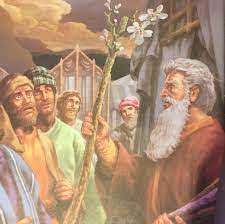
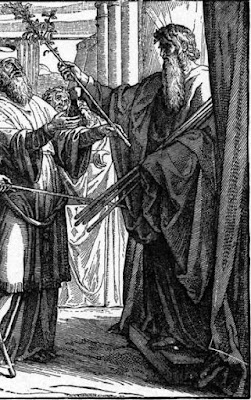
Parapsychology - What Is Aaron's Rod?


A magical wand based on the biblical story of Moses and Aaron's rods, which were employed in the marvels of parting the Red Sea and causing water to spring from a rock in the desert. 

Aaron's rod morphed into a snake when he threw it in front of Pharaoh and his magicians (Exodus 7), hence the esoteric usage of Aaron's Rod with a serpent image.

According to Jewish folklore, Aaron's rod was created on the sixth day of Creation and was kept by Adam when he left the Garden of Eden, eventually passing through a series of patriarchs.


According to an apocryphal Christian tale, the rod was cut from the Tree of Knowledge, ultimately falling into Judas' hands, and finally becoming the cross beam on which Christ was crucified.

The hazel wand used by water diviners in dowsing is reminiscent of Aaron's rod in the wilderness, which found water.

A wand of some kind has long been a symbol of power.

The wand is also used by contemporary conjuring magicians as a magical staff.


Hinduism - What Is Urdhvabahu?


("one with an upraised arm") A person who engages in a particularly gruesome kind of physical humiliation in which one or both arms are constantly elevated.

The muscles atrophy after a while, and the arms can no longer be lowered.

Although urdhvabahu is not widely practiced, it has a long history as a kind of ascetic discipline.

As with many forms of extreme physical austerity, this is said to provide tremendous spiritual awareness and magical power.

This view is founded in part on the widely held belief that the desire to endure physical pain develops spiritual power, but it might also arise from the strength of will required to ca

~Kiran Atma


You may also want to read more about Hinduism here.

Be sure to check out my writings on religion here.rry it out—a strength of will that would presumably have equivalents in other aspects of one's personality.

Hinduism - What Is The Significance Of Truth In Hindu Philosophy?


The Power of Truth.

Truth, according to traditional Hindu belief, has magical power of its own, a power to which people might turn in times of need.

The famous act of truth, a conditional statement in which the first part is a true statement about one's past behavior and the second part is a request for a specific result (for example, "If I have always given to those who begged from me, may this fire not burn me"), is one method of appealing to this power.

The power of truth was also evoked in ordeal trials, and it was considered as the power that made the ordeal a genuine way of putting individuals to the test.

~Kiran Atma


You may also want to read more about Hinduism here.

Be sure to check out my writings on religion here.

Hinduism - What Is Panchagni-Tapa?


("asceticism of the five flames") A sort of voluntary physical mortification in which the individual sits surrounded by four flames, with the fifth fire being the sun above, commonly performed during the hot season.

Although this practice is no longer common, it is extremely ancient and is often mentioned as one of the typical ascetic practices in the puranas and other holy books.

This ceremony is undertaken with the premise that deliberately enduring pain and/or adversity is a method to develop spiritual, religious, and magical power, as is the case with all types of physical ascetic endurance (tapas).

~Kiran Atma


You may also want to read more about Hinduism here.

Be sure to check out my writings on religion here.

Hinduism - Who Is Lord Hanuman In The Hindu Pantheon And Hindu Mythology?


Hanuman is a Hindu deity with a monkey head.

Hanuman first appears in the Ramayana, the first of the two major Indian epics, where he is depicted as a minister of the monkey king Sugriva and a faithful servant of Rama, the epic's protagonist and god-king.

Despite his modest status in the Hindu pantheon, Hanuman is a very popular deity in contemporary India because he provides mankind with a god who is fundamentally similar to themselves (or what they would want to be), but on a larger scale and with more power.

Hanuman is thought to be the result of a mating between Vayu, the wind deity, and Anjana, the nymph.

Hanuman the child is always hungry after his birth, and one day he tries to devour the sun.

Indra, the gods' monarch and ruler of heaven, gets enraged at Hanuman's behavior and smashes him with a thunderbolt, fracturing his jaw (hanu).

When Vayu learns of his son's injuries, he gets enraged and stops doing his customary things.

Vayu's strike indicates that no one can live a normal existence since winds are responsible for all internal activities in Indian physics, including digestion, breathing, and excretion.

The gods realize their position after a short time and beseech Vayu for pardon; he is appeased when each deity agrees to offer Hanuman a wonderful gift.

Hanuman has immense abilities as a result of these celestial blessings.

He is very powerful, as seen by his picture, which depicts him with bulging muscles.

He can also treat people using plants and natural remedies, as well as his magical skills to defend people from bad supernatural entities.

One of his most unusual divine gifts is the ability to live as long as he wants and to choose when he dies.

His greatest virtue, and many believe the true source of his power, is his devotion to Rama (bhakti).

Hanuman is an important character in the Ramayana who helps the plot progress.

Hanuman is sent with a troop of monkeys to retrieve Sita, Rama's stolen wife, and finds her imprisoned in the country of Lanka after a long and laborious quest.

Hanuman is given considerably more prominence in Tulsidas' Ramcharitmanas (a vernacular translation of the Ramayana), in which he is converted from a formidable monkey servant to a devotee (bhakta) whose only purpose is to serve Rama with passionate devotion.

This devotion forbids any kind of worldly connection, including marriage and family, and Hanuman continues to be a role model for a religious lifestyle that emphasizes celibacy and abstinence.

Celibacy is seen as a source of strength in Indian culture since it avoids the loss of a man's vital energy that occurs after ejaculation.

Hanuman's greatest attribute, according to his worshippers, is his capacity to function as a go-between for Rama, who is normally seen as far removed from human matters.

People feel a connection and kinship with Hanuman since he is also a devotee, despite the fact that his abilities are considerably greater than theirs.

In fact, they feel Hanuman's words have a larger probability of reaching Rama's attention and being acted upon.

Tulsidas, the poet-saint, names Hanuman as his messenger in a poem suitably titled the "Letter of Petition" (Vinaya Patrika), with the full assurance that his case would be heard in the heavenly court.

Hanuman's close relationship with heavenly power, his unquestionable abilities, and his perceived accessibility and empathy have all combined to make him one of India's most widely venerated deities, transcending sectarian lines.

He is often said to be a Vaishnava or follower of Vishnu because of his dedication to Rama.

However, in an unexpected twist, Hanuman is also adored by the Shaivites, Shiva's adherents, as an avatar or "incarnation" of the deity Shiva.

Hanuman is typically venerated on astrologically unfavourable days as a guardian god, to keep these inauspicious forces at bay.

His colossal strength, celibacy, and unwavering devotion have made him the patron god of Indian wrestlers, who attempt to emulate him while training.

Finally, he serves as a healer and a source of sustenance.

On the one hand, he is known for his work as an exorcist, assisting individuals in the exorcism of demonic spirits.

On the other hand, he protects life for those who know his particular phrase, which allows them to select their own death moment, just as he did.

Hanuman is just now getting the respect he deserves, despite his relevance in modern Hindu culture.

Sudhir Kakar, Shamans, Mystics, and Doctors, 1982, has further information. 


You may also want to read more about Hinduism here.

Be sure to check out my writings on religion here.


Hinduism - Who Is Goddess Ganga In Hindu Mythology? What Is Lord Vishnu's Promise To Her?


The deity whose physical form is the Ganges River in Hindu mythology.

The Ganges is revered because it is said to be a goddess who has the capacity to cleanse individuals who bathe (snana) in it of their sins.

Several stories exist to explain her origins.

The most well-known is the story of King Bhagirath, who succeeds in bringing the Ganges down from heaven to earth by ascetic discipline.

Bhagirath is the great-greatgrandson of King Sagar, whose 60,000 sons were burnt to ashes by the sage Kapila's magical abilities after falsely accusing Kapila of thievery.

Later, Kapila informs Anshuman, King Sagar's grandson and only living descendent, that bringing the Ganges down from heaven to earth is the only way to restore peace to the spirits of Sagar's sons.

Anshuman, like his son Dilip before him, tries miserably to achieve this goal.

Bhagirath, Dilip's son, is moved by their efforts and retreats to the Himalayas, where he practices asceticism until the gods agree to bring the Ganges down to earth.

Bhagiratha's efforts, however, are not yet complete.

Then he must win the favor of the deity Shiva, who must agree to absorb the impact of the falling river on his head.

Otherwise, the earth will be destroyed by its might.

The Ganges eventually crashes to earth on Shiva's head when everything is in place.

Bhagirath brings Ganga down of the mountains and to the sea, where she touches the ashes of his forefathers and the two of them eventually find peace.

This legend emphasizes the Ganga's salvific power as well as her close ties to the dead's final rituals (antyeshthi samskara).

According to another legend, the Ganges descends to earth as a result of a curse declared by Vishnu and his wives Ganga, Lakshmi, and Saraswati after a family feud.

Saraswati becomes enraged and proceeds to beat Ganga when she witnesses Ganga and Vishnu sharing passionate looks in public.

As Lakshmi attempts to stop her, Saraswati unleashes a series of curses, including Vishnu's birth as a stone (the shalagram), Lakshmi's birth as a plant (the tulsi plant), and Ganga's birth as a river, carrying the world's sins.

Saraswati is cursed to become a river throughout the struggle.

Ganga's punishment is sweetened by Vishnu's promise that she would be regarded exceedingly holy on earth and will have the capacity to cleanse people's sins.

She will also descend from heaven onto the head of the deity Shiva and become his spouse, according to Vishnu. 


You may also want to read more about Hinduism here.

Be sure to check out my writings on religion here.


Hinduism - Who Is A Godman? Who Are The Godmen Of India?


 A slang term for a charming Hindu ascetic of a certain sort.

Godmen are religious personalities who are known for their high-profile appearance, ability to garner attention and support from the greater Indian culture, and claims to profound spiritual attainments.

They may claim to have magical abilities, such as the capacity to heal, read minds, prophesy the future, or affect future events, which they demonstrate to demonstrate the godman's spiritual attainments.

Godmen are often found outside of recognized ascetic groups, and they may have never received official ascetic initiation.

They may thrive in India's religious "free market," which pays and acknowledges religious charisma.

Godmen usually live in their own ashrams rather than those affiliated with an order.

Despite the fact that most of them recognize a guru or religious preceptor, their success is due to their own attributes rather than the spiritual lineage's power.

Several of these godmen have developed considerable numbers of overseas devotees in recent years, which may bring both income and prestige.

Sathya Sai Baba, whose ashram is at Puttaparthi in the southern state of Andhra Pradesh, is a modern example of such a godman.

See Peter Ludwig Brent, Godmen of India, 1972, for an example of one person's contacts with a variety of these people.


You may also want to read more about Hinduism here.

Be sure to check out my writings on religion here.


Hinduism - Who Is Durvasas?


A sage who is a partial embodiment of the deity Shiva in Hindu mythology. 

Durvasas is the son of Anasuya, who was granted boons by the gods Brahma, Vishnu, and Shiva for her power in convincing another women to remove a curse. 

Vishnu is born as Dattatreya, Shiva is born as Durvasas, and Brahma is born as Chandra, according to Anasuya's desire. 

Durvasas is known for his magical abilities as a fabled character, which is not unexpected considering his origins. 

He's also renowned for his nasty temper and his proclivity to curse anyone who irritate him. 

One of the maidens who suffers from his fury is Shakuntala, who, engrossed in her newfound love for King Dushyanta, fails to see and pay tribute to Durvasas. 

She is cursed by the fact that her love would forget about her. 

In another instance, Durvasas curses all gods with old age and death. 

An "insult" from Indra's elephant Airavata, who had thrown a garland provided by Durvasas on the ground, causes this. 

These curses, like others in Hindu mythology, cannot be reversed, although their intensity may be decreased by mitigating circumstances. 

Shakuntala is advised that if she gives King Dushyanta some evidence of their connection, he would remember her, which she does. 

By acquiring and ingesting the nectar of immortality, the gods may avert old age and death (amrta). 

Durvasas, like all the sages, may bestow amazing blessings on those who satisfy him. 

Kunti, one of the Mahabharata's heroines, was one of these beneficiaries. 

Durvasas provides Kunti a strong mantra (holy sound) that allows her to conceive a child with any deity by merely thinking about him. 

As soon as Kunti gets this mantra, she puts it to the test by staring at the sun, and the golden infant Karna is born. 

She puts the kid in a box and abandons him in the Ganges in her fear at becoming a mother unexpectedly—she is still unmarried and reasonably worried about what others may think. 

This mantra is the only way she may have children after her marriage to Pandu (son of the sage Vyasa and queen Ambalika), since Pandu has been cursed to die the instant he sleeps with one of his wives. 

She teaches this mantra to her co-wife Madri, who carries Nakula and Sahadeva, after using it to carry Yudhishthira, Arjuna, and Bhima. 

As a result of Durvasas' gift, all of the Pandava brothers—the epic's protagonists—are gods' offspring. 


You may also want to read more about Hinduism here.

Be sure to check out my writings on religion here.


Hinduism - What Is A Dharna?


When all other methods have failed, this ritual is used to persuade another person to address one's grievances. 

The term dharna is derived from the Sanskrit (holy language) verb dharna, which meaning "to hold" or "to keep." The supplicant's constant public presence in close proximity to the individuals to whom he or she is appealing is one feature of the dharna ritual. 

In contemporary India, a dissatisfied civil worker may stage a dharna before the Parliament building in Delhi, and in some instances, individuals have slept there for months to raise awareness of their situation and organize public opinion. 

People may also perform a dharna at a deity's temple to seek direction or assistance; the most famous example of this is at the Tarakeshvar temple in West Bengal. 

Self-inflicted pain, which is commonly done via fasting (upavasa) or other types of monastic self-denial, is another prevalent feature of dharna. 

Pilgrims to Tarakeshvar abstain from eating or drinking until the deity Shiva delivers them a vision, however temple officials frequently restrict this to three days in practice. 

On a political level, Mohandas K. Gandhi developed the "fast unto death" as a means of achieving his goals. 

The ancient Hindu idea that by willingly enduring bodily agony (tapas), one might acquire spiritual and magical power is one of the cultural assumptions that contributes to make such self-inflicted misery compelling. 

The announcement at the start of the ritual is the other working premise that makes the dharna effective. 

Dharnas are frequently held to rectify very specific perceived injustices that are made public at the outset on a human level. 

It is widely believed that if the person holding the dharna dies, the person against whom the dharna was held would face karmic consequences for causing that person's death. 

Such dharnas are usually only done when there are no other options. 

They continue to be a significant resource because of this idea, even in modern times. 


You may also want to read more about Hinduism here.

Be sure to check out my writings on religion here.


Hinduism - Who Is Bhagirath?


 The one person most responsible in Hindu mythology for bringing the heavenly Ganges down to earth. 


Because the river Ganges and the goddess Ganges are identical, the river is revered. 


  • Bhagirath is the great-great-grandson of King Sagar, whose 60,000 sons were burnt to ashes by the sage Kapila's magical abilities after they falsely accused Kapila of thievery. 
  • The guru subsequently informs Anshuman, King Sagar's grandson and only living descendent, that bringing the Ganges from heaven down to earth is the only way to restore peace to their spirits. 
  • Anshuman, like his son Dilip before him, tries for the rest of his life, but both are unsuccessful. 


Bhagirath, Dilip's son, is moved by their efforts and retreats to the Himalayas, where he practices penance until the gods agree to bring the Ganges down to earth. 


  • Bhagirath's efforts, however, are not yet complete. 
  • He must next satisfy Shiva in order for the god to accept to bear the impact of the descending river on his head, since the river's power would otherwise destroy the earth. 
  • The Ganges ultimately descends to earth on Shiva's head when everything is in place. 
  • Bhagirath then guides the river out of the mountains to the sea, where she touches the ashes of his forefathers, and they finally find rest.


You may also want to read more about Hinduism here.

Be sure to check out my writings on religion here.


HINDU PHILOSOPHY AND YOGA


    Hinduism - A Philosophy, Religion, Way Of Life, And Identity


    The difference between philosophy and religion in Hinduism is not as obvious as it is in modern Western culture. 


    • The terms "philosophy" and "religion" have no clear counterparts in Sanskrit, Hinduism's holy language. 
    • Anvikshiki-vidya is the closest synonym for "philosophy" ("science of examination"). 
    • Only the Nyaya school of philosophy, which deals with logic and dialectics, uses the similar word tarka-shastra ("discipline of reasoning"). 
    • To describe what we understand by "philosophical inquiry," modern pundits use the phrase tattva-vidya-shastra ("discipline of knowing reality"). 


    Sanatana-dharma The Sanskrit word dharma, which meaning "jaw" or "standard," captures the idea of "religion" (with many other connotations). 


    • Sanatana-dharma ("eternal law") is a Hindu term that relates to the Western concept of philosophia perennis. 
    • For Hindus, philosophy is more than just abstract knowledge; it is a metaphysics with moral consequences. 
    • To put it another way, whatever one's theoretical conclusions about reality are, they must be put into practice in everyday life. 
    • As a result, philosophy is usually viewed as a way of life rather than a meaningless exercise in logical thought. 

    Furthermore, Hindu philosophy (and Indian philosophy in general) includes a spiritual component. 


    • All philosophical systems accept the presence of a transcendental Reality and believe that a person's spiritual well-being is based on how he or she interacts with that Reality, with the exception of the materialist school known as Lokayata or Carvaka. 
    • As a result, Hindu philosophy is closer to the spirit of ancient Greek philosophia ("love of knowledge") than to the modern academic field of conceptual analysis, which goes by the name of philosophy but isn't especially concerned with life-enhancing insight. 
    • Ontology (which deals with the categories of existence), epistemology (which is concerned with the knowledge processes by which we come to know what there is "in reality"), and logic (which defines the rules of rational thought) are all areas of rational inquiry that have preoccupied Western philosophers since the time of Socrates, Plato, and Aristotle (which seeks to understand beauty). 


    Hindu philosophy, like Christian philosophy, is deeply concerned with humanity's ultimate spiritual destiny. 


    • As a result, it is often referred to as atma-vidya ("science of the Self") or adhyatmika-vidya ("spiritual science"). 
    • Though sophisticated self-critical systems seem to be the result of the period following the birth of Buddhism in the sixth century B.C.E., the ancient Rig Veda contains the first philosophical musings or intuitions of Hinduism. 


    Six systems are traditionally differentiated, which are referred to as "viewpoints" or "visions" (darshana, from the verbal root drish "to see"). 


    • This statement alludes to two important aspects of Hindu philosophy: Each system is the result of visionary-intuitive processes as well as logical thought, and each system is a unique viewpoint from which the same reality is seen, implying a stance of tolerance (at least in theory, if not in practice). 
    • And that same Truth is what has been passed down by word of mouth (and esoteric initiation) as the ultimate or transcendental Reality, whether it is referred to as God (ish, isha, Ishvara, all meaning "ruler"), the Self (atman, purusha), or the Absolute (brahman). 


    The Vedic revelation (shruti), especially the Rig-Veda, is a major element of Hindu philosophy, and tradition refers to it. 


    • The Hindu philosophers had to defer to, or at least pay lip service to, the ancient Vedic legacy in order to establish their separate schools inside the orthodox fold. 
    • Purva-Mimamsa (which proposes a philosophy of sacrificial ritualism), Uttara Mimamsa or Vedanta (which is the nondualist metaphysics espoused especially in the Upanishads), Samkhya (whose main contribution concerns the categories of sacrificial ritualism), Uttara Mimamsa or Vedanta (which is the nondualist metaphysics espoused especially in the Upani (which is primarily a theory of logic and argument). 
    • I'll provide a short overview of each school and its connection to the Yoga heritage. 


    Purva-Mimarnsa. 


    The Purva-Mimamsa ("Earlier Inquiry") school is so named because it analyzes the "earlier" two parts of the Vedic revelation: the early Vedic hymnodies and the Brahmana texts that explain and deepen their sacrifice rites. 


    • It is opposed to the Uttara Mimamsa ("Later Inquiry"), which is represented by the Upanishads' nondualist doctrines. 
    • The Mimamsa-Sutra of Jaimini gave the Purva-Mimamsa school its unique shape (c.200300 B .C.E.). 
    • In line with Vedic ritualism, it expounds the art and science of moral conduct. 
    • Its main point is the idea of dharma, or virtue, as it relates to an individual's religious or spiritual destiny. 


    The ethical authorities (dharma-shastra) are in charge of defining and explaining the secular applications of dharma. 


    • There have been many well-known Jaiminis, and the author of the Sutra must be differentiated from the sage who was a Vyasa student during the Bharata war. 
    • Mimamsa philosophers, or mimamsakas, see ethical conduct as an unseen, exceptional power that shapes the world's appearance: 
      • Action affects the quality of human life in both this incarnation and future incarnations since humans are inherently active. 


    Bad acts (activities that violate the Vedic moral code, which is believed to reflect the global order itself) result in negative life circumstances, while good actions (actions that follow the Vedic moral code) result in favorable life circumstances. 


    • The goal of leading a morally sound life is to enhance one's quality of life in the present, the afterlife, and future incarnations. 
    • Because the person has free will, he or she may utilize good acts to accrue positive consequences and even cancel out bad ones. 
    • The fact that the fundamental Self is transcendental and everlasting ensures free choice. 
    • Unlike Vedanta, the Mimamsa tradition believes in many fundamental selves (atman). 
    • These are considered inherently unconscious and only become aware in the presence of a body-mind. 

    For the Mimamsa philosophers, awareness is always I-consciousness (aham-dhi). 


    • Although some members of this school began to believe in a Creator God in the fourteenth century, there is no God above and beyond those numerous everlasting and omnipresent Selves. 
    • Because the Self is said to lack both awareness and joy, the early mimamsakas naturally considered the liberation goal sought by other schools to be unappealing. 
    • The eighth-century philosopher Kumarila Bhatta and his disciple Prabhakara were opposed to this viewpoint. 
    • They both taught that abstaining from forbidden and simply optional acts, as well as diligent execution of prescribed actions, inevitably result in the separation of the Self from the bodymind—that is, freedom. 
    • They saw the Self as awareness, but they didn't completely grasp the metaphysical consequences of their viewpoint. 


    Yoga methods have no place in Mimamsa, which extols the concept of obligation for the sake of duty. 


    • "As a philosophical perspective of the world, it is startlingly inadequate," said Sarvepalli Radhakrishnan, a former president of India and a renowned scholar, of this school of thought. 
    • Nothing in such a religion can "touch the heart and make it shine." However, since Poorva-Mimamsa was one of the cultural influences faced by the Yoga tradition, it must be included here. 
    • Though Poorva-Mimarnsa was important in the development of logic and dialectics, this school of thinking would scarcely be considered philosophical by Western standards. 


    Apart from Jaimini, Kumarila, and Prabhakara, Mandana Mishra (ninth century c.E.) is the most notable thinker of this school, which has a fairly extensive literature. 


    • He subsequently converted to Shankara's Advaita Vedanta school and took the name Sureshvara. 
    • In the fourteenth-century Shankara-Dig-Vijaya, a fictitious biography of Shankara, the tale of the electrifying meeting between Shankara and Mandana Mishra is recounted. 

    According to tradition, the youthful Shankara, who had taken up renunciation, came to Mandana Mishra's magnificent home just as the renowned scholar of Vedic ritualism was about to begin one of his rituals. 


    • Shankara, who lacked the customary hair tuft and the holy thread across his breast, irritated him. 
    • Mandana Mishra, quite proud of his knowledge, challenged the guest to a discussion after a torrent of nasty comments, which Shankara accepted quietly and not without pleasure. 
    • They decided, as was usual at the time, that whomever lost the argument would adopt the winner's lifestyle.
    • Their intellect and wit duel attracted huge groups of academics and lasted many days. 


    Ubhaya Bharati, Mandana Mishra's wife (who was really Sarasvati, the Goddess of Learning in disguise), was named umpire. 


    • She quickly proclaimed her husband's loss, but quickly countered that Shankara had only beaten half of the battle; for his victory to be complete, he needed to vanquish her as well. 
    • She slyly pushed the young renouncer to a sexuality debate. 
    • Shankara requested an adjournment without losing his cool, so that he might familiarize himself with this field of expertise. 
    • Shankara took advantage of the fact that the monarch of a neighboring country had recently died and utilized his yogic abilities to enter the body and reanimate it. 
    • He returned to the palace to the joyful exclamations of the king's family. 


    Shankara enjoyed and explored for a while the pleasures of sexual love among the deceased king's wives and courtesans in the spirit of Tantra. 


    • According to tradition, he became so engrossed in his new life that his followers had to sneak into the palace to remind him of his previous existence as a renouncer. 
    • Shankara regained his real identity and skillfully dropped the king's corpse before returning to his argument with Mandana Mishra's wife. 
    • Of course, he triumphed. Mandana Mishra said that he was a Shankara student, prompting his wife, Ubhaya Bharat!, to disclose her real identity. 
    • Shankara's win is often seen as a triumph of his better nondualist metaphysics against Purva-less Mimamsa's complex philosophy. 
    • Although this is true, it was mainly a victory of yogic experientialism over intellectualism. 


    Uttara-Mimamsa 


    The many-branched school of Uttara-Mimamsa ("Later Inquiry"), also known as Vedanta ("Veda's End"), takes its name from the fact that it arose from the study of the "later" two portions of Vedic revelation: the Aranyakas (forest treatises composed by hermits) and the Upanishads (esoteric gnostic scriptures composed by sages). 


    • Both the Aranyakas and the Upanishads teach the absorption of archaic rites via meditation, which is a metaphoric reworking of the old Vedic legacy. 
    • The Upanishadic doctrines, in particular, gave birth to the Vedanta tradition's whole consciousness technology. 
    • The Upanishads (of which there are over two hundred books), the Bhagavad-Gita (which is accorded the holy rank of an Upanishad and may date from c. 500-600 B.C.E. ), and the Vedanta Brahma-Sutra of Badarayana (c. 200 C.E.) make up the Uttara-Mimamsa school's (Vedanta) literature. 


    Vedanta is the pinnacle of metaphysics. 


    Its many sub-schools all teach one form or another of nondualism, in which Reality is seen as a one, homogenous totality. 


    Sureshvara (the former Mandana Mishra) articulates the basic concept of Vedantic nondualism in the following stanzas from the Naishkarmya-Siddhi ("Perfection of Action-Transcendence"): 


    • The failure to see the single Selfhood [of all things] is [spiritual] ignorance (avidya). 
    • The experience of one's own self is the foundation of [such ignorance]. 
    • It is the beginning of the world's transformation. 


    The emancipation (mukti) of the ego is the elimination of that [spiritual ignorance].


    • The illusion of [there being a separate] self is shattered by the fire of correct knowledge (jnana) originating from magnificent Vedic words. 
    • Because action is not incompatible with ignorance, it does not [eliminate it]. 
    • Action does not eliminate illusion since it originates from ignorance. 
    • Because it is the polar opposite of ignorance, right understanding [alone] can eliminate it, just as the sun is the polar opposite of darkness. 


    One gets scared and flees after mistaking a tree stump for a thief. 


    • Similarly, a misguided individual superimposes the Self on the buddhi [i.e., the higher intellect] and other [aspects of human identity], and then acts [on the basis of that erroneous belief]. 
    • Advaita Vedanta turned the previous Vedic ritualism on its head. 
    • It is a gospel of gnosis, which is the liberating perception of the transcendental Reality, rather than cerebral or factual knowledge. 
    • Shankara (c. 788-820 C.E.) and Ramanuja (c. 788-820 C.E.) were the two greatest exponents of Vedanta. 
    • The former was successful in building a cohesive philosophical framework out of Upanishadic ideas, and is mainly responsible for Hinduism's survival and Buddhism's expulsion from India. 


    Ramanuja, on the other hand, came to the Advaita Vedanta tradition's rescue when it was on the verge of becoming dry scholasticism. 


    • His concept of the Divine as encompassing rather than transcending all characteristics aided the public push for a more devotional Hindu faith. 
    • Many other Vedanta gurus, like Shankara and Ramanuja, have significant ties to the Yoga tradition. 
    • Samkhya has moved toward intellectualism in later times as a result of its focus on discriminative knowledge rather than meditation, while Yoga has always been vulnerable to straying into simple magical psychotechnology. 
    • The Samkhya philosophy has been the most dominant school of thinking within Hinduism, second only to Vedanta, and Shankara saw it as his primary foe. 
    • The Sage Kapila, who is attributed with authorship of the Samkhya-Sutra, is believed to have established Samkhya. 
    • Despite the fact that a teacher with that name existed during the Vedic Era, the Samkhya-Sutra seems to have been written according to certain 


    Samkhya


    The Samkhya ("Enumeration") tradition, which includes a wide range of schools, is mainly concerned with enumerating and explaining the major kinds of existence. 


    In Western philosophy, this method is known as "ontology," or "science of being." 


    • Samkhya and Yog are closely related in their metaphysical concepts, and they originally constituted an unified pre-classical school. 
    • However, while Sankhya's disciples utilize discernment (viveka) and renunciation as their primary methods of salvation, yogins primarily use a combination of meditation and renunciation. 
    • Sankhya is often mistakenly described as the theoretical component of Yoga practice. 
    • As late as the fourteenth or fifteenth century C.E., each traditions had their own unique ideas and practical scholars. 


    The Samkhya alluded to in the six darshanas is the school of ishvara Krishna (c. 350 C.E. ), creator of the SamkhyaKarika. 


    • Ishvara Krishna taught that Reality is multiple, not single, in contrast to Vedanta and the older Samkhya schools described in the Mahabharata epic. 
    • On one hand, there are numerous changeable and unconscious forms of Nature (prakriti), and on the other, there are countless transcendental Selves (purusha), which are pure Consciousness, omnipresent, and everlasting. 
    • When examined more carefully, plurality seems to be irrational. 
    • If innumerable Selves are all omnipresent, they must also be endlessly intersecting one another, making them logically identical. 


    While Shankara's nondualism is the most academically beautiful, Ramanuja's qualified nondualism may satisfy both reason and intuition the best. 


    • Ishvara Krishna went on to say that Nature (prakriti) is a huge composite or multidimensional structure produced by the interaction of three main forces: the dynamic characteristics, the material qualities, and the spiritual qualities (guna). 
    • The term guna literally means "strand," yet it has a lot of other meanings. 
    • The word signifies the irreducible ultimate "reals" of the universe in Yoga and Samkhya metaphysics. 


    The three kinds of gunas are believed to mirror the energy quanta of modern physics. 


    • Sattva, rajas, and tamas are the three gunas. 
    • They are at the root of all physical and psychological processes. 
    • Their distinct characteristics are described as follows in the Samkhya-Karika: The [three kinds of] gunas are of the natures of joy, joylessness, and dejection, and have the functions of enlightening, activating, and limiting, respectively. 
    • They outnumber each other, and their actions are interconnected, productive, and cooperative. 
    • Sattva is said to be uplifting and enlightening. 
    • Rajas is energizing and dynamic. 
    • Tamas is passive and oblivious. 


    Like a lamp [made up of many components that together create the single phenomenon of light], the action [of the gunas] is purposeful. 


    • Just as atoms are matter-energy, the gunas are Nature. 
    • They are collectively responsible for the vast diversity of natural forms that exist on all levels of existence, with the exception of the transcendental Selves, who are pure Consciousness. 
    • We can best explain the gunas by the general idea of two opposites and the middle term between them, or as Hegel's thesis, antithesis and synthesis, which are manifested in nature by light, darkness, and mist; in morals by good, bad, and indifferent, with many applications and modifications, according to German Sanskritist Max Muller. 
    • The gunas are in a condition of equilibrium in the transcendental dimension of Nature, known as prakriti-pradhdna ("Nature's basis"), according to the Samkhya-Karika. 


    Mahat, which literally means "great one" or "great principle," is the first product or evolute to emerge in the process of development from this transcendental matrix to the diversity of space-time forms. 


    • Because of its brightness and intelligence, it is also called as buddhi ("intuition" or "cognition"), which means "greater knowledge."
    • But, in fact, mahat (like other elements of Nature) is completely unconscious, and it simply symbolizes a highly refined form of matter-energy. 


    Its "light" of intellect is derived from transcendental Self-Consciousness. 


    • The principle of individuation, ahamkara ("I-maker"), arises from the mahat, or buddhi, and ushers in the difference between subject and object. 
    • The lower mind (manas), the five cognitive senses (sight, smell, taste, touch, and hearing), and the five conative senses all emerge as a result of this existential category (speech, prehension, movement, excretion, and reproduction). 
    • The ahamkara principle is also responsible for the five subtle essences (tanmatra) that underpin sensory capabilities. 
    • The five gross material elements (bhuta), namely earth, water, fire, air, and ether, are produced by them in tum. 
    • As a result, Classical Samkhya acknowledges twenty-four different types of material existence. 

    There are innumerable transcendental Self-monads outside the guna triad and its products, which are unaffected by Nature's ramifications. 


    • The closeness of the transcendental Selves (purusha) to the transcendental matrix of Nature triggers the whole evolutionary process. 
    • Furthermore, the procedure is for the release of those Selves who, for some inexplicable and erroneous reason, identify themselves with a specific body-mind rather than their inherent state of pure Consciousness. 
    • The Samkhya tradition's psychocosmological evolutionism is intended to help people transcend the world rather than understand it. 
    • It is a practical framework for individuals who seek Self-realization and come across many levels or types of existence while practicing meditation. 


    Vaisheshika


    The Vaisheshika ("Distinctionism") school of thought is concerned with the distinctions (vishesha) that exist between things. 


    Liberation is achieved via a comprehensive knowledge of the six fundamental types of existence, according to the teachings:


    l. The ninefold substance (dravya): earth, water, fire, air, ether, time, space, thought (manas), and Self (atman)

    2. quality (guna), which is divided into twenty-three categories, including color, sensory impressions, magnitude, and so forth. 

    3. take action (karma)

    4. universality (samanya or jati)

    5. the specific (vishesha) Yoga particularly refers to the school of Patanjali, the author of the Yoga-Sutra, among the six schools of Hindu philosophy. 

    • This school, also known as Classical Yoga, is regarded a relative of ishvara Krishna's Samkhya school.  

    • Both are dualist ideologies that teach that the transcendental Selves (purusha) are fundamentally different from Nature (prakriti) and that the former is eternally unchanging, while the latter is always changing and therefore unsuitable for long-term pleasure. 


    6. inherence (samavaya), which refers to the logical connection that must exist between wholes and pieces, or substances and their characteristics, and so on. 


    Kanada, the author of the Vaisheshika-Sutra, who flourished about 500 or 600 B.C.E., established the Vaisheshika school. 


    • Kanada seems to be a nickname, literally meaning "particle eater." 
    • Although some Sanskrit sources say that the term immortalizes the fact that this great ascetic lived on grain particles (kana), it is likely that it alludes to the kind of philosophy he developed. 
    • Both readings may be accurate. Kanada's school of thinking has an enigmatic beginning. 


    Some academics believe it is a descendant of the earlier Mimamsa school, while others view it as a continuation of the materialist tradition, and yet others believe it has its origins in a schismatic branch of Jainism. 


    • The Vaisheshika school is similar to the Nyaya system, with which it is usually associated, in terms of general direction and metaphysics. 
    • Both of these systems are the closest to what we think of as philosophy in the West. 
    • They contributed to Indian thinking for a long time, but neither school has remained dominant. 
    • The Vaisheshika school is almost extinct, while the Nyaya school has just a few adherents, most of whom live in Bengal. 


    Nyaya


    The Nyaya ("Rule") school of thought was founded by Akshapada Gautama (c.500 B.C.E. ), who lived during a period of intense debate between Vedic ritualism and such heterodox developments as Buddhism and Jainism—an era in which critical thinking and debating were at an all-time high, similar to that of Greece. 


    One of the first efforts to establish sound logic and rhetorical principles was his. 


    • Gautama's moniker, Akshapada, suggests that he had a tendency of gazing down at his feet (perhaps while being immersed in thought or in order to purify the ground while walking). 
    • He is credited with writing the Nyaya-Sutra, which has been the subject of many comments. 
    • Vatsyayana Pakshilasvamin's commentary (c. 400 C.E.) is the earliest surviving commentary, written at a period when Buddhism was still dominant in India. 


    Bharadvaja's or Uddyotakara's Nyaya-Varttika is another excellent commentary, with a good subcommentary by Vacaspati Mishra, who also wrote on Yoga. 


    • Around 1200 C.E., Nyaya began flowering, marking the start of the so-called Nava-Nyaya era (or "New Nyaya"). 
    • In order to live properly and pursue meaningful objectives, Akshapada Gautama began with the realization that we must first define what constitutes right knowledge. 
    • He developed sixteen categories considered essential for anybody wanting to discover the truth, in keeping with the Indic flare for categorization. 
    • These topics include the acquisition of genuine knowledge (pramana), the nature of doubt, and the distinction between discussion and simple bickering. 


    The Nyaya school's metaphysics is of particular importance. 


    • There are several transcendental Subjects, or Selves, according to Nyaya's disciples (atman). 
    • The ultimate actor underlying the human mind is each infinite Self, and each Self enjoys and suffers the consequences of its acts in the limited universe. 
    • God is seen as a unique atman in Classical Yoga, and he is the only one who is aware. 


    The Nyaya thinkers advocated the pursuit of freedom (apavarga) as the greatest aim in life, despite the fact that the human Selves are all regarded unconscious, like in the Mimamsa school. 


    • Of course, their opponents did not miss an opportunity to point out the impossibility of a freedom that would result in a rocklike, insentient life. 
    • The fact that Nyaya followers sought spiritual shelter in Shaivism's religious doctrines demonstrates how little they believed in their own metaphysics. 
    • Between Nyaya and Yoga, there are many places of interaction. 
    • The NyayaSutra describes yoga as a state in which the mind is in touch with the Self alone, resulting in mental balance and a lack of sensitivity to physical discomfort. 


    Vatsyayana Pakshilasvamin said that yogins may see distant and even future occurrences while addressing different kinds of perception, a talent that can be developed by consistent practice of meditative focus. 


    • The word apavarga refers to liberation, and it is also used in the Yoga-Sutra (2. 1 8) to contrast it with the concept of world experience (bhoga). 
    • Another interesting similarity is that both Nyaya and Classical Yoga follow the sphota theory. 
    • The everlasting connection between a word and its sound is referred to by this phrase. 


    The notion is that the letters y, o, g, and a, or even the whole term yoga, cannot adequately express our understanding of the phenomenon known as "Yoga." 


    • Over and above these letters or sounds, there is an everlasting idea, the essence of a thing, which "bursts out" (sphuta) or exposes itself spontaneously in our mind upon hearing a sequence of sounds, leading to understanding of the object so indicated. 
    • A last point of connection is that a Nyaya follower is also known as yauga, which means "one who does Yoga." It's unclear what this designation conceals. 


    Hindu philosophy is divided into six schools, which is rather arbitrary. 


    • Many other schools, particularly those connected with sectarian movements, have played an important role in the development of Indian philosophy at one point or another. 
    • It's important to remember that Yoga impacted most of these methods and traditions, but it did so more as a loose collection of ideas, beliefs, and practices than as Patanjali's philosophical framework (darshana).


    You may also want to read more about Kundalini Yoga here.

    You may also want to read more about Yoga here.


    You may also want to read more about Yoga Asanas and Exercises here.


    You may also want to read more about Hinduism here.

    Be sure to check out my writings on religion here.