Showing posts sorted by relevance for query Rama. Sort by date Show all posts

Ramayana


One of the two major Sanskrit epics, attributed to the legendary sage Valmiki in the past.

The Ramayana is a far shorter and less intricate work than the Mahabharata, India's second major epic.

The Ramayana's text was written after the Mahabharata's basic plot had been completed, while the Mahabharata's final recension came after the Ramayana had been completed.

The Mahabharata tells the narrative of a "evil" royal dynasty whose greed and power-hunger leads to their demise.

The Ramayana, on the other hand, is the story of a "good" royal family, with many of the epic's characters representing traditional Indian family values: Rama is the ideal son and king, Lakshmana and Bharata his ideal younger brothers, and Sita the ideal bride.

Despite this, there are some serious moral dilemmas in the narrative, notably in relation to Rama's treatment of Sita.

The tale has evolved through time, with the most significant modification being Rama's elevation to divine status as an avatar or incarnation of the deity Vishnu.

The earliest Ramayana, according to the sage Valmiki, only emphasizes Rama's divinity in the first and final books, while he is presented solely as a great hero in the rest of the poem.

Scholars argue that these allusions to divinity may easily have been added to the original main plot of exile, abduction, and retribution, given their location.

The Ramayana's text is broken into seven portions (khandas), each with a distinct theme.

The narrative chronicles the birth of Rama and his brothers (Lakshmana, Bharata, and Shatrughna) to King Dasharatha and their life as young princes in the first portion, the Balakhanda ("childhood section").

Rama and his brothers compete in an archery tournament hosted by King Janaka, in which Rama's ability as an archer earns Janaka's daughter Sita's hand in marriage.

They are blissfully married and reside in Dasharatha's palace.

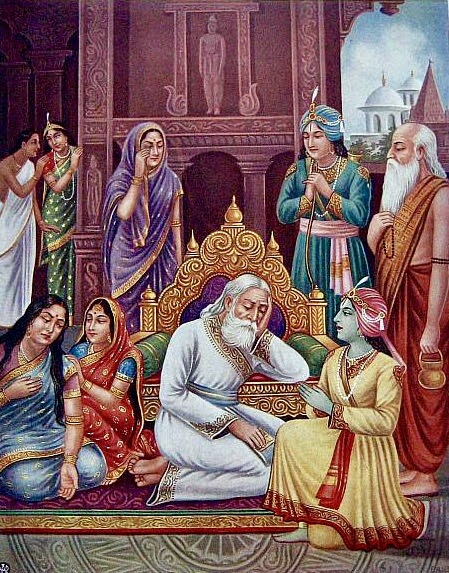
The Ayodhyakhanda ("Ayodhya sec tion") describes Dasharatha's preparations to anoint Rama as his successor, but how these efforts are thwarted by Rama's stepmother Kaikeyi the night before the ceremony.

Kaikeyi had received two favors from Dasharatha many years previously, but she had never utilized them.

Kaikeyi asks of Dasharatha that Rama be sent to the wilderness for fourteen years and that her son Bharata be enthroned in his stead, as suggested by her hunchback maid Manthara.

This calamity seems to be motivated by malice, but it is revealed to be the result of a curse cast on Dasharatha, which prophesies that he would die without his sons.

Rama promptly prepares to depart after learning of his stepmother's request, refusing to take the kingdom by force, and Sita and Lakshmana proclaim their determination to join him.

Bharata is installed on the throne, but only as a regent in Rama's absence, and Dasharatha dies of sadness.

Rama, Lakshmana, and Sita settle into life as forest exiles in the Aranyakhanda ("Forest section").

Many of the demons (rakshasas) who harass the forest residents are killed by Rama and Lakshmana, giving calm to the region.

Shurpanakha, a female demon who is enamored with the two young men, visits them one day and wants them to marry her.

The brothers taunt her before mutilating her by removing her ears and nose.

Shurpanakha seeks vengeance for the assault from her brother Ravana, the demon ruler of Lanka.

When frontal attacks fail, Ravana instructs his uncle Maricha to disguise himself as a golden deer and entice Rama away from his house.

Rama follows the deer at Sita's request, after giving Lakshmana strong instructions not to leave Sita's side.

Rama kills the deer, who, with its last breath, screams out Lakshmana's name in a voice that sounds just like Rama's.

When Sita receives the call, she becomes enraged because Lakshmana refuses to leave her.

She ultimately drives him away with an outburst, accusing him of forsaking his brother in a moment of danger so that he may have Sita all to himself.

When Lakshmana leaves, Ravana disguises himself as a mendicant monk and approaches Sita.

He kidnaps her after luring her out of a protective magic circle put around her by Lakshmana.

Ravana's departure is temporarily thwarted by Jatayu, a brave vulture who tries to save Sita.

Jatayu is gravely wounded in the subsequent battle, but he survives long enough for Rama and Lakshmana to discover him and learn the name of Sita's kidnapper.

Rama and Lakshmana's journey south to the Kishkindha forest is recounted in the Kishkindhakhanda ("Kishkindha section").

They make buddies with Sugriva, the monkey king, whose lost realm Rama helps to reclaim by assassinating Sugriva's brother Bali.

Sugriva and his monkey followers, notably his lieutenant Hanuman, begin combing the nation for any evidence of Sita after enjoying the benefits of royalty.

Hanuman chooses to jump over the sea to Lanka in the hopes of finding her.

The Sundarakhanda ("Beautiful Section") opens with Hanuman jumping over the sea to Lanka and explains how, after a long quest, he eventually finds Sita.

Meanwhile, Ravana fails miserably in his attempt to persuade Sita to accept him as her husband.

The demon's activities are driven by his desire to escape a curse that declares if he rapes a lady who opposes him, he would die.

Hanuman promises Sita that everything would be OK, and after a series of adventures, he returns to Rama to notify him that Sita has been found.

The Lankakhanda ("Lanka portion") depicts the start of a fight between Rama's and Ravana's soldiers.

Rama constructs a bridge over the sea to Lanka and starts besieging the city, aided by armies of monkeys and bears.

Ravana's younger brother Vibhishana, who opposes Ravana's bad activities and casts his lot with Rama, aids him in his battle.

Ravana is aided by his brother Kumbhakarna and son Indrajit, but Ravana and his demon friends are ultimately defeated in combat.

Sita is put to a fire trial to prove her virginity when she is rescued, and when the fire refuses to burn her, she is revealed to have been fully true to Rama.

They triumphantly return to Ayodhya, where Bharata abdicates the kingdom and the couple lives happily ever after.

Rama has further questions about Sita's morality in the "Final portion" (Uttarakhanda), which was probably definitely inserted later.

He overhears a washerman insulting his wife for being out all night while traversing the city late one night.

The washerman claims he is not as stupid as their monarch.

Rama is upset by this, and although being persuaded of Sita's innocence, he sends her into exile in order to appease his subjects—an act of mistrust unbecoming of a ruler who is meant to symbolize the ideal of morality.

Sita gives birth to twin boys, Lava and Kusha, while in exile, their prowess brings them to Rama's attention, and they are subsequently recognized as his heirs.

Sita, despite her anguish, is adamant about not reconciling.

As a last evidence, she asks her mother, the Soil, to give witness to her goodness, and Sita slips into the earth, never to be seen again, as a symbol that this is true.

Soon after, Rama departs from his body and reverts to his real form of Vishnu.

The social ideals represented by the characters in the Ramayana have made it an incredibly important work.

The epic is well-known throughout the subcontinent, as shown by the various retellings in local languages, the most renowned of which being the Tamil Ramayana of poet Kamban (9th century) and the Ramcharitmanas of poet saint Tulsidas (17th c.).

The epic continues to be a popular text in current times, as shown by its phenomenal success as a weekly television series directed by Ramanand Sagar in the mid-1980s.

The Valmiki Ramayana has been translated multiple times, with Robert Goldman and Sheldon Pollack's partial translation being the most recent.

Also see Tamil epics.

Rama


The deity Vishnu's seventh incarnation, the crown prince of the Solar Line and the protagonist of the Ramayana, one of India's two major epics.

Rama is created to slay a creature powerful enough to knock the universe out of balance, in this instance Ravana, the demon-king of Lanka, as with all of Vishnu's avatars.

Rama's attempt to reclaim his wife Sita, who has been kidnapped by Ravana, is the central struggle in the Ramayana.

Rama's conflict with Ravana, Ravana's death, and the reestablishment of cosmic equilibrium, symbolized by Rama's accession to celestial kingship, make up the epic's finale sequence.

Rama is a cornerstone of society, unlike the deity Krishna, whose divine play (lila) sometimes subverts or ignores established societal standards.

The Ramayana as a whole tends to promote and defend traditional social ideals like as religious obligation (dharma), social hierarchy (varna), and life phases (ashrama).

Rama, the epic's protagonist, embodies all of these ideals.

He is dependable, steady, righteous, and consistent.

In Hindu tradition, Rama is seen as the ideal son, and he demonstrates this by being completely committed to his parents and placing considerably more emphasis on his responsibilities as a son than on his responsibilities as a spouse.

Rama is married and faithful, unlike Krishna, who has countless liaisons with his female followers (bhakta) all in the name of divine play.

When it comes to battle, he is the most fearsome of fighters, embodying the warrior (kshatriya) ethos of utilizing power to preserve justice, protect the good, and punish the bad.

He personifies some of Hindu culture's most deeply ingrained beliefs in all of these ways.

However, there are also disturbing occurrences, especially in the Valmiki Ramayana, the epic's first edition.

These occurrences either show Rama acting out of character or highlight significant contradictions in traditional Hindu norms.

Rama shoots Bali in the back from a hidden location in order to aid monkey-king Sugriva fight his rival Bali, a conduct that is incompatible with the concept of fair and honorable combat.

His activities in upholding the current social order demonstrate the repressive and restricted character of the system.

In one episode, Rama murders a low-status shudra who is seen practicing physical asceticism (tapas), a privilege reserved for his superiors, and pours molten lead into the ears of another shudra who is caught lis tening to the holy Vedas, which is a forbidden act for such a person.

Both episodes demonstrate the hierarchical character of idealized Hindu society, as well as the king's role in maintaining and protecting it.

When Ravana's sister Shurpanakha approaches Rama and his brother Lakshmana, they first deceive and insult her, then mutilate her by chopping off her ears and nose.

Ravana kidnaps Sita in retaliation for these deeds, which appear incompatible with the kshatriya ideal of respect for women and the just use of force.

Rama's treatment of his wife Sita raises some of the most unsettling questions.

She undergoes an ordeal by fire shortly after being freed from servitude, from which she emerges unharmed, proving her assertion that she stayed chaste while imprisoned.

Despite this conclusive evidence, Rama insists on a second test, in which Sita is swallowed by the soil in protest.

As a result, the epic paints a picture of Rama as a character who was virtuous by his time's standards yet strict and uncompromising at times.

This depiction significantly transforms in later versions of the Ramayana, especially the Ramcharitmanas by poet-saint Tulsidas (1532–1623? ), probably in an effort to soften or erase these troubling episodes.

Tulsidas' passage has been altered to emphasize the primacy of devotion (bhakti) above all other religious emotions.

Rama is more clearly shown as God incarnate in Tulsidas' Rama, a person who is conscious of his divine position and whose acts are carried out for the benefit of his believers.

This Rama is still concerned with societal values, especially the kshatriya responsibility to defend and safeguard religious duties (dharma).

The centrality of bhakti, which is depicted as the ultimate religious ideal, is in contrast with — and occasionally in antagonism to — this ethic.

These small modifications in the later text allude to a clash between two opposing ideals—dharma and bhakti—both of which are accepted as necessary.

For more on Rama, see the Ramayana texts (the Valmiki Ramayana, Kamba Ramayana, and Ramcharitmanas) or translations from the Sanskrit puranas, such as Cornelia Dimmitt and J.

A. B. van Buitenen (eds. and trans. ), Classical Hindu Mythology, 1978; secondary sources include V.

Raghavan (ed. ), The Ramayana Tradition in Asia, 1980; 

Battle of Rama and Ravana


Rama is the Self in the Hindu epic narrative Ramayana (Atman). The story's demon king's name, "Ravana," means "ten mouths," which represents the ten sense organs (5 organs of knowledge; eyes, ears, nose, tongue, and skin, and the 5 organs of action; hands, feet, mouth, genitals, and anus), and all of the world's objects are demons who make up the demon king's army. 

All of these items are attempting to defeat Rama, the Self. Hanuman, the monkey, represents the mind. Rama's army is "right ideas," while "Peace," or Sita, is his loyal wife. Ravana has kidnapped Sita and is holding her against her will. When the awareness of sense things fades, then the army of Ravana dies and one receives Peace, or Sita. 

All of the numerous sense objects make up the army of Ravana. Ravana wanted to conduct a battle with the power of his army and destroy Rama. 

Rama's brother, Laxman, is the leader of the army of Rama. "Laksh" implies attentiveness, while "mana" implies thought. Meditation should be done with complete concentration of the mind. Laxman is Indrajit's (the ego's) father-in-law, while Lakshaman was Ravana's aide in his previous life. Ravana had granted Indrajit an unique favor, ensuring that he would die solely at the hands of his in-law and not in any other way. Indrajit is the ego's "I." 

The ego, Indrajit, dies when your intellect wishes to obtain "Knowledge of Brahman." When the mind is fixed on Brahman, the ego dies; when the mind is fixed on sense things, one stays a servant of the senses, or Ravana. Ravana has no fear of death. Shiva had given him the ability to die only if he so desired. 

When his whole army was decimated, he pondered to himself, "What is Sita's purpose in being imprisoned here? I shall be set free if I die at Rama's hands. 

I have not imprisoned Sita to save my life; rather, I have imprisoned her in order to achieve liberation. By just yielding to Rama, I shall not be able to govern over my empire. I have no choice except to die." "I aim my arrow at you in order to taunt and irritate you," Ravana stated to Rama. He did so, and he perished as a result. Pride, by example, is Ravana, who will only die of his own volition. 

This is the Jiva, the person. Individuals grow ready to die by listening to Vedanta (non-dual spiritual doctrine). The sensation of "I Am," which is subtle pride, obscures the true essence of the Self. This pride is like Rahu, who has eclipsed everything (Rahu eclipses the Sun in Vedic astrology). In this case, the Sun represents the Self). 

When pride declares, "I am Brahman," it is just referring to the physical body, which has a name. 

The eclipse of the "True Self" is what it's termed. While the body with a name is born, the individual believes that he, the jiva, is the one who is born. You would die when your body died if you were merely your body. You are the observer of the body, not the body itself. The body passes away. You don't have it. With the aid of Hanuman's army, Laxman defeated Ravana's army. 

The mind comes to comprehend that what appears to be true is not genuine through accurate thinking. 

Laxman (properly focusing the mind's attention) realized this, and Ravana's army was decimated. Satya-nash is a Sanskrit term that meaning "to destroy." This means that it does not exist, despite the fact that it looks to be genuine. Thoughts that are correct are like monkeys. The army of Ravana was defeated by Hanuman's (the mind's) monkey army of "good ideas" (the sense objects). 

The "Kingdom of Rama" became conceivable once Ravana perished. 

Sita, the embodiment of peace, returned home. Continue to battle by brandishing the sword of wisdom (spiritual teaching) and reciting Rama's name (meditation). Because of Ravana's dread, all of the gods had fled. Ravana was able to wield absolute power as a result of this. 

The epic Ramayana was composed with the intention of passing on "Spiritual Knowledge." 

In the Kingdom of Rama, there is no wrath or desire; only serenity and pleasure exist. The Kingdom of Rama is the Self. Everything becomes Rama if you grasp it right. If Rama wins, the gods shower him with flowers; if Ravana wins, all the demons begin dancing. The demons are the objects in the world, and the "Self who is God," or Atmaram, is the condition of thought in which there are no objects.


You may also want to read more about Spirituality and Healing here.

Be sure to check out my writings on Religion here.


Hinduism - Who Is Sita In The Hindu Pantheon?


(“furrow”) Daughter of King Janaka, wife of the god-prince Rama (himself the deity Vishnu's seventh avatar or incarnation), and a key female character in the Ramayana, the first of the two great Sanskrit epics.

Sita's identity is nearly entirely derived from her husband, unlike many other Hindu deities, and she has no independent devotion or personality of her own.

Her kidnapping by the demon king Ravana is the central story point of the Ramayana, causing her husband and companions to search the world for her before fighting a climactic battle to reclaim her, which ends with Ravana's death.

Throughout the chaos, Sita quietly waits to be rescued, certain that this would bring more honor to her husband.

Sita is not born normally, according to her charter story, but is discovered in a furrow by King Janaka while he ploughs his field.

As a result, Sita has a strong connection to the ground, fertility, and prosperity; as David Kinsley points out, her marriage to Rama represents the union of the fertile land and a righteous monarch who would prosper it.

When she calls on the ground to swallow her up as a testimony to her virginity in response to Rama's allegations of unfaithfulness, she vanishes forever.

Sita's greatest virtue is her love for her husband, and she is a model Hindu wife in her unwavering devotion to him, much as many of the Ramayana's other characters exemplify cultural values.

When Rama is wrongfully banished in the jungle for fourteen years, she shows an early proof of her love.

Sita is resolved to follow him into exile, despite the fact that she has never known anything except wealth and leisure.

She believes that a true wife should always accompany her husband.

Rama complains, argues, and even prohibits her, but Sita refuses to obey her husband's wishes—perhaps the only time she does so.

She joins Rama and her brother-in-law Lakshmana in the jungle, happily accepting the harsh life of an ascetic in order to be with her husband.

When she is kidnapped and kept hostage by Ravana, her devotion to her husband is put to the ultimate test.

Despite Ravana's constant lobbying, threats, and efforts to persuade her that Rama has been murdered, she remains firm in her beliefs.

Ravana's feet are the only part of him she ever sees, according to one account, since she kept her eyes modestly downcast rather than gaze straight at another man like a loyal wife would.

When Hanuman, Rama's ally, finds Sita's hiding place, she refuses to let him take her away since it would entail touching another man and denying her husband the chance to save her.

Rama feels that she must have been disloyal to him throughout her lengthy incarceration, thus her love is severely tested once she is rescued.

This charge stems from the Indian traditional belief that women have much more sex desires than males, and far less capacity to manage them.

She begs Rama to build her a funeral pyre and enters it with the hope that the flames would not hurt her if she is innocent.

She emerges unhurt from the inferno, with the deity Agni (fire personified) as a witness to her virginity.

Despite this evidence, Rama exiles her from Ayodhya upon their return.

When Rama requests a second suffering, Sita asks the ground to swallow her up as a testament to her purity, and then vanishes.

Sita's capacity to endure both ordeals underscores the widely held Indian concept that women obtain power by their devotion to their husbands, power that may be so strong that they can even curse the gods.

Cultural signals regarding women's roles and the value of their interactions with others are encoded in this idea.

Sita is an ideal Indian lady who is devoted to her husband and his family first and foremost.

This represents the northern Indian marriage custom of bringing women into the groom's household and assimilating them into their married families, breaking their ties to their birth families.

Wives are supposed to put other people's needs ahead of their own in order to have a happy marriage.

A wife becomes an example for everybody to admire and revere in exchange for such self-sacrifice.

See John Stratton Hawley and Donna Wulff (eds. ), The Divine Consort, 1986; David R. Kinsley, Hindu Goddesses, 1986; and Sara Mitter, Dharma's Daughters, 1991 for additional information about Sita and all the Hindu goddesses.

~Kiran Atma


You may also want to read more about Hinduism here.

Be sure to check out my writings on religion here.

Hinduism - Who Is Dasharatha?


Dasharatha is a monarch of the Ikshvaku dynasty and the father of Rama, the protagonist of the Ramayana, the earlier of the two major Indian epics. 

Dasharatha is often shown as a good monarch, but, like many other figures in Indian mythology, his final fate is determined by the repercussions of a curse that he cannot escape. 

Dasharatha used to like hunting as a young guy. 

He shoots an arrow to the area where he hears the sound of an animal drinking at a creek on one occasion. 

When he goes to investigate, he discovers a young guy who has been hit by his arrow, along with the water jug he had been filling at his side. 

With his final breaths, the young man tells Dasharatha that he is his blind parents' only source of support and orders Dasharatha to notify them of his death. 

Dasharatha is a man of honor, and he honors the boy's last wish. 

When the boy's father hears the account, he becomes enraged and curses Dasharatha to die in the same way, without his sons. 

For many years, it seemed that Dasharatha's curse would not be fulfilled since he had no sons despite having three wives: Kausalya, Kaikeyi, and Sumitra. 

Dasharatha supports a number of religious ceremonies for the birth of boys before commissioning the sage Rishyashringa to make a tremendous sacrifice. 

A glowing figure comes from the sacrificial fire at the end of the ceremony, sets a pot of milk-rice in front of Dasharatha, and tells him to give it to his wives. 

Dasharatha distributes the pot's contents between Kausalya and Kaikeyi, who each give Sumitra a portion. 

Kausalya gives birth to Rama, Kaikeyi to Bharata, and Sumitra gives birth to twins Lakshmana and Shatrughna after getting a portion from each of her co-wives. 

Dasharatha is blissfully pleased as his boys grow into maturity, and the memory of the curse slips from his mind. 

Rama demonstrates his skill and kindness as a young man, and Dasharatha chooses him to be the heir apparent. 

The curse, however, comes to fruition the night before the ceremony. 

The whisperings of Rama's maid Manthara subtly poisoned his stepmother Kaikeyi's psyche throughout the preparations leading up to his investiture. 

Manthara persuades Kaikeyi that when Rama is proclaimed heir-apparent, she and her son Bharata would be nothing more than slaves. 

Kaikeyi is forced to take harsh measures as a result of this. 

Dasharatha had promised Kaikeyi two benefits in exchange for her assistance in winning a big battle many years previously. 

She has never asked for these things before, but she now demands that Rama spend fourteen years in exile in the jungle, and that her own son, Bharata, take his place as king. 

Dasharatha begs Kaikeyi to reconsider, but she is certain that her desires must be fulfilled if Dasharatha is to maintain the family honor. 

Later, Dasharatha begs Rama to defy him and seize the kingdom by force, but Rama refuses since it is an unjust deed. 

Rama departs into the wilderness, thereby preserving the family honor, but Dasharatha dies of a broken heart as a result of his grief at being separated from Rama. 


You may also want to read more about Hinduism here.

Be sure to check out my writings on religion here.


Hinduism - Who Is Kaikeyi In Hindu Mythology?


Kaikeyi is the second wife of King Dasharatha, the mother of Bharata, and the foster mother of Rama, the epic's protagonist, in the Ramayana, the earlier of the two major Indian epics.

Kaikeyi is personally responsible for one of the epic's most heinous acts: forcing Rama into a fourteen-year exile in the forest, which is a crucial story point.

Despite her horrible deeds, she is not seen as a nasty person, but rather as a mother who acts out of love for her son but is plagued by poor judgment and bad advise.

Kaikeyi is overjoyed when Dasharatha declares that he plans to appoint Rama as the successor to the kingdom.

Rama has always held Bharata in the same regard as his own mother, Kausalya, and has regarded him as an equal.

Kaikeyi's psyche was steadily poisoned by her maid, Manthara, as the ceremony day neared.

Manthara persuades Kaikeyi that, after Rama is crowned heir-apparent, she and Bharata would be treated as chattel, or things, if they are permitted to live at all.

Kaikeyi's fear for her son drives her to take desperate measures.

Dasharatha had given Kaikeyi two boons, or gifts, for her assistance in winning a major battle many years previously.

She has never repaid these boons, but now asks that Dasharatha banish Rama to the wilderness for fourteen years and replace him with Bharata as king.

Dasharatha tries to persuade Kaikeyi to reconsider her decision, but she refuses.

Finally, he is obliged to give her desire.

Not only does Kaikeyi's request bring her shame from her husband, who blames her for separating him from Rama, but it also brings her shame from her kid.

Bharata chastises Kaikeyi for depriving Rama of something that is properly his, and he refuses to reign until Rama orders him to serve in his place during the exile.

Rama, who is depicted in the epic as serenely glad to accept his parents' orders, whatever they may be, is the only one who does not condemn her.


You may also want to read more about Hinduism here.

Be sure to check out my writings on religion here.


Hinduism - Who Is Lakshmana In Hindu Mythology?


Lakshmana is one of King Dasharatha's sons with his wife Sumitra, and the younger half-brother of Rama, the epic's protagonist, in the Ramayana, the earlier of the two major Indian epics.

Lakshmana is the ideal younger brother throughout the Ramayana, living only to serve and assist Rama.

When Rama is exiled to the forest for fourteen years, Lakshmana follows him like a shadow the whole time, first as a forest ascetic, looking for Rama's stolen wife Sita, then fighting heroically in the battle with Ravana's army, and ultimately returning to serve Rama at his court in Ayodhya.

Many of the Ramayana's characters are archetypes for Indian cultural beliefs.

As with his brother Bharata, Lakshmana represents the perfect younger brother.

Brothers are the center of the joint family in northern India.

Sisters, on the other hand, stay at home after marriage and live with their married families.

Every generation's oldest brother ultimately ascends to the position of joint family leader.

The oldest brother, who has main authority and responsibility for the whole family, cannot thrive without the participation of his younger brothers, who must respect and support his authority.

Lakshmana is a devoted younger brother in his devotion to Rama and his full disregard for his own wants.

Lakshmana is far from faultless, despite his courage, heroism, and complete devotion to Rama.

He lacks Rama's tolerance and discernment, and he acts before he thinks.

When Bharata pursues the two brothers after they have gone into exile, Lakshmana assumes that Bharata is taking advantage of the chance to murder them in order to smooth his path to the throne.

Lakshmana plots to assassinate Bharata, but Rama's logic prevents a disaster.

Shurpanakha, a demon princess and sister of Ravana, Lanka's demon-king, is Lakshmana's most grievous blunder in judgment.

When she makes sexual approaches toward Lakshmana, he mocks her before mutilating her.

Ravana kidnaps Rama's wife, Sita, in order to exact vengeance on the brothers.

Lakshmana, like all the characters in the Ramayana, is neither good nor bad; he has many qualities as well as some serious defects. 


You may also want to read more about Hinduism here.

Be sure to check out my writings on religion here.


Hinduism - Who Is Lord Hanuman In The Hindu Pantheon And Hindu Mythology?


Hanuman is a Hindu deity with a monkey head.

Hanuman first appears in the Ramayana, the first of the two major Indian epics, where he is depicted as a minister of the monkey king Sugriva and a faithful servant of Rama, the epic's protagonist and god-king.

Despite his modest status in the Hindu pantheon, Hanuman is a very popular deity in contemporary India because he provides mankind with a god who is fundamentally similar to themselves (or what they would want to be), but on a larger scale and with more power.

Hanuman is thought to be the result of a mating between Vayu, the wind deity, and Anjana, the nymph.

Hanuman the child is always hungry after his birth, and one day he tries to devour the sun.

Indra, the gods' monarch and ruler of heaven, gets enraged at Hanuman's behavior and smashes him with a thunderbolt, fracturing his jaw (hanu).

When Vayu learns of his son's injuries, he gets enraged and stops doing his customary things.

Vayu's strike indicates that no one can live a normal existence since winds are responsible for all internal activities in Indian physics, including digestion, breathing, and excretion.

The gods realize their position after a short time and beseech Vayu for pardon; he is appeased when each deity agrees to offer Hanuman a wonderful gift.

Hanuman has immense abilities as a result of these celestial blessings.

He is very powerful, as seen by his picture, which depicts him with bulging muscles.

He can also treat people using plants and natural remedies, as well as his magical skills to defend people from bad supernatural entities.

One of his most unusual divine gifts is the ability to live as long as he wants and to choose when he dies.

His greatest virtue, and many believe the true source of his power, is his devotion to Rama (bhakti).

Hanuman is an important character in the Ramayana who helps the plot progress.

Hanuman is sent with a troop of monkeys to retrieve Sita, Rama's stolen wife, and finds her imprisoned in the country of Lanka after a long and laborious quest.

Hanuman is given considerably more prominence in Tulsidas' Ramcharitmanas (a vernacular translation of the Ramayana), in which he is converted from a formidable monkey servant to a devotee (bhakta) whose only purpose is to serve Rama with passionate devotion.

This devotion forbids any kind of worldly connection, including marriage and family, and Hanuman continues to be a role model for a religious lifestyle that emphasizes celibacy and abstinence.

Celibacy is seen as a source of strength in Indian culture since it avoids the loss of a man's vital energy that occurs after ejaculation.

Hanuman's greatest attribute, according to his worshippers, is his capacity to function as a go-between for Rama, who is normally seen as far removed from human matters.

People feel a connection and kinship with Hanuman since he is also a devotee, despite the fact that his abilities are considerably greater than theirs.

In fact, they feel Hanuman's words have a larger probability of reaching Rama's attention and being acted upon.

Tulsidas, the poet-saint, names Hanuman as his messenger in a poem suitably titled the "Letter of Petition" (Vinaya Patrika), with the full assurance that his case would be heard in the heavenly court.

Hanuman's close relationship with heavenly power, his unquestionable abilities, and his perceived accessibility and empathy have all combined to make him one of India's most widely venerated deities, transcending sectarian lines.

He is often said to be a Vaishnava or follower of Vishnu because of his dedication to Rama.

However, in an unexpected twist, Hanuman is also adored by the Shaivites, Shiva's adherents, as an avatar or "incarnation" of the deity Shiva.

Hanuman is typically venerated on astrologically unfavourable days as a guardian god, to keep these inauspicious forces at bay.

His colossal strength, celibacy, and unwavering devotion have made him the patron god of Indian wrestlers, who attempt to emulate him while training.

Finally, he serves as a healer and a source of sustenance.

On the one hand, he is known for his work as an exorcist, assisting individuals in the exorcism of demonic spirits.

On the other hand, he protects life for those who know his particular phrase, which allows them to select their own death moment, just as he did.

Hanuman is just now getting the respect he deserves, despite his relevance in modern Hindu culture.

Sudhir Kakar, Shamans, Mystics, and Doctors, 1982, has further information. 


You may also want to read more about Hinduism here.

Be sure to check out my writings on religion here.


Shabari


A tribal lady who is a devout follower (bhakta) of the deity Rama in the Ramayana, the earlier of the two major Indian epics.

Shabari is a member of the Shabaras, and her moniker, which is essentially the feminine variant of the group's name, gives her a feeling of anonymity.

During their quest for Rama's abducted wife Sita, Rama and Lakshmana stop at Shabari's house.

Rama happily accepts her hospitality as a recompense for the dedication with which it is delivered, despite her low social rank as a tribal.

Shabari tastes each fruit before giving it to Rama in the Ramcharitmanas, a vernacular retelling of the Ramayana written by the poet-saint Tulsidas (1532–1623? ), to ensure that he gets only the sweetest—an act that violates one of the most pervasive ritual taboos prohibiting the exchange of any food that has come into contact with saliva, especially from lower to higher status people.

However, because of the affection with which the fruits are presented, Rama eats them joyously in the narrative.

This episode's message is congruent with a prominent topic in the Ramcharitmanas, namely, the capacity of devotion to overcome or overturn societal rules.

Shabari dies a joyful death soon after Rama and Lakshmana's arrival.

Hinduism - What Are The Major Works Of Tulsidas?


Tulsidas (1532–1623) was a Hindu king who lived from 1532 to 1623.

Poet-saint and devotee (bhakta) of the deity Rama, whose major literary work, the Ramcharitmanas, retells the epic Ramayana in the colloquial idiom of his day.

Tulsidas was born into a desperately poor brahmin family, according to evidence in his poetry, but the power of Rama's name transformed his life.

This may be interpreted both metaphorically and literally as a reference to his instructor, who is said to have been a Ramanandi.

Tulsidas repeatedly emphasizes that Rama's name contains the divinity's power and so makes that power available to believers.

Despite his reputation, he had a hard life, according to legend, and his stress on devotion caused him conflicts with other brahmins who were worried about preserving their social standing.

Tulsidas, like all of the Ramayana's vernacular retellings, did not simply translate Rama's story, but also interpreted it according to his own religious convictions.

The two most significant shifts are Tulsidas' overwhelming emphasis on the importance of devotion (bhakti) and the salvific power of Rama's name, which Tulsidas values more than Rama himself.

Tulsidas also incorporates legendary material from a number of other texts, including the Shiva Purana and the Adhyatmaramayana, to name a few.

This content is mostly added to the opening and end chapters, which are where Tulsidas deviates the most from the original epic.

One theory for why Tulsidas brought in this additional material is because he was attempting to transcend narrow sectarian limit aries, as shown by the fact that most of the poem is told by the deity Shiva in the form of a conversation with his wife Parvati.

The crow Bhushundi, who represents the power of dedication to save even an ordinary carrion-eating crow, takes over as narrator for portion of the last book.

Apart from the Ramcharitmanas, Tulsidas wrote a number of additional works in several regional languages, each devoted to a different deity; the Kavitavali, Vinaya Patrika, Ramavali, and Shrikrishnavali are among the most notable.

Tulsidas mentions writing down his poetry, and although the manuscript tradition for some of his writings is unknown, the move from song to written text happened far quicker than it did for most of his contemporaries, many of whom were illiterate.

For further details, read F. Raymond Allchin's Kavitavali (1964); W. Douglas P. Hill's The Holy Lake of Rama's Acts (1971); and John Stratton Hawley and Mark Juergensmeyer's Songs of the Saints of India (1988).

~Kiran Atma


You may also want to read more about Hinduism here.

Be sure to check out my writings on religion here.

Hinduism - What IS The Month Of Margali In The Tamil Calendar?


Ninth month of the Tamil solar year, equivalent to the northern Indian solar month of Dhanush (Sagittarius zodiac sign), which normally falls in December and January.

The persistence of many calendars is a significant indication of regional cultural patterns' continued relevance.

The Tamils keep their culture alive by following their ancient calendar.

Tamil is one of India's few regional languages with a long and illustrious literary legacy.

Tamil months, Tamil Nadu, and Tamil language are also included.

Margashirsha is the ninth month of the lunar year, generally occurring between November and December, according to the lunar calendar, which is used to calculate most Hindu religious events.

Margashirsha is traditionally regarded as an unlucky month, with only Bhairava Jayanti, Utpanna Ekadashi, and Mokshada Ekadashi as prominent festivals.

Maricha is the uncle of Ravana, the demon-king of Lanka who is the epic's nemesis, in the Ramayana, the earlier of the two major Indian epics.

After Rama and Lakshmana, the epic's heroes, insult and mutilate Ravana's sister Shurpanakha, Ravana plans to get retribution by kidnapping Rama's wife, Sita.

He enlists Maricha's assistance in kidnapping Sita.

Maricha transforms into a golden deer.

Sita requests Rama to kill the deer for her when she sees it.

Rama chases the deer into the forest, instructing Lakshmana to remain with Sita no matter what happens.

Rama chases the deer for a long time, eventually getting close enough to kill it.

Maricha calls out Lakshmana's name in a Rama-like voice with his last breath, trying to entice Lakshmana away from Sita and leave her unprotected.

Lakshmana is first hesitant to follow his directions.

When Sita accuses Lakshmana of withholding assistance to Rama because he wants to have her to himself, he eventually departs.

Lakshmana feels compelled to act in response to this unfair accusation.

He weaves a magical protective circle around Sita before leaving, telling her that no harm would come to her as long as she remains in the circle.

Ravana, disguised as an elderly monk, approaches Sita and begs for charity.

Sita leaves the circle to pay alms out of respect for an ascetic.

Ravana transforms into his real form and drags her away.


You may also want to read more about Hinduism here.

Be sure to check out my writings on religion here.


Hinduism - Where Is Ayodhya?


The term Ayodhya has the literal meaning of “unassailable” in the Sanskrit language.


Ayodhya is a historic and Sacred city (tirtha) on the Sarayu River in Uttar Pradesh's Faizabad district, and one of India's seven sacred towns. 


  • Ayodhya is renowned for being the location for most of the Ramayana, the second of two major Hindu epics in which the deity Rama is the central figure. 
  • Ayodhya is the capital city of Rama's father, King Dasharatha, as well as the birthplace and boyhood home of Rama and his siblings, as well as the city to which Rama returns triumphantly after his exile. 
  • Although scholars have questioned the historical accuracy of the Ramayana and the authenticity of the events depicted in it, Rama's followers (bhakta) have no such reservations. 


The worship of Rama is firmly rooted in Ayodhya, and numerous locations around the city are connected with events from the epic that are believed to have happened. 


  • With the exception of the Ram Janam Bhumi, the location regarded as Rama's birthplace, this has had no negative consequences. 
  • The Babri Masjid, a Muslim mosque allegedly constructed after the previous temple was destroyed, occupied this location until 1992. 
    • The mosque was demolished by organized teams of Hindu activists from the Vishva Hindu Parishad on December 6, that year, in little over six hours. 

  • Thousands of people were murdered in Hindu-Muslim communal riots throughout India as a result of the damage. 

        • These actions  have now culminated in the reconstruction of a Lord Ram temple.
        • Hindus will once again resume the commemoration and worship of  Lord Ram at Ayodhya.


      See Hans Bakker's Ayodhya (1986); Peter van der Veer's Gods on Earth (1988); Sarvepalli Gopal's Anatomy of a Confrontation (1991); and Christophe Jaffrelot's The Hindu Nationalist Movement in India (1996) for more information on Ayodhya.


      You may also want to read more about Hinduism here.

      Be sure to check out my writings on religion here.


      Hinduism - Who Is Vibhishana In Hindu Mythology?


      Vibhishana is the younger brother of Ravana, the demon king of Lanka, in the Ramayana, the earlier of the two major Indian epics.

      Vibhishana, Ravana, and their third brother, Kumbhakarna, practiced extreme physical asceticism (tapas) in their youth in order to win boons from the gods.


      Unlike his brothers, who have chosen boons to improve their military skill and fame, Vibhishana requests that he stay virtuous in the face of peril, and this trait defines his life.


      When Ravana gathers a council of war before fighting Rama's army, Vibhishana is the only one who votes against fighting and instead recommends Ravana to restore Rama's stolen wife, Sita, and seek Rama's forgiveness.

      Ravana expels his brother from the city as a result of these comments, and Vibhishana joins Rama's army, where he battles courageously throughout the conflict.


      Rama appoints Vibhishana king of Lanka after Ravana's death as a reward for his faithfulness and integrity.


      In Indian mythology, demons (in this instance, the sort of demons known as rakshasas) are not intrinsically wicked, as Vibhishana exemplifies.

      They are formidable creatures who may battle gods and mankind, yet they also possess many qualities.

      Vibhishana is shown as a great devotee (bhakta) of Rama in the Ramcharitmanas, a vernacular retelling of the Ramayana authored by the poet-saint Tulsidas (1532–1623? ), in line with Tulsidas' emphasis on devotion above all other types of religious activity.


      ~Kiran Atma


      You may also want to read more about Hinduism here.

      Be sure to check out my writings on religion here.


      Hinduism - Who Was Bharata(Mythology)?


      Bharata is a mythological character from India (2). 


      Bharata is the son of King Dasharatha by his wife Kaikeyi and the virtuous younger brother of the deity Rama, the epic's protagonist, in the Ramayana, the earlier of the two major Hindu epics. 


      • Bharata's devotion to his family is put to the test on many occasions. 
      • The most severe occurs early in the epic, when Rama is exiled for fourteen years in the jungle due to Kaikeyi's betrayal, and Bharata is appointed king in his stead. 
      • Despite the apparent attractions of riches and power, Bharata refuses to take his brother's kingdom, blames his mother for her deception, and flees with Rama to live in exile. 
      • On the grounds that the people would suffer without a ruler, Rama orders Bharata to return to Ayodhya and govern during his absence. 
      • Bharata reluctantly agrees to serve as a temporary king, but with two symbolic changes: he moves the court from Ayodhya to Nandigrama as a symbol of Rama's exile, and he sits at the foot of the royal throne throughout his reign; a pair of Rama's sandals are placed upon the throne as a symbol of the rightful king. 


      Many of the Ramayana's characters are archetypes for Indian cultural ideals, and Bharata represents the ideal younger brother. 


      • The brothers are the heart of the family in the traditional joint household since they reside at home their whole lives, while their sisters live with their husbands' families when they marry. 
      • After the elder members of the joint family have gone away, the oldest brother in each generation becomes the leader of the joint family. 
      • He is the family's main authority and duty, but he can't thrive without the help of his younger brothers, who must respect and support his rule. 
      • Bharata is a model younger brother because he refuses to usurp his older brother's legitimate leadership. 
      • He sets his personal wants and chances aside to preserve and promote the family's overall welfare.


      You may also want to read more about Hinduism here.

      Be sure to check out my writings on religion here.


      Hinduism - Where Is Nandigrama?


      Nandigrama is a village outside of Ayodhya in the Ramayana, the earlier of the two major Hindu epics, where Prince Bharata sets up the royal court while his brother Rama is away.

      Bharata's mother, Kaikeyi, uses her power to exile Rama for fourteen years and install Bharata as king in his stead.

      Bharata agrees to function as the interim king at Rama's request, but with two symbolic changes.

      The first is that Bharata transfers the royal court from Ayodhya to Nandigrama as a metaphor of Rama's exile; the second is that during his regency, Bharata sits at the foot of the royal throne, on which a pair of Rama's shoes are put, symbolizing that Rama is the legitimate king.

      As a result, Nandigrama represents Bharata's righteousness.


      ~Kiran Atma


      You may also want to read more about Hinduism here.

      Be sure to check out my writings on religion here.

      Hinduism - Who Is Kabandha In Hindu Mythology?


       ("trunk with no head") In the Ramayana (the older of the two major Hindu epics), a demon confronts the epic's protagonist, god-king Rama, and Rama's brother Lakshmana.

      Kabandha was a monarch of the gandharvas, or heavenly musicians, in a previous incarnation, but his head was thrust down into his body after a fight with the god Indra.

      When Kabandha asks for a way to eat, Indra inserts a mouth into Kabandha's stomach.

      When Rama and Lakshmana chop off his arms, Indra promises him that the curse will be broken.

      As Rama and Lakshmana seek a jungle for Rama's abducted wife Sita, Kabandha approaches them and grips each of them in one of his extended arms.

      When they realize they can't get away, Rama and Lakshmana each slice off one of his arms, and Kabandha requests the brothels to burn his corpse with his dying breaths.

      The gandharva king emerges from the flames in his former form and instructs the brothers to seek aid from the monkey-king Sugriva while the corpse burns.


      You may also want to read more about Hinduism here.

      Be sure to check out my writings on religion here.