Showing posts sorted by date for query serpent. Sort by relevance Show all posts

Parapsychology - What Is Aaron's Rod?


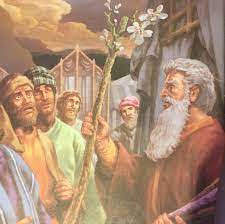
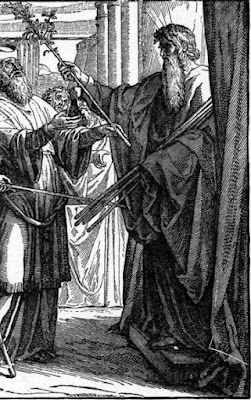
A magical wand based on the biblical story of Moses and Aaron's rods, which were employed in the marvels of parting the Red Sea and causing water to spring from a rock in the desert. 

Aaron's rod morphed into a snake when he threw it in front of Pharaoh and his magicians (Exodus 7), hence the esoteric usage of Aaron's Rod with a serpent image.

According to Jewish folklore, Aaron's rod was created on the sixth day of Creation and was kept by Adam when he left the Garden of Eden, eventually passing through a series of patriarchs.


According to an apocryphal Christian tale, the rod was cut from the Tree of Knowledge, ultimately falling into Judas' hands, and finally becoming the cross beam on which Christ was crucified.

The hazel wand used by water diviners in dowsing is reminiscent of Aaron's rod in the wilderness, which found water.

A wand of some kind has long been a symbol of power.

The wand is also used by contemporary conjuring magicians as a magical staff.


Hinduism - Who Is Lord Vishnu In The Hindu Pantheon?


Vishnu meaning the “all-pervasive” in Sanskrit, is one among the three most powerful deities in the Hindu pantheon, with Brahma, Shiva and the Goddess.

All three are significant for being largely unmentioned in the Vedas, the oldest Hindu religious books, and their rise, as well as the progressive eclipse of the Vedic gods, indicates a marked change in Hindu religious life.

Vishnu is the one who appears most often in the Vedas among the three.

Many hymns that mention him refer to him as a helper to Indra, the major Vedic deity, and one of Vishnu's epithets is Upendra ("junior Indra").

He also appears as an autonomous actor in certain late hymns, linked with wonderful works for the benefit of the cosmos, such as measuring out the universe in three steps.

Vishnu is also linked to the sun, both in terms of his ability to travel through the skies and his ability to fall on (and therefore "observe") everything.

Vishnu is the sustainer or maintainer of the universe, according to the holy trinity of Brahma Vishnu-Shiva.

Vishnu is pictured reclining on the back of his serpent couch, Shesha, in the primordial ocean at the moment of cosmic disintegration in one of the most prominent creation myths (pralaya).

Vishnu's navel produces a lotus, which opens to reveal Brahma, the creator, who starts the creation process.

When the time comes for disintegration, the whole process reverses, and the cosmos is pulled back into Vishnu, who is therefore considered as the source of everything.

The cosmos is also sustained by Vishnu's avatars or incarnations, who come into the world to restore balance to a universe that has been dangerously out of balance, generally as a result of an out of proportionally powerful demon.

There are 10 avatars as far as we know.

The Fish avatar, Tortoise avatar, Boar avatar, and Man-Lion avatar are the first four in nonhuman forms.

The other six are in human form, frequently as sages or heroes: Vamana avatar, Parashuram avatar, Rama avatar, Krishna avatar, Buddha avatar, and Kalki avatar.

In each of these instances, Vishnu takes on a physical form in order to avoid tragedy and preserve the cosmos' purity.

The theory of the avatars served as a means of assimilating existing deities into the broader pantheon while still granting them distinct status.

Although most of the avatars are no longer objects of devotion (the Boar and Man-Lion avatars each had a significant following early in the common period), Rama and Krishna's adoration has entirely exceeded that of Vishnu himself in most of northern India.

Vishnu is still revered throughout southern India, especially among Shrivaishnavas.

Apart from the avatar idea, notable local deities like as Jagannath, Venkateshvara, and Vithoba have all been absorbed into the pantheon as manifestations of Vishnu.

Vaishnavas and Shaivas established sectarian rivalry in medieval Hinduism, both claiming supremacy over their own deities (Vishnu and Shiva).

Despite the fact that Vaishnavas see Vishnu as the universe's highest force, his legendary persona and activities are vastly different from Shiva's.

Vishnu's headgear is a crown, and his persona is that of an all-ruling monarch, but Shiva is linked with ascetic life and practices (tapas) and hence with the religious force created by such acts.

Vishnu frequently succeeds by guile, ingenuity, and deceit, but Shiva eliminates his mythological enemies with sheer might, which is devoid of any finesse.

Each deity's followers recognize their divinity as the supreme force in the cosmos, from which all other gods get their power, and both are portrayed as kind and caring to their worshippers (bhakta).


~ Kiran Atma


You may also want to read more about Hinduism here.

Be sure to check out my writings on religion here.


Hinduism - Who Is Vasuki In Hindu Mythology?


Who Is Vasuki?

A renowned Naga from Hindu mythology (mythical serpent).

Vasuki's most well-known legendary role is in the narrative of the gods and demons churning the Ocean of Milk in search of immortality's nectar (amrita).


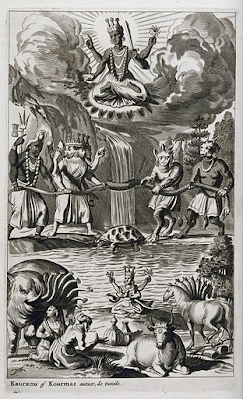
The deity Vishnu acts as the churning-base in the shape of his Tortoise incarnation, Mount Mandara serves as the churning-stick, and Vasuki, with his immense length, serves as the churning rope.

They tug Vasuki back and forth, with the gods on one side and the devils on the other, until the sea of milk yields up its riches.


~Kiran Atma


You may also want to read more about Hinduism here.

Be sure to check out my writings on religion here.
Hinduism - Who Is TakshakaIn Hindu Mythology?


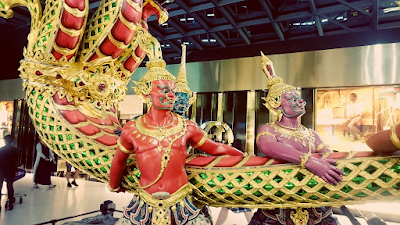
A venomous serpent-king that bites King Parikshit and kills him in Hindu legend.

Parikshit is doomed to die of a snakebite within seven days after disrespecting a powerful sage.

Parikshit takes whatever measure he can to avert his fate: He constructs a home on a large plot of land, has all items entering the house thoroughly checked, and surrounds himself with snakebite doctors.

Six days pass without incident, but as the seventh day approaches, people begin to unwind and bring some fruit into the office to eat.

Takshaka had disguised himself as a little worm in one of the fruit pieces and, when the fruit is split open, transforms into his true form, bites the monarch, and kills him.

Despite his terrifying part in this narrative, Takshaka isn't wholly wicked, as shown by a previous story.

Takshaka's mother, Kadru, bets her sister Vinata that the tail of a specific heavenly horse is black, while Vinata believes it is white; the sister agrees that the loser would serve the winner as a servant.

Kadru invites her snake offspring to hang from the horse's back to make it seem black, and thereby gains an unfair advantage.

Some of her offspring, notably Takshaka, refuse to participate in such deception, and Kadru curses Janamjeya, King Parikshit's son, to murder them.

Takshaka manages to avoid the curse—one of the rare occasions in Hindu mythology that this happens—but his brothers are not so fortunate.


~Kiran Atma


You may also want to read more about Hinduism here.

Be sure to check out my writings on religion here.

Hinduism - What Is Sushumna?


 In ancient concepts of the subtle body, one of the vertical channels (nadi).

The subtle body is a physiological system that is thought to exist on a separate level than coarse matter yet has certain similarities with it.

It's shown as a series of six psychic centers (chakras) that run nearly parallel to the spine and are joined by three parallel vertical channels.

The corporeal abodes of the two divine principles, Shiva (consciousness) and Shakti (power)—the latter as the latent spiritual force known as kundalini—are envisioned in the shape of a coiled serpent above and below these centers.

The ultimate goal of yoga that focuses on the subtle body is to awaken the kundalini and move it up via the chakras to Shiva's home.

The combination of Shiva and Shakti in the aspirant's body reflects the movement of these divine energies in the macrocosm, and it is through this union that the aspirant achieves happiness and complete soul freedom (moksha).

The sushumna is the most essential of the three vertical channels in the subtle body—the other two are the ida nadi and the pingala nadi—and it is the center of the three.

During the aspirant's spiritual exercises, the rising kundalini wakes and straightens, penetrating through the chakras on its route.

The sushumna is usually blocked where it joins the chakras, which prevents energy from flowing freely through it.

The route for the kundalini to climb to Shiva's dwelling and effect the union of Shakti and Shiva that would bring ultimate enlightenment has been opened when the chakras have been pierced and opened by the rising kundalini.

See Arthur Avalon's (Sir John Woodroffe's) Shakti and Shakta, 1978; Philip S. Rawson's The Art of Tantra, 1973; Swami Agehananda Bharati's The Tantric Tradition, 1975; and Douglas Renfrew Brooks' The Secret of the Three Cities, 1990 for further details.


You may also want to read more about Hinduism here.

Be sure to check out my writings on religion here.

Hinduism - What Is Nag Panchami?


Nag Panchami  is a festival celebrated on the fifth day (panchami) of Shravan (July–August), the bright, waxing half of the lunar month.

This day is dedicated to serpent worship, whether in the form of Nagas (minor deities who assume the shape of snakes) or genuine cobras and other snakes.

The Naga deities' pictures are washed and offered offerings on this day.

Real serpents are also honored with offerings.

On this day, people avoid digging in the ground because snakes thrive there.

This ritual takes place on the fifth day because Shesha, the god Vishnu's snake couch, is the guardian deity for this day according to astrology (jyotisha).

This festival takes place during the start of the rainy season, when rising waters from the monsoon rains lure snakes out of their burrows and into people's houses and gardens.

The rainy season is also a good time to plant crops, although snakes may be a significant threat to anyone working in the fields.

According to one estimate, 10,000 Indians die each year from snake bites.

Following this procedure, according to popular belief, would protect one against snake bites for the full year.

This is a protection ritual that marks the beginning of a perilous period for many villages.


~Kiran Atma


You may also want to read more about Hinduism here.

Be sure to check out my writings on religion here.

Hinduism - Who Is Kaliya In Hindu Mythology?


Kaliya is a thousand-headed snake in Hindu mythology who is destroyed by the adolescent deity Krishna in one of the god's early actions, predicting his future glory.

Because of the toxic poison he regularly releases, Kaliya has settled into a deep pool in the Yamuna River, leaving the pool and its surrounds uninhabitable.

Krishna resolves to get rid of Kaliya one day as he and his colleagues are tending to the cows.

Krishna climbs to the top of a large tree and jumps deep into the pool, despite his companions' pleadings.

A massive fight follows.

Krishna eventually subdues Kaliya by dancing on his hoods and trampling each of the serpent's heads till Kaliya's jaws run dry.

Kaliya's wives beseech Krishna to save his life, which Krishna agrees to do but banishes him to a more suitable location.

His benevolence reflects the Hindu belief that all creatures, including Kaliya, have a legitimate place in the universe.

Although issues develop when such entities are in the incorrect area, they may be resolved by relocating them to a more suitable one.

See John Stratton Hawley's "Krishna's Cosmic Victories," in Journal of the American Academy of Religion, Vol. 47, No. 2, 1979, for a more detailed explanation of this concept.


You may also want to read more about Hinduism here.

Be sure to check out my writings on religion here.


Hinduism - What Are The Devotthayan And Devshayani Ekadashi?


Devotthayan Ekadashi is the eleventh day (ekadashi) of the bright (waxing) half of the lunar month Kartik (October–November) is celebrated. 

This is the day when the deity Vishnu emerges from his four-month rest, which began on the Devshayani Ekadashi (“eleventh day festival”) in Ashadh (June–July). 

The ritually perilous chaturmas ("four-month") period ends when Vishnu awakens, and auspicious life-cycle ceremonies like as marriages and the sacred thread ceremony ("adolescent initiation") may resume. 

The eleventh day (ekadashi) of the bright (waxing) half of the lunar month of Ashadh is celebrated as Devshayani Ekadashi (June-July). 

This is the day when the deity Vishnu goes asleep on his serpent couch Shesha and does not wake up until Devotthayan Ekadashi, four lunar months later. 

Because it is a time when the deity is said to be insensible, this four-month period (chaturmas) is considered unfortunate and ritually harmful. 

Weddings and other life-cycle rites that may be postponed are often not conducted during this time. 

The arrival of the rainy season corresponds with the start of this celebration, and the ambivalence associated with the rains may be witnessed here. 

On the one hand, rains are necessary for crops and hence promote life and fertility. 

The rains, on the other hand, bring with them actual risks such as snakes, scorpions, and gastrointestinal diseases. 


You may also want to read more about Hinduism here.

Be sure to check out my writings on religion here.


Hinduism - What Is The Significance Of Curses And Cursing In Hinduism?


Curses. 


 One of the usual techniques in Hindu mythology for either advancing the narrative or accounting for some inevitable occurrence. 

Curses like this are often cast by sages and other spiritual adepts, but they may also be cast by anybody who has flawlessly performed their social duty, such as a loyal wife, loving son, or caring father. 

A person's spiritual abilities are expended when they make a curse. 

Such curses, at least in legendary stories, always come true, no matter what a person does to attempt to avoid them. 

In one tale, King Parikshit hides himself on a high pillar to avoid being bitten by a snake, but he is slain when a divine serpent disguises itself as a worm in a piece of fruit. 

A curse can't be undone after it's been said, but it may be changed to lessen its overall impact. 

Robert Goldman, “Karma, Guilt, and Buried Memories: Public Fantasy and Private Memory in Traditional India,” Journal of the American Oriental Society, Vol. 105, No. 3, 1985, discusses the role of curses in Indian mythology.


You may also want to read more about Hinduism here.

Be sure to check out my writings on religion here.


Hinduism - What Is Bhujangavalaya?


Bhujangavalaya means "snake bracelet" in Hindi. 


The name of a specific jewelry worn by the deity Shiva in Hindu imagery. 


  • A snake-shaped bracelet is known as the bhujangavalaya. 

  • Shiva is known in Hindu mythology for wearing serpents, particularly cobras, as decorations on his arms and chest. 
  • This is only one of the characteristics that distinguishes him as unique, strong, and perhaps deadly.
  • This practice has been continued in the prescriptive canons for the production of Hindu pictures, and Shiva is always shown wearing these serpent bands.


You may also want to read more about Hinduism here.

Be sure to check out my writings on religion here.


Pagan Religions - What Is APAP (APOPHIS)?


The Serpent of Evil is a symbol for evil. 


The Solar Boat transports the divine slayers of Apap in the Egyptian Book of the Dead. 


  • Apap is known as the 'Devourer of Souls,' since he is made out of soulless substance. 
  • Horus is shown slaying Apap on many monuments, aided by a multitude of dog-headed gods. Take a look at Apep.


You may also want to refer to my Comprehensive list of World Pagan Religious Terms And Concepts.


You may also want to read more about Paganism here.

Be sure to check out my writings on Religion here.


HINDU RELIGION AND YOGA


    Yoga is spirituality, esotericism, or mysticism, not religion in the traditional sense. 


    Regardless of whether we are discussing Hinduism, Buddhism, Jainism, or Sikhism, Yoga is often linked to the cosmologies as well as religious beliefs and practices of these many traditions. 


    • This has proved to be a stumbling barrier for many Western Yoga practitioners, who are either unaware of these traditions or have a strained relationship with their own religious heritage, whether Christianity or Judaism. 
    • They are particularly taken aback by the many deities of the Hindu, Buddhist, and Jaina pantheons, and they are unsure how these deities connect to real Yoga practice and the doctrine of nondualism (advaita) that is common to most varieties of Yoga. 
    • Students who tend toward monotheism may be worried about falling to polytheism, which is regarded a sin in the Judeo-Christian faith. 


    Because the emphasis of this discussion is Hindu Yoga, I propose to begin by introducing the main Hindu Gods and Goddesses who figure in the Sanskrit and vernacular literature of Yoga. 


    Many Hindu deities are also part of the vast Buddhist pantheon, and the Jainas have mostly kept the same deities. 


    The different deities are worshiped and summoned as manifestations or personifications of the ultimate Reality, and each is regarded as the absolute Godhead in the perspective of their worshipers. 


    • For example, worshipers of God Shiva consider Shiva as transcendental, formless, and qualityless (nirgu­ na), yet bestow onto this featureless being the gift of devotion. 
    • Goodness, beauty, strength, and elegance are examples of anthropomorphic characteristics or attributes (guna). 


    All other gods are regarded as lofty beings that inhabit different celestial regions in comparison to Shiva (loka). 


    • They are known as archangels or angels in Christian language. 
    • The scenario is the polar opposite for Vishnu worshippers. 


    Vishnu is the ultimate Godhead for them, while all other gods—including Shiva—are simply devas, or "shining ones," who have a position comparable to angelic beings in Judeo-Christian and Islamic faiths. 


    • The deities were first understood from three perspectives: 

        • material (adhibhautika), 
        • psychological (adhyatmika), 
        • and spiritual (adhidaivika). 

    • The Vedic God Agni, for example, 

        • represents the physical sacrificial fire, 
        • the sacrificer's inner fire (connected to snake power or kundalint-shakti), 
        • and the divine fire or transcendent Light. 


    When considering a god, we must examine all three characteristics. 


    Most academics have concentrated only on the first component, leading them to reject Vedic spirituality as simply "naturalistic." 


    • However, a deeper examination reveals that the Vedic seers and sages were well-versed in symbolism and adept in the use of metaphoric language. 
    • It's our comprehension, not their symbolic communication, that's lacking. 

    India's "theologians" have talked about thirty-three deities since Vedic times, despite the fact that there have long been many more listed in the scriptures. 

    The following discussion will concentrate on only a few deities who are particularly connected with Yoga. 


    To begin, there is Shiva ("Benevolent One"). 


    Shiva is already referenced in the Rig-Veda (1.14; 2.33): Shaivism, or the Shaiva tradition of worship and religion, revolves around him. 


    • He is the god of yogins par excellence, and he is often portrayed as a yogin with long, matted hair, ashes on his body, and a garland of skulls—all indications of his complete sacrifice. 
    • The crescent moon in his hair represents mystical insight and wisdom. 
    • His three eyes, which represent the sun, moon, and fire, show all that has happened in the past, present, and future to him. 
    • The cosmic fire is linked to the central or "third" eye, which is situated on the forehead, and a single look from this eye may incinerate the whole universe. 

    The snake wrapped around his neck represents Kundalinf's hidden spiritual force. 


    • The Ganga (Ganges) River, which flows from Shiva's crown, is a symbol of continuous cleansing, which is the mechanism behind his gift of spiritual freedom to followers. 
    • His four limbs symbolize his complete mastery over the four cardinal directions, and the tiger hide on which he sits signifies power (shakti). 

    His trident symbolizes Nature's three basic characteristics (guna), tamas, rajas, and sattva. 


    • Shiva's most well-known animal is the bull Nandin ("Delightful"), a symbol of sexual energy that Shiva has harnessed to perfection. 
    • The lion, which is often shown in Shiva pictures, represents desire for food, which he has also subdued. 
    • Shiva has been linked to Rudra ("Howler") from the beginning, a god who is especially associated with the air element and its many expressions (e.g., wind, storm, thunder, and lightning, but also life force and the breath, etc.). 

    Rudra, on the other hand, is said to be a powerful healer, and Shiva's name alludes to the same function. 


    • Shiva became the destructive side of the renowned trinity (lri-murti) in later Hinduism, the other two being Vishnu (representing the principle of preservation) and Brahma (representing the principle of creation) (standing for Hindu Religion, Customs and Manners the principle of ereation). 
    • As a result, Shiva is often referred to as Hara ("Remover"). 

    He is often shown on Mount Kaitasa with his heavenly wife Piirvati ("She who dwells on the mountain"). 


    • He is regarded as the first instructor of esoteric knowledge in several Tantras. 
    • The Shaivas refer to him as Maheshvara ("Great Lord," from mahfi "great" and fsh vara "lord") because he is the ultimate Reality. 
    • Shankara is the name given to him as the source of pleasure or tranquility, and Shambhu is the name given to him as the home of enjoyment. 
    • Pashupati ("Lord of the Beasts"), ishana ("Ruler"), and, last but not least, Mahadeva are some of the other titles given to him ("Great God"). 

    The linga is another symbol that is often associated with Shiva and has various meanings. 


    • The term Shiva-linga is often mistranslated as "phallus," although it really means "sign" and represents the fundamental principle of creation. 
    • The linga (also known as "lingam" in English) is the undivided and causative creative heart of cosmic existence (prakriti). 
    • Its female counterpart is the yoni principle ("womb," "source"). 
    • Both of these concepts work together to create the tapestry of space-time. 

    The shiva-linga is worn as an amulet by certain Shaivas, particularly the Lingayatas, and stone or metal replicas of the linga placed in yoni bowls remind Tantric practitioners of the bipolar nature of all apparent existence: Shiva and Parvati (Shakti), or Consciousness and Energy, play in the world. 


    Among the Vaishnavas, Vishnu ("Pervader") is the object of worship: 


    Vishnu is referenced in the Rig-Veda, thus Vaishnavism has its origins in Vedic times (e.g., 1 .23; 1 54; 8. 1 2; 29). 


    • Hari ("Remover"), Narayana ("Abode of Humans"), and Vasudeva are some of his other notable names ("God of [all] things"). 
    • Vishnu is depicted in mythology as sleeping in a formless condition on the cosmic snake Shesha (or Ananta) floating in the endless ocean of unrnanifest existence between the various eras of world creation. 

    Vishnu, like Shiva, is often shown with four arms, which symbolize his omnipresence and power. 


    • The conch (symbol of creation), the discus (symbolizing the universal mind), the lotus (representing the unity), the bow and arrows (symbolizing the ego sense and the senses), the mace (symbolizing the life force), the lock of golden hair on the left side of his chest (symbolizing the core of Nature), and the chariot (symbolizing the mind as the principle) are among his attributes. 
    • Vishnu is believed to have incarnated many times in order to reestablish the moral order (dharma) on Earth. 


    The following are Vishnu's 10 incarnations (avatira, "de­scent"): 


    1. Matsya ("Fish") incarnated for the sole purpose of rescuing Manu Satyavrata, the founder of the human race, from the flood at the beginning of the current world era. 


    2. Kurma ("Tortoise") emerged from Vishnu's infinity to retrieve numerous riches lost after the flood, most notably the elixir of life. 


    • Using the cosmic snake (Ananta) as a rope and the cosmic mountain Mandara as a churning rod, both the deities (deva or sura) and the counter-deities (asura) cooperated in churning the global ocean. 
    • The rod was pivoted around Kurma. 
    • All of the lost riches were retrieved as a result of their churning, restoring global order and equilibrium. 

    3. Varaha ("Boar") was created with the task of destroying Hiranyaksha ("Golden-Eyed"), the demon who had inundated the whole world. 


    4. Nara-Simha ("Man-Lion") appeared to destroy the e v i l monarch Hiranyakashipu ("Golden Vestment"), who had failed to slay his Reproduced from Hinduson PrahJada, a famous devoVishnu astee of Vishnu. 


    • Hiranyakashipu could not be slain by a god, human being, or beast at any time of day or night, within or beyond the walls of his palace, thanks to a blessing bestowed by God Brahma. 
    • Nara-Simha appeared as a lion-headed person inside a pillar at twilight. 
    • He ripped apart the king's body with his claws, killing him. 


    5. Vamana ("Dwarf") incarnated specifically to kill the evil Bali, who had dethroned the gods and taken control of the world. 


    • He asked Bali for as much land as he could walk across in three paces.
    • The demon emperor was amused by the request and allowed it. 
    • Yamana took two steps to encompass all of creation, then put his foot on Bali's head and pushed him into the infernal regions with his third stride. 
    • Yamana bestowed rulership over the nether regions to Bali since he was not completely devoid of qualities. 
    • The three stages of Vishnu are previously mentioned in the Rig-Veda (e.g., l .23. 1 71 8, 20). 

    6. Parashu-Rama (also known as "Rama with the Ax") was a warlike manifestation of Rama. 


    • He demolished the warrior estate twenty-one times, implying a major conflict between the kshatriyas and the brahmins during the early Vedic period. 

    7. Rama ("Dark one" or "Pleasing one"), also known as Ramacandra, was the righteous king of Ayodhya Nara-Simha and a younger contemporary of Parashu-Rama. 


    • The Ramayana epic tells the tale of his life.
    • Sita ("Furrow"), who is frequently associated with the Goddess Lakshmi ("Good Sign") and represents the principles of marriage faithfulness, love, and devotion, was his wife. 
    • She was abducted by Ravana, a demon king whose realm may have been in Sri Lanka (formerly Ceylon), and saved by Hanumat, the monkey-headed demigod who symbolizes the ideal of loyal service. 

    8. Krishna ("Pul ler") was a God-man whose teachings are found throughout the Mahabharata epic, including the Bhagavad-Gfta and many other parts. 


    • The kali-yuga, which began with Krishna's death and will continue for thousands of years, is still in full flow. 


    9. Buddha ("Awakened One") was created to deceive evildoers and demons. 


    • Although some scholars dispute that this relates to Gautama the Buddha, there is little doubt that this was the intention of the brahmins who established the ten incarnation theory. 


    10. The avatara to come is Kalki ("THE BASE ONE"). 


    • He is depicted as riding a white horse and wielding a flaming sword in different Puranas. 
    • His mission will be to put the current world (yuga) to an end and the beginning of the following Golden Age, or Age of Truth (satya-yuga). 


    God Brahma is the most abstract of the Hindu trinity, and as a result, he has failed to captivate the imagination of the brahmins. 


    He is just the world's Creator. He must be distinguished from brahman, the nondual transcendental Reality, with caution. 

    Smartas, or followers of the Smritis (nonrevelato­ ry literature), are frequently characterized as those who do not belong to the major religious groups, such as Shaivism or Vaishnavism. 


    Gan­esha ("Lord of the Hosts")


    The elephant-headed God, is closely connected with God Shiva and is known by several other names, including Ganapati (which has the same meaning) and Vinayaka ("Leader"). 


    Ganesha hit the front pages of the New York Times and other major newspapers across the globe in 1995 for what has become known as the "milk miracle" (kshfra-camatkiira). 


    On September 2nd of that year, a normal Hindu in New Delhi dreamt that Ganesha was hungry for milk. 


    • When the guy awoke, he immediately rushed to the closest temple and, with the priest's permission, gave a scoop of milk to the statue of this god. 
    • The milk disappeared, much to his and the priest's surprise. 
    • The word spread quickly across the nation, and tens of millions of devoted Hindus rushed to the temples. 
    • Apparently, many others, including astonished doubters, saw the miracle in a variety of holy and non-religious places (such as Gane­ sha statues on car dashboards). 
    • The miracle ended as quickly as it had started, within twenty-four hours. 
    • Whatever perspective we take on the occasion, it allows us to consider the symbolism of the milk offering. 


    Milk was often blended with the legendary soma draft before it was given into the holy fire for the deities' pleasure, or it was imbibed by the sacrificial priest to enhance his connection with the deities in early Vedic times. 


    • Soma sacrifices were only comprehended and performed metaphorically in later times. 
    • Soma became the nectar of immortality, created by great concentration inside the human body. 
    • Milk, being a product of the holy cow, is steeped with symbolism. 

    Ganesha is especially associated with the sym­bolism of the life force (prana) and the serpent energy (kundalini), which causes the ambrosial liquid to flood the yogin's body after it has completely ascended to the psychospiritual center at the crown of the head. 


    Then we must seek out Durga ("She who is difficult to cross"). 


    Durga who symbolizes the cosmic force of destruction, namely the annihilation of the ego (ahamkara), which stands in the path of spiritual development and ultimate freedom. 


    • She is a loving mother only to those who follow the road of self-transcendence; everyone else is subjected to her anger. 
    • The embodiment of Durga's wrath, Kali ("Dark One"), is one of ten main Goddesses known as the "Great Wisdoms" (mahd-vidya).
    • Tara, Tripura Sundari, Bhuvaneshvari, Chinnamasta, Bhairavi, Dhumavati, BagaJamukhi, Matangi, and Kamala are the other goddesses. 
    • Chinnamasta ("She who has her head chopped off") is particularly significant for Yoga. 


    This ferocious Goddess is usually portrayed naked, with a garland of skulls around her neck stump, from which two streams of blood pour. 


    • In her left hand, she clutches her severed head. 
    • The Goddess chopped off her own head to feed her two attendants, Dakini and Vamini, or Jaya and Vijaya, according to several tales. 
    • This first sacrifice of the holy Mother, according to yogic interpretation, represents the left and right currents-idd and pinga/0, which must be sacrificed in order to induce the free flow of psychospiritual energy via the center channel (sushumno-nodi). 


    In order for enlightenment to occur, the head­ symbol of the mind-must be severed, that is, transcended. 


    • Sushumnasvara Bhasini, the Goddess's other name, suggests this yogic symbolism: "She who glows with the sound of the center channel." 
    • The Goddess Lakshmi, whose name is derived from lakshman ("sign") and meaning "Good Sign" or "Fortune," emphasizes the benevolent side of the Ultimate in its feminine form. 
    • The same element of the Divine is expressed by the South Indian Goddess Lalita Tripura Sundari ("Lovely Beauty of the Triple City"). 


    Rather than frightening (ugra) and horrific (saundarya), she is characterized as kind (saumya) and lovely (saundarya) (ghora). 


    • However, since Lakshmi and Lalita are seen as the ultimate Reality, they must also have a destructive side. 
    • The Divine, from our limited human perspective, is neither solely good nor solely negative, but it transcends all such classifications. 
    • The enormous Devi­ BhdgliJata, a Shakta counterpart of the Vaishnava Bhdgavata-Purona, which has been dated between the seventh and twelfth centuries, is the most significant Hindu book praising the Divine in its feminine form. 

    The great Goddess is presented as the universe's everlasting essence.


    You may also want to read more about Kundalini Yoga here.

    You may also want to read more about Yoga here.


    You may also want to read more about Yoga Asanas and Exercises here.


    You may also want to read more about Hinduism here.

    Be sure to check out my writings on religion here.