Showing posts sorted by date for query Siddhi. Sort by relevance Show all posts

Hinduism - Who Is A Yogi?


 In practice, the term "yogic adept" refers solely to a yogic adept—someone who "possesses" yoga in the sense of mastering it—rather than to someone who just does yoga.

True yogis are often thought to possess superhuman abilities (siddhi) as a result of their lengthy spiritual growth, which they may and will use for the benefit of their disciples—for physical cure, psychiatric assistance, or spiritual and mundane advice.

The yogi is seen as a spiritually developed individual, and their authority is entirely based on this attribution, which, ironically, is not susceptible to external proof.

As a result, there are major differences of opinion over whether or not someone is a yogi.


You may also want to read more about Hinduism here.

Be sure to check out my writings on religion here.


Hinduism - What Are The Yoga Sutras?


 ("yoga aphorisms") A collection of short sayings attributed to the sage Patanjali that serve as the basic texts for the Yoga school, one of the six schools of Hindu philosophy.

The sage Vyasa's commentary on Patanjali's Yoga Sutras is often read alongside the text, and it has been considered as an important component of the book.


The Yoga Sutras are split into four sections, each of which focuses on a different theme: 


  1. The first part is about concentration (samadhi), 
  2. the second part is about the mechanics of spiritual development (sadhana), 
  3. the third part is about various attainments (vibhuti), including magical powers (siddhi), 
  4. and the last part is about yogic isolation (kaivalya), which the text calls liberation.


The Yoga school is often considered the "practical" articulation of Samkhya theory, and the text presupposes the cosmology taught by the Samkhya school, another of the six schools.


You may also want to read more about Hinduism here.

Be sure to check out my writings on religion here.


Hinduism - What Is Vashitvam?


What Is Vashitvam Among Siddhis?

Vashitvam means “control” in Sanskrit. 


One of the eight superhuman abilities (siddhi) thought to be bestowed by high spiritual attainment.

This ability allows you to control others while remaining unaffected by outside influences.


~Kiran Atma


You may also want to read more about Hinduism here.

Be sure to check out my writings on religion here.

Hinduism - What Is Tantra?


A broad word for a subset of religious activities that are centered on hidden rituals.

These are most often given forth in tantras ("loom") writings, which are so termed because they weave a separate image of reality.

Tantric practitioners (tantrikas) are connected with illegal sexuality, the use of prohibited foods such as meat and wine, and the capacity to murder or injure others via black magic in popular Hindu culture.

Tantrikas are feared because of their might and alleged amorality, a feature that some individuals have exploited.

Tantra's three traits, according to a more objective appraisal, are secrecy, power, and nondualism, or the ultimate oneness of all things.

In tantra, secrecy serves two purposes.

On the one hand, it keeps the rituals and practices hidden from those who are ineligible to receive them, and on the other, it establishes a religious subcommunity with a distinct identity and feeling of privilege.

One of the reasons tantra is seen as a higher religious practice is the feeling of exclusivity that comes with knowing something that only a few people know about.

Even though a tantra's text has been written down, it is considered that the texts are lifeless until they have been instructed by a skilled individual.

Because of this emphasis on personal transmission, diksha (a sort of initiation) is the only method to obtain access to this system, and tantra emphasizes the guru-disciple relationship even more than the Hindu tradition as a whole.

Gurus have complete discretion over who they initiate.

Although many tantrikas are twice born men, that is, members of the three highest classes (varnas)—brahmins, kshatriyas, and vaishyas—who have received the adolescent religious initiation known as the second birth, tantric practice is theoretically open to everyone, regardless of gender or social status.

Tantra's power manifests in a variety of ways.

One of them occurs during the transmission of the instruction itself, when it is thought that the guru's empowerment is required to "activate" the taught information, especially mantras.

Tantric practice is also said to be significantly more potent than traditional religious practice, and so more effective in achieving ultimate soul freedom (moksha).

The common argument is that tantra's power allows for such emancipation in a single lifetime, while other types of religious practice require eons.

The emphasis on secrecy stems from the fact that such tremendous powers must be kept hidden from the uninformed.

It is commonly acknowledged that as a natural outcome of spiritual achievement obtained via tantric practice, superhuman abilities (siddhi) are attained.

Although aspirants are discouraged from pursuing such abilities since the act of seeking is considered as founded in selfish desire, individuals who get them without seeking are said to be able to employ them without becoming corrupted.

Nondualism—the belief that all reality is ultimately one thing—is both a philosophical affirmation and a guiding concept for tantrikas in their religious practice.

Tantrikas commonly regard their chosen god (ishtadevata) as the material, efficient, and ultimate cause of all reality.

For tantrikas, finally seeing the basic oneness of all things frees them from the erroneous understanding that leads them to be bound and reborn.

Tantric practice upholds nondualism, with ceremonies emphasizing the merging of opposing locations.

As a result, some tantrikas perform rituals with items that are not explicitly banned, such as the "Five Forbidden Things" (panchamakara): fish, alcohol, meat, parched grain, and sexual intercourse.

In principle, this ritual is a way to break down dualism since it defies society conventions prohibiting intoxication, nonvegetarian cuisine, and illegal intercourse, in an attempt to sacralize what is generally banned.

Although this ceremony blurs the lines between good and evil, pure and impure, the purpose is to replace exterior rites (bahiryaga) with internal rites (antaryaga), thereby exploding the subject-object dichotomy.

Tantric yoga is the model for this kind of inner work.

This is generally a kind of kundalini yoga in which the two divine elements of Shiva and Shakti are brought together in the subtle body of the practitioner.

The last vehicle for tantric practice is rituals using symbolic diagrams (yantra), of which the shrichakra is an example.

These are generally peculiar to tantric lineages (parampara), grounding the aspirant in a certain tradition.

See Arthur Avalon's (Sir John Woodroffe's) Shakti and Shakta, 1978; Swami Agehananda Bharati's The Tantric Tradition, 1977; and Douglas Renfrew Brooks' The Secret of the Three Cities, 1990 for further details.


~Kiran Atma


You may also want to read more about Hinduism here.

Be sure to check out my writings on religion here.


Hinduism - Who Was Sureshvara In Hindu Philosophy?


Advaita Vedanta philosopher, one of two documented pupils of Shankaracharya (788–820? ), the other being Padmapada.

The Advaita school believes in monism, which is the concept that there is a single Ultimate Reality that lies underlying all things, and that all things are only different expressions of that reality.

Advaita proponents exhibit this idea by claiming that reality is nondual (advaita), that is, that all things are nothing but the formless, unqualified Brahman, despite the appearance of diversity and variety.

The idea that the universe is actual as seen is a basic misunderstanding of the ultimate essence of things, according to Advaita proponents, and an evidence of avidya.

Although typically interpreted as "ignorance," avidya refers to a lack of genuine insight that leads to karmic bonds, rebirth (samsara), and pain.

Sureshvara is the sole explicit proponent of jump philosophy in Hindu thinking, however aspects of it may be seen in other Advaita Vedanta thinkers, notably in his instructor.

The leap philosophy asserts that complete freedom from bondage, which is defined in the Indian context as the end of rebirth and full release of the soul (moksha), may be attained, but that such freedom cannot be attained by a perfectly determined sequence of causes and consequences.

Since the ultimate issue arises from one's erroneous understanding, the only solution, according to Sureshvara, is pure, accurate knowledge.

Sureshvara's approach, such as it is, is to utilize a negative dialectic to clearly define what the Self is not, and then to obtain a flash of mystic insight by hearing one of the mahavakyas ("great utterances") that connect the Self with Brahman once one's mind has been pre pared.

Sureshvara asserts that actions have no place in this process since action is inextricably linked to the world and is tainted by ignorance.

For further detail, see A. J. Alston's translation of Sri Suresvara's Naiskarmya Siddhi, published in 1959, and Karl H. Potter's ed. of Advaita Vedanta up to Samkara and His Pupils, published in 1981.


You may also want to read more about Hinduism here.

Be sure to check out my writings on religion here.
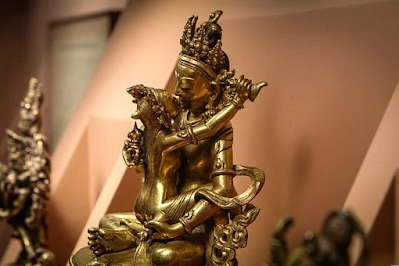


Hinduism - What Is Siddhi?


"Attainment" is Siddhi.

 The most popular term for a superhuman ability or capability.

The eight siddhis are mentioned for the first time in Patanjali's Yoga Sutras (3.45), and are traditionally said to be: minuteness (anima), lightness (lagh ima), greatness (madhima), acquisition (prapti), irresistible will (prakamyam), control (vashitvam), superiority (ishit vam), and suppression of desire (kamavasayitvam).

The presence of such siddhis is often seen as a sign of great spiritual progress, yet there is a mixed reaction to the gifts.

They provide incredible skills, but they are also immensely alluring since they may be used for both good and evil.

The ability to avoid being seduced by them is a real measure of spiritual growth, and a spiritually immature person may easily fall into the trap of manipulating them for selfish ends.

Since a result, religious aspirants are discouraged from attempting to get such abilities, as the act of seeking is seen as a selfish ambition.

People who have earned such abilities as a result of spiritual development, on the other hand, are seen to be able to maintain them in appropriate perspective.

Simantonnayana Samskara is a Sanskrit word that means "Simantonnayana Samskara." The final of the prenatal samskaras, and the third of the life-cycle rituals (samskaras).

This was done when the pregnancy was farther along, however different authors specified different timeframes for it.

The husband dividing his wife's hair is a crucial component of this tradition, which is intended to protect her from misfortune and black magic that are said to afflict pregnant women.

Parting the hair may also be seen as a sign of a smooth birth, and since it was a ceremony of protection, it would offer the pregnant mother psychological confidence that everything will be well.

Many dharma literature authors categorize this samskara as being for the mother rather than the unborn child, and as only needed to be performed during the first pregnancy, which supports this view.

In recent times, this samskara is seldom practiced.

~Kiran Atma


You may also want to read more about Hinduism here.

Be sure to check out my writings on religion here.

Prapti


 (“acquisition”) One of the eight superhuman abilities (siddhi) said to be bestowed by great spiritual achievement.

This special skill allows you to get any thing merely by wishing it.

Prakamyam


  ("irresistible will") is a Sanskrit word that means "irresistible will." One of the eight superhuman abilities (siddhi) bestowed by great spiritual development, according to legend.

This power eliminates all impediments to one's mobility, allowing them to travel anywhere they choose, including passing through solid things as if they were flowing through water.

Hinduism - What IS The Attitude Towards Magic, The Black Arts, And The Atharva Veda In Hindu Societies?


There are many different forces in the cosmos, and numerous methods to influence them, both apparent and hidden, according to Hindu belief.

The Atharva Veda, one of the earliest Hindu sacred books, is mostly a compilation of spells, thereby emphasizing the importance of magic.

Many Hindus currently believe that some powerful religious adepts have the ability to command invisible forces as well as the ability to negate other people's spells.

People with high degrees of religious achievement are said to possess superhuman abilities (siddhi), enabling them to do feats that regular people cannot.

These superhuman abilities are not seen as mystical, but rather as the usual exercise of a degree of intellect above that of most individuals.

For ages, Indian culture has had a lengthy heritage of illusion, sleight of hand, and other forms of deception, which has perplexed and entertained observers.

Lee Siegel's 1991 book Net of Magic gives a detailed overview of these abilities.


You may also want to read more about Hinduism here.

Be sure to check out my writings on religion here.


Hinduism - What Is Madhima Siddhi?


 (“greatness”) One of the eight superhuman abilities (siddhi) said to be bestowed by great spiritual achievement.

This special talent allows you to grow as big as you choose.


You may also want to read more about Hinduism here.

Be sure to check out my writings on religion here.


Hinduism - What Is Laghima In Hindu Spirituality?


Laghima ("lightness") is a Sanskrit word that means "to be light." One of eight superhuman abilities (siddhi) attributed to great spiritual development.

This special talent allows you to become as light as you choose, giving you the capacity to fly. 


You may also want to read more about Hinduism here.

Be sure to check out my writings on religion here.


Hinduism - What Is Kamavasayitvam?


 ("want suppression") One of the eight superhuman abilities (siddhi) said to be bestowed by great spiritual achievement.

This talent allows you to regulate your urges.

It also implies that any pronouncement, such as a blessing (ashirvad) or a curse, will surely come to pass.

The lack of individual desire in such a person seems to be the source of this latter power, implying that such a person will never be motivated by self-interest.

This authority symbolizes the pan-Indian notion that through giving up everything, one may eventually obtain control over everything. 


You may also want to read more about Hinduism here.

Be sure to check out my writings on religion here.


Hinduism - What Is Ishitvam In Hindu Philosophy?


 (“superiority”) One of the eight superhuman abilities (siddhi) that is historically said to be obtained by a person who has attained a high level of spiritual attainment.

The control over matter (prakrti), which is one of the two principles of the Samkhya philosophical system, is the source of this power.

This mastery of fundamental matter enables the creation, destruction, and rearrangement of material things.


You may also want to read more about Hinduism here.

Be sure to check out my writings on religion here.


HINDU PHILOSOPHY AND YOGA


    Hinduism - A Philosophy, Religion, Way Of Life, And Identity


    The difference between philosophy and religion in Hinduism is not as obvious as it is in modern Western culture. 


    • The terms "philosophy" and "religion" have no clear counterparts in Sanskrit, Hinduism's holy language. 
    • Anvikshiki-vidya is the closest synonym for "philosophy" ("science of examination"). 
    • Only the Nyaya school of philosophy, which deals with logic and dialectics, uses the similar word tarka-shastra ("discipline of reasoning"). 
    • To describe what we understand by "philosophical inquiry," modern pundits use the phrase tattva-vidya-shastra ("discipline of knowing reality"). 


    Sanatana-dharma The Sanskrit word dharma, which meaning "jaw" or "standard," captures the idea of "religion" (with many other connotations). 


    • Sanatana-dharma ("eternal law") is a Hindu term that relates to the Western concept of philosophia perennis. 
    • For Hindus, philosophy is more than just abstract knowledge; it is a metaphysics with moral consequences. 
    • To put it another way, whatever one's theoretical conclusions about reality are, they must be put into practice in everyday life. 
    • As a result, philosophy is usually viewed as a way of life rather than a meaningless exercise in logical thought. 

    Furthermore, Hindu philosophy (and Indian philosophy in general) includes a spiritual component. 


    • All philosophical systems accept the presence of a transcendental Reality and believe that a person's spiritual well-being is based on how he or she interacts with that Reality, with the exception of the materialist school known as Lokayata or Carvaka. 
    • As a result, Hindu philosophy is closer to the spirit of ancient Greek philosophia ("love of knowledge") than to the modern academic field of conceptual analysis, which goes by the name of philosophy but isn't especially concerned with life-enhancing insight. 
    • Ontology (which deals with the categories of existence), epistemology (which is concerned with the knowledge processes by which we come to know what there is "in reality"), and logic (which defines the rules of rational thought) are all areas of rational inquiry that have preoccupied Western philosophers since the time of Socrates, Plato, and Aristotle (which seeks to understand beauty). 


    Hindu philosophy, like Christian philosophy, is deeply concerned with humanity's ultimate spiritual destiny. 


    • As a result, it is often referred to as atma-vidya ("science of the Self") or adhyatmika-vidya ("spiritual science"). 
    • Though sophisticated self-critical systems seem to be the result of the period following the birth of Buddhism in the sixth century B.C.E., the ancient Rig Veda contains the first philosophical musings or intuitions of Hinduism. 


    Six systems are traditionally differentiated, which are referred to as "viewpoints" or "visions" (darshana, from the verbal root drish "to see"). 


    • This statement alludes to two important aspects of Hindu philosophy: Each system is the result of visionary-intuitive processes as well as logical thought, and each system is a unique viewpoint from which the same reality is seen, implying a stance of tolerance (at least in theory, if not in practice). 
    • And that same Truth is what has been passed down by word of mouth (and esoteric initiation) as the ultimate or transcendental Reality, whether it is referred to as God (ish, isha, Ishvara, all meaning "ruler"), the Self (atman, purusha), or the Absolute (brahman). 


    The Vedic revelation (shruti), especially the Rig-Veda, is a major element of Hindu philosophy, and tradition refers to it. 


    • The Hindu philosophers had to defer to, or at least pay lip service to, the ancient Vedic legacy in order to establish their separate schools inside the orthodox fold. 
    • Purva-Mimamsa (which proposes a philosophy of sacrificial ritualism), Uttara Mimamsa or Vedanta (which is the nondualist metaphysics espoused especially in the Upanishads), Samkhya (whose main contribution concerns the categories of sacrificial ritualism), Uttara Mimamsa or Vedanta (which is the nondualist metaphysics espoused especially in the Upani (which is primarily a theory of logic and argument). 
    • I'll provide a short overview of each school and its connection to the Yoga heritage. 


    Purva-Mimarnsa. 


    The Purva-Mimamsa ("Earlier Inquiry") school is so named because it analyzes the "earlier" two parts of the Vedic revelation: the early Vedic hymnodies and the Brahmana texts that explain and deepen their sacrifice rites. 


    • It is opposed to the Uttara Mimamsa ("Later Inquiry"), which is represented by the Upanishads' nondualist doctrines. 
    • The Mimamsa-Sutra of Jaimini gave the Purva-Mimamsa school its unique shape (c.200300 B .C.E.). 
    • In line with Vedic ritualism, it expounds the art and science of moral conduct. 
    • Its main point is the idea of dharma, or virtue, as it relates to an individual's religious or spiritual destiny. 


    The ethical authorities (dharma-shastra) are in charge of defining and explaining the secular applications of dharma. 


    • There have been many well-known Jaiminis, and the author of the Sutra must be differentiated from the sage who was a Vyasa student during the Bharata war. 
    • Mimamsa philosophers, or mimamsakas, see ethical conduct as an unseen, exceptional power that shapes the world's appearance: 
      • Action affects the quality of human life in both this incarnation and future incarnations since humans are inherently active. 


    Bad acts (activities that violate the Vedic moral code, which is believed to reflect the global order itself) result in negative life circumstances, while good actions (actions that follow the Vedic moral code) result in favorable life circumstances. 


    • The goal of leading a morally sound life is to enhance one's quality of life in the present, the afterlife, and future incarnations. 
    • Because the person has free will, he or she may utilize good acts to accrue positive consequences and even cancel out bad ones. 
    • The fact that the fundamental Self is transcendental and everlasting ensures free choice. 
    • Unlike Vedanta, the Mimamsa tradition believes in many fundamental selves (atman). 
    • These are considered inherently unconscious and only become aware in the presence of a body-mind. 

    For the Mimamsa philosophers, awareness is always I-consciousness (aham-dhi). 


    • Although some members of this school began to believe in a Creator God in the fourteenth century, there is no God above and beyond those numerous everlasting and omnipresent Selves. 
    • Because the Self is said to lack both awareness and joy, the early mimamsakas naturally considered the liberation goal sought by other schools to be unappealing. 
    • The eighth-century philosopher Kumarila Bhatta and his disciple Prabhakara were opposed to this viewpoint. 
    • They both taught that abstaining from forbidden and simply optional acts, as well as diligent execution of prescribed actions, inevitably result in the separation of the Self from the bodymind—that is, freedom. 
    • They saw the Self as awareness, but they didn't completely grasp the metaphysical consequences of their viewpoint. 


    Yoga methods have no place in Mimamsa, which extols the concept of obligation for the sake of duty. 


    • "As a philosophical perspective of the world, it is startlingly inadequate," said Sarvepalli Radhakrishnan, a former president of India and a renowned scholar, of this school of thought. 
    • Nothing in such a religion can "touch the heart and make it shine." However, since Poorva-Mimamsa was one of the cultural influences faced by the Yoga tradition, it must be included here. 
    • Though Poorva-Mimarnsa was important in the development of logic and dialectics, this school of thinking would scarcely be considered philosophical by Western standards. 


    Apart from Jaimini, Kumarila, and Prabhakara, Mandana Mishra (ninth century c.E.) is the most notable thinker of this school, which has a fairly extensive literature. 


    • He subsequently converted to Shankara's Advaita Vedanta school and took the name Sureshvara. 
    • In the fourteenth-century Shankara-Dig-Vijaya, a fictitious biography of Shankara, the tale of the electrifying meeting between Shankara and Mandana Mishra is recounted. 

    According to tradition, the youthful Shankara, who had taken up renunciation, came to Mandana Mishra's magnificent home just as the renowned scholar of Vedic ritualism was about to begin one of his rituals. 


    • Shankara, who lacked the customary hair tuft and the holy thread across his breast, irritated him. 
    • Mandana Mishra, quite proud of his knowledge, challenged the guest to a discussion after a torrent of nasty comments, which Shankara accepted quietly and not without pleasure. 
    • They decided, as was usual at the time, that whomever lost the argument would adopt the winner's lifestyle.
    • Their intellect and wit duel attracted huge groups of academics and lasted many days. 


    Ubhaya Bharati, Mandana Mishra's wife (who was really Sarasvati, the Goddess of Learning in disguise), was named umpire. 


    • She quickly proclaimed her husband's loss, but quickly countered that Shankara had only beaten half of the battle; for his victory to be complete, he needed to vanquish her as well. 
    • She slyly pushed the young renouncer to a sexuality debate. 
    • Shankara requested an adjournment without losing his cool, so that he might familiarize himself with this field of expertise. 
    • Shankara took advantage of the fact that the monarch of a neighboring country had recently died and utilized his yogic abilities to enter the body and reanimate it. 
    • He returned to the palace to the joyful exclamations of the king's family. 


    Shankara enjoyed and explored for a while the pleasures of sexual love among the deceased king's wives and courtesans in the spirit of Tantra. 


    • According to tradition, he became so engrossed in his new life that his followers had to sneak into the palace to remind him of his previous existence as a renouncer. 
    • Shankara regained his real identity and skillfully dropped the king's corpse before returning to his argument with Mandana Mishra's wife. 
    • Of course, he triumphed. Mandana Mishra said that he was a Shankara student, prompting his wife, Ubhaya Bharat!, to disclose her real identity. 
    • Shankara's win is often seen as a triumph of his better nondualist metaphysics against Purva-less Mimamsa's complex philosophy. 
    • Although this is true, it was mainly a victory of yogic experientialism over intellectualism. 


    Uttara-Mimamsa 


    The many-branched school of Uttara-Mimamsa ("Later Inquiry"), also known as Vedanta ("Veda's End"), takes its name from the fact that it arose from the study of the "later" two portions of Vedic revelation: the Aranyakas (forest treatises composed by hermits) and the Upanishads (esoteric gnostic scriptures composed by sages). 


    • Both the Aranyakas and the Upanishads teach the absorption of archaic rites via meditation, which is a metaphoric reworking of the old Vedic legacy. 
    • The Upanishadic doctrines, in particular, gave birth to the Vedanta tradition's whole consciousness technology. 
    • The Upanishads (of which there are over two hundred books), the Bhagavad-Gita (which is accorded the holy rank of an Upanishad and may date from c. 500-600 B.C.E. ), and the Vedanta Brahma-Sutra of Badarayana (c. 200 C.E.) make up the Uttara-Mimamsa school's (Vedanta) literature. 


    Vedanta is the pinnacle of metaphysics. 


    Its many sub-schools all teach one form or another of nondualism, in which Reality is seen as a one, homogenous totality. 


    Sureshvara (the former Mandana Mishra) articulates the basic concept of Vedantic nondualism in the following stanzas from the Naishkarmya-Siddhi ("Perfection of Action-Transcendence"): 


    • The failure to see the single Selfhood [of all things] is [spiritual] ignorance (avidya). 
    • The experience of one's own self is the foundation of [such ignorance]. 
    • It is the beginning of the world's transformation. 


    The emancipation (mukti) of the ego is the elimination of that [spiritual ignorance].


    • The illusion of [there being a separate] self is shattered by the fire of correct knowledge (jnana) originating from magnificent Vedic words. 
    • Because action is not incompatible with ignorance, it does not [eliminate it]. 
    • Action does not eliminate illusion since it originates from ignorance. 
    • Because it is the polar opposite of ignorance, right understanding [alone] can eliminate it, just as the sun is the polar opposite of darkness. 


    One gets scared and flees after mistaking a tree stump for a thief. 


    • Similarly, a misguided individual superimposes the Self on the buddhi [i.e., the higher intellect] and other [aspects of human identity], and then acts [on the basis of that erroneous belief]. 
    • Advaita Vedanta turned the previous Vedic ritualism on its head. 
    • It is a gospel of gnosis, which is the liberating perception of the transcendental Reality, rather than cerebral or factual knowledge. 
    • Shankara (c. 788-820 C.E.) and Ramanuja (c. 788-820 C.E.) were the two greatest exponents of Vedanta. 
    • The former was successful in building a cohesive philosophical framework out of Upanishadic ideas, and is mainly responsible for Hinduism's survival and Buddhism's expulsion from India. 


    Ramanuja, on the other hand, came to the Advaita Vedanta tradition's rescue when it was on the verge of becoming dry scholasticism. 


    • His concept of the Divine as encompassing rather than transcending all characteristics aided the public push for a more devotional Hindu faith. 
    • Many other Vedanta gurus, like Shankara and Ramanuja, have significant ties to the Yoga tradition. 
    • Samkhya has moved toward intellectualism in later times as a result of its focus on discriminative knowledge rather than meditation, while Yoga has always been vulnerable to straying into simple magical psychotechnology. 
    • The Samkhya philosophy has been the most dominant school of thinking within Hinduism, second only to Vedanta, and Shankara saw it as his primary foe. 
    • The Sage Kapila, who is attributed with authorship of the Samkhya-Sutra, is believed to have established Samkhya. 
    • Despite the fact that a teacher with that name existed during the Vedic Era, the Samkhya-Sutra seems to have been written according to certain 


    Samkhya


    The Samkhya ("Enumeration") tradition, which includes a wide range of schools, is mainly concerned with enumerating and explaining the major kinds of existence. 


    In Western philosophy, this method is known as "ontology," or "science of being." 


    • Samkhya and Yog are closely related in their metaphysical concepts, and they originally constituted an unified pre-classical school. 
    • However, while Sankhya's disciples utilize discernment (viveka) and renunciation as their primary methods of salvation, yogins primarily use a combination of meditation and renunciation. 
    • Sankhya is often mistakenly described as the theoretical component of Yoga practice. 
    • As late as the fourteenth or fifteenth century C.E., each traditions had their own unique ideas and practical scholars. 


    The Samkhya alluded to in the six darshanas is the school of ishvara Krishna (c. 350 C.E. ), creator of the SamkhyaKarika. 


    • Ishvara Krishna taught that Reality is multiple, not single, in contrast to Vedanta and the older Samkhya schools described in the Mahabharata epic. 
    • On one hand, there are numerous changeable and unconscious forms of Nature (prakriti), and on the other, there are countless transcendental Selves (purusha), which are pure Consciousness, omnipresent, and everlasting. 
    • When examined more carefully, plurality seems to be irrational. 
    • If innumerable Selves are all omnipresent, they must also be endlessly intersecting one another, making them logically identical. 


    While Shankara's nondualism is the most academically beautiful, Ramanuja's qualified nondualism may satisfy both reason and intuition the best. 


    • Ishvara Krishna went on to say that Nature (prakriti) is a huge composite or multidimensional structure produced by the interaction of three main forces: the dynamic characteristics, the material qualities, and the spiritual qualities (guna). 
    • The term guna literally means "strand," yet it has a lot of other meanings. 
    • The word signifies the irreducible ultimate "reals" of the universe in Yoga and Samkhya metaphysics. 


    The three kinds of gunas are believed to mirror the energy quanta of modern physics. 


    • Sattva, rajas, and tamas are the three gunas. 
    • They are at the root of all physical and psychological processes. 
    • Their distinct characteristics are described as follows in the Samkhya-Karika: The [three kinds of] gunas are of the natures of joy, joylessness, and dejection, and have the functions of enlightening, activating, and limiting, respectively. 
    • They outnumber each other, and their actions are interconnected, productive, and cooperative. 
    • Sattva is said to be uplifting and enlightening. 
    • Rajas is energizing and dynamic. 
    • Tamas is passive and oblivious. 


    Like a lamp [made up of many components that together create the single phenomenon of light], the action [of the gunas] is purposeful. 


    • Just as atoms are matter-energy, the gunas are Nature. 
    • They are collectively responsible for the vast diversity of natural forms that exist on all levels of existence, with the exception of the transcendental Selves, who are pure Consciousness. 
    • We can best explain the gunas by the general idea of two opposites and the middle term between them, or as Hegel's thesis, antithesis and synthesis, which are manifested in nature by light, darkness, and mist; in morals by good, bad, and indifferent, with many applications and modifications, according to German Sanskritist Max Muller. 
    • The gunas are in a condition of equilibrium in the transcendental dimension of Nature, known as prakriti-pradhdna ("Nature's basis"), according to the Samkhya-Karika. 


    Mahat, which literally means "great one" or "great principle," is the first product or evolute to emerge in the process of development from this transcendental matrix to the diversity of space-time forms. 


    • Because of its brightness and intelligence, it is also called as buddhi ("intuition" or "cognition"), which means "greater knowledge."
    • But, in fact, mahat (like other elements of Nature) is completely unconscious, and it simply symbolizes a highly refined form of matter-energy. 


    Its "light" of intellect is derived from transcendental Self-Consciousness. 


    • The principle of individuation, ahamkara ("I-maker"), arises from the mahat, or buddhi, and ushers in the difference between subject and object. 
    • The lower mind (manas), the five cognitive senses (sight, smell, taste, touch, and hearing), and the five conative senses all emerge as a result of this existential category (speech, prehension, movement, excretion, and reproduction). 
    • The ahamkara principle is also responsible for the five subtle essences (tanmatra) that underpin sensory capabilities. 
    • The five gross material elements (bhuta), namely earth, water, fire, air, and ether, are produced by them in tum. 
    • As a result, Classical Samkhya acknowledges twenty-four different types of material existence. 

    There are innumerable transcendental Self-monads outside the guna triad and its products, which are unaffected by Nature's ramifications. 


    • The closeness of the transcendental Selves (purusha) to the transcendental matrix of Nature triggers the whole evolutionary process. 
    • Furthermore, the procedure is for the release of those Selves who, for some inexplicable and erroneous reason, identify themselves with a specific body-mind rather than their inherent state of pure Consciousness. 
    • The Samkhya tradition's psychocosmological evolutionism is intended to help people transcend the world rather than understand it. 
    • It is a practical framework for individuals who seek Self-realization and come across many levels or types of existence while practicing meditation. 


    Vaisheshika


    The Vaisheshika ("Distinctionism") school of thought is concerned with the distinctions (vishesha) that exist between things. 


    Liberation is achieved via a comprehensive knowledge of the six fundamental types of existence, according to the teachings:


    l. The ninefold substance (dravya): earth, water, fire, air, ether, time, space, thought (manas), and Self (atman)

    2. quality (guna), which is divided into twenty-three categories, including color, sensory impressions, magnitude, and so forth. 

    3. take action (karma)

    4. universality (samanya or jati)

    5. the specific (vishesha) Yoga particularly refers to the school of Patanjali, the author of the Yoga-Sutra, among the six schools of Hindu philosophy. 

    • This school, also known as Classical Yoga, is regarded a relative of ishvara Krishna's Samkhya school.  

    • Both are dualist ideologies that teach that the transcendental Selves (purusha) are fundamentally different from Nature (prakriti) and that the former is eternally unchanging, while the latter is always changing and therefore unsuitable for long-term pleasure. 


    6. inherence (samavaya), which refers to the logical connection that must exist between wholes and pieces, or substances and their characteristics, and so on. 


    Kanada, the author of the Vaisheshika-Sutra, who flourished about 500 or 600 B.C.E., established the Vaisheshika school. 


    • Kanada seems to be a nickname, literally meaning "particle eater." 
    • Although some Sanskrit sources say that the term immortalizes the fact that this great ascetic lived on grain particles (kana), it is likely that it alludes to the kind of philosophy he developed. 
    • Both readings may be accurate. Kanada's school of thinking has an enigmatic beginning. 


    Some academics believe it is a descendant of the earlier Mimamsa school, while others view it as a continuation of the materialist tradition, and yet others believe it has its origins in a schismatic branch of Jainism. 


    • The Vaisheshika school is similar to the Nyaya system, with which it is usually associated, in terms of general direction and metaphysics. 
    • Both of these systems are the closest to what we think of as philosophy in the West. 
    • They contributed to Indian thinking for a long time, but neither school has remained dominant. 
    • The Vaisheshika school is almost extinct, while the Nyaya school has just a few adherents, most of whom live in Bengal. 


    Nyaya


    The Nyaya ("Rule") school of thought was founded by Akshapada Gautama (c.500 B.C.E. ), who lived during a period of intense debate between Vedic ritualism and such heterodox developments as Buddhism and Jainism—an era in which critical thinking and debating were at an all-time high, similar to that of Greece. 


    One of the first efforts to establish sound logic and rhetorical principles was his. 


    • Gautama's moniker, Akshapada, suggests that he had a tendency of gazing down at his feet (perhaps while being immersed in thought or in order to purify the ground while walking). 
    • He is credited with writing the Nyaya-Sutra, which has been the subject of many comments. 
    • Vatsyayana Pakshilasvamin's commentary (c. 400 C.E.) is the earliest surviving commentary, written at a period when Buddhism was still dominant in India. 


    Bharadvaja's or Uddyotakara's Nyaya-Varttika is another excellent commentary, with a good subcommentary by Vacaspati Mishra, who also wrote on Yoga. 


    • Around 1200 C.E., Nyaya began flowering, marking the start of the so-called Nava-Nyaya era (or "New Nyaya"). 
    • In order to live properly and pursue meaningful objectives, Akshapada Gautama began with the realization that we must first define what constitutes right knowledge. 
    • He developed sixteen categories considered essential for anybody wanting to discover the truth, in keeping with the Indic flare for categorization. 
    • These topics include the acquisition of genuine knowledge (pramana), the nature of doubt, and the distinction between discussion and simple bickering. 


    The Nyaya school's metaphysics is of particular importance. 


    • There are several transcendental Subjects, or Selves, according to Nyaya's disciples (atman). 
    • The ultimate actor underlying the human mind is each infinite Self, and each Self enjoys and suffers the consequences of its acts in the limited universe. 
    • God is seen as a unique atman in Classical Yoga, and he is the only one who is aware. 


    The Nyaya thinkers advocated the pursuit of freedom (apavarga) as the greatest aim in life, despite the fact that the human Selves are all regarded unconscious, like in the Mimamsa school. 


    • Of course, their opponents did not miss an opportunity to point out the impossibility of a freedom that would result in a rocklike, insentient life. 
    • The fact that Nyaya followers sought spiritual shelter in Shaivism's religious doctrines demonstrates how little they believed in their own metaphysics. 
    • Between Nyaya and Yoga, there are many places of interaction. 
    • The NyayaSutra describes yoga as a state in which the mind is in touch with the Self alone, resulting in mental balance and a lack of sensitivity to physical discomfort. 


    Vatsyayana Pakshilasvamin said that yogins may see distant and even future occurrences while addressing different kinds of perception, a talent that can be developed by consistent practice of meditative focus. 


    • The word apavarga refers to liberation, and it is also used in the Yoga-Sutra (2. 1 8) to contrast it with the concept of world experience (bhoga). 
    • Another interesting similarity is that both Nyaya and Classical Yoga follow the sphota theory. 
    • The everlasting connection between a word and its sound is referred to by this phrase. 


    The notion is that the letters y, o, g, and a, or even the whole term yoga, cannot adequately express our understanding of the phenomenon known as "Yoga." 


    • Over and above these letters or sounds, there is an everlasting idea, the essence of a thing, which "bursts out" (sphuta) or exposes itself spontaneously in our mind upon hearing a sequence of sounds, leading to understanding of the object so indicated. 
    • A last point of connection is that a Nyaya follower is also known as yauga, which means "one who does Yoga." It's unclear what this designation conceals. 


    Hindu philosophy is divided into six schools, which is rather arbitrary. 


    • Many other schools, particularly those connected with sectarian movements, have played an important role in the development of Indian philosophy at one point or another. 
    • It's important to remember that Yoga impacted most of these methods and traditions, but it did so more as a loose collection of ideas, beliefs, and practices than as Patanjali's philosophical framework (darshana).


    You may also want to read more about Kundalini Yoga here.

    You may also want to read more about Yoga here.


    You may also want to read more about Yoga Asanas and Exercises here.


    You may also want to read more about Hinduism here.

    Be sure to check out my writings on religion here.