Showing posts sorted by relevance for query Saraswati. Sort by date Show all posts

Saraswati


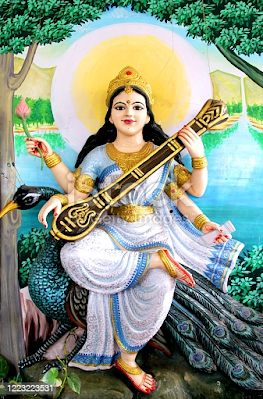
Goddess associated with art, aesthetics, learning, sacred speech, and wisdom.

Saraswati is the patron deity of culture in all its manifestations.

The spoken word is considered very powerful in Hindu culture and Saraswati can either promote or frustrate one’s efforts by conferring or withdrawing the ability to speak clearly.

Her association with sacred speech goes back to the time of the sacrificial manuals known as the Brahmanas, in which the cult of sacrifice was based on the precise performance of sacred speech and ritual.

Her iconography emphasizes her connection with the life of the mind: She holds a book, a crystal (symbolic of a purified mind), a vina (musical instrument), and a rosary (associated with religious rites, and particularly with the repetition of the sacred sounds known as mantras) (associated with religious rites, and particularly with the repetition of the sacred sounds known as mantras).

Her animal vehicle is the swan, whose white color is a symbol of purity and whose high flight is a symbol of transcendence.

Through Saraswati’s blessings (ashirvad) human beings can transcend their biological condition to create works of art and culture.

Saraswati is usually believed to be married, although different mythic sources give her different husbands.

In some cases she is described as the wife of the god Brahma, the creator; here their joint activity encompasses the formation of the material world and its transformation through human cultural activity.

In other stories she is described as the wife of the god Vishnu, and thus a co-wife of Lakshmi.

Here the realms of Lakshmi and Saraswati can be seen as giving differing messages about the “good things” in life— while Lakshmi grants wealth and materi al prosperity, Saraswati brings wisdom and culture.

A popular Indian saying reports that Saraswati’s devotee (bhakta) will never make money, while a follower of Lakshmi (whose vehicle is the owl) will be “blind” to spiritual wisdom.

For more information on Saraswati and all the god desses of Hinduism, see David R. Kinsley, Hindu Goddesses, 1986.

Saraswati River


Along with the Ganges, Yamuna, Godavari, Narmada, Indus, and Cauvery, it is one of India's seven holy rivers.

The Saraswati is especially fascinating since no one knows precisely where it flows.

The Saraswati River is referenced in the hymns of the Vedas, the oldest and most authoritative Hindu religious books, and hence seems to be in the northeastern portion of India, where these poems are placed.

In contemporary times, the Saraswati River runs through the northern Indian state of Haryana before drying up in Rajasthan's desert.

On its banks, archaeologists have discovered huge villages from the Indus Valley civilization, indicating that the river was once an active tributary of the Indus.

The Saraswati, according to popular mythology, flows underground and meets the Ganges and Yamuna Rivers at their confluence at Allahabad.

One of the site's names, Triveni ("triple stream"), comes from the legendary confluence of three holy rivers.

YOGA KUNDALINI UPANISHAD


Of the 108 Upanishads, the Yoga-Kundalini Upanishad is the eighty-sixth. It is included in the Krishna Yajurveda. It discusses Hatha and Lambika Yogas in detail. It ends with a summary of a non-qualified Brahman. Both seekers are on a search for the Non-dual Brahman.

The Yoga-Kundalini Upanishad is a very important work on Kundalini Yoga, despite being classified as a minor Upanishad. It starts with an examination of Chitta's essence. Samskaras and Vasanas, on the one hand, and Prana, on the other, are said to be the causes of Chitta's life. Prana is automatically controlled if Vasanas are controlled. The Vasanas are automatically monitored if Prana is controlled.

Methods for controlling Prana are presented in the Yoga-Kundalini Upanishad. Vasanas are not dealt with by the Yogic practitioner. He is interested in the methods for monitoring Prana.

Mitahara, Asana, and Shakti-Chalana are the three methods for controlling Prana offered in the Yoga-Kundalini Upanishad. The first chapter covers all three approaches in detail.

Mitahara's diet consists of light, soft, and nutritious foods. Two popular Asanas used by Yogic students are Padmasana and Vajrasana. The Kundalini is being awoken and sent to the crown of the head by Shakti-Chalana.

A two-pronged approach can be used to awaken Kundalini. The two traditions are Saraswati Chalana and Prana Restraint. Saraswati Chalana is the rousing of the Saraswati Nadi.

The Yoga-Kundalini Upanishad describes a clear method for arousing Kundalini. The Prana goes out in 16 digits when a human exhales. Inhalation results in just 12 digits, resulting in a 4 digit loss. If one can inhale Prana for 16 digits, the Kundalini is aroused. This is achieved by sitting in Padmasana and lengthening inwards 4 digits further as Prana is streaming through the left nostril.

The Yogic student should exploit the Saraswati Nadi and stir up the Kundalini Shakti with all his might, from right to left, repeatedly, using this lengthened energy. This procedure could take up to three quarters of an hour to complete. All of this is outlined in the Yoga-Kundalini Upanishad in a concise yet thorough manner.

Shaking the Saraswati Nadi has many benefits, the most significant of which is that it cures various diseases that arise in the stomach and cleanses and purifies the system. The Yogic pupil is initiated into the Kevala Kumbhaka after doing the Sahita Kumbhaka. The Prana is fully restrained in these two forms of Kumbhaka.


The Sahita Kumbhaka is divided into four divisions: Suryabheda Kumbhaka, Ujjayi Kumbhaka, Sitali, and Bhastrika. Suryabheda Kumbhaka eliminates intestinal worms as well as Vayu's four types of evils. Ujjayi cleanses the body, eliminates pathogens, and boosts gastric fire. 

It also reduces the heat in the head and the phlegm in the throat. Sitali is a body coolant. Gulma, dyspepsia, pliha, consumption, bile, fever, hunger, and poison are all destroyed by it. These ways of Sahita Kumbhaka cleanse and brace the entire physiological body for Kundalini Sakti stimulation and non-dual Brahman encounter.

Bhastrika Kumbhaka pierces the three knots, or Granthis, in addition to bringing about a host of beneficial physiological improvements. The Yoga-Kundalini Upanishad then instructs the Yogic student on how to do the three Bandhas. The Mulabandha is the mechanism by which the spincter muscles of the anus push up the downward inclination of the Apana (breath). 

The Apana is raised by this Bandha. It hits the Agni, or fuel, sphere. The Agni's flame grows long and is blown about by Vayu. Agni and Apana mix with the Prana in a heated state. Agni is a ruthless being.

Via the radiant heat of this fiery Agni, the fire that awakens and arouses the Kundalini appears in the body. The awakened Kundalini makes a hissing noise, stands up, and enters Brahmanadi's hole. This Mulabandha is practiced by the Yogins on a regular basis.

The other two Bandhas, namely the Uddiyana Bandha and the Jalandhara Bandha, also play a significant role in arousing the Sarasvati Nadi and Kundalini Shakti.

The Yoga-Kundalini Upanishad outlines the many challenges that Yogic students face after providing extensive knowledge of the Bandha techniques. It also explains how to get through these roadblocks.


There are seven causes of illness in the human body. 


1. Taking a nap during the day. 

2. Midnight vigils at a late hour. 

3. Excessive sexual activity. 

4. Navigating around crowds. 

5. The consequences of eating unhealthily. 

6. Urine and feces discharge are examined. 

7. Exhausting emotional operations involving the Prana.


Obstacles on the Yogic Path 


  1. When diseases strike, the Yogic student makes the error of incorrectly attributing the illnesses to his Yoga practice. This is the first stumbling block in Yoga.
  2. The Yogic student starts to question the Yoga Sadhana's effectiveness. This is the second stumbling block. 
  3. The third barrier is carelessness or a state of misunderstanding. 
  4. The fourth barrier is indifference or laziness. 
  5. The connection to sense-objects is the sixth barrier, and sleep is the seventh. 
  6. The seventh stumbling block is false belief or illusion. 
  7. The eighth is preoccupation with earthly matters.
  8. The ninth reason is a lack of confidence. 
  9. The tenth impediment to Yoga practice is a lack of aptitude for understanding Yoga realities.

Many of these stumbling blocks should be avoided by diligent investigation and deliberation by sincere spiritual aspirants. The Upanishads go on to explain the method of rousing the Kundalini and transporting it to the Sahasrara by piercing through the Granthis.


The Kundalini, once awakened, pushes upwards, releasing a torrent of nectar. This is something that the Yogi loves, as it takes him free from all sensual desires. On 104, the Yogi takes a decision.

The Atman (Inner Reality), he is in the best possible spiritual state. He achieves equilibrium and devotes himself solely to the Atman or Self.

The Yogi's body achieves a very delicate state of spiritual Consciousness through the whole Kundalini Yoga Sadhana phase. 

All becomes Consciousness to the Yogi who has achieved Samadhi. The Yogi recognizes the macrocosm's and microcosm's oneness.

The Yogi enjoys the greatest Avastha since Kundalini Shakti has achieved the Sahasrara Kamala, or thousand-petalled lotus, and has been unified with Siva. This is the last of the beatitudes.

The Chakras are the essential energy centers of Shakti. Pranavayu manifests Prana Shakti in the living body through these centers.

Kundalini Yoga is for those who want to arouse the Kundalini Shakti in order to experience the Bliss of Union of Siva and Shakti through awakened Kundalini and receive the resulting Powers or Siddhis. 

This Yoga-Kundalini Upanishad is extremely important to them. It provides them with a thorough understanding of the Kundalini Yoga practices and procedures, with a focus on the Khechari Mudra.

Both Bhukti and Mukti are sought by the Kundalini Yogi. In and around the universe, he achieves salvation. Jnana Yoga is an ascetic and liberating course. Kundalini Yoga is a path that leads to happiness and liberation.

The Hatha Yogi aspires to have a body that is as solid as stone, balanced, pain-free, and therefore long-lived. The Yogi is the master of the body, as well as of life and death. His gleaming form exudes the vigor of youth. 

He loves the realm of shapes for as long as he has the will to survive. His death is a voluntary death (Ichha-Mrityu). The Yogi should follow the advice of a knowledgeable Guru.

The Serpent Power is the power that provides the entire body and all of its shifting Pranic powers with a static protection or Adhara. 

Yoga disturbs the balance of bodily identity, whose consciousness is the product of the preservation of these two poles, and therefore destroys the polarity as it resides in and as the body.

The Supreme Power, which is the future pole of Energy in the human body, is roused to motion. In the Sahasrara, the Shakti is shifted upward to join with Siva, the quiescent Consciousness.

The static Shakti is influenced and becomes active by Pranayama and other Yogic processes. The polarization of the body gives way as Kundalini unites with Siva in the Sahasrara and becomes fully dynamic. 

The two poles merge into one, resulting in the state of consciousness known as Samadhi. In the Consciousness, there is polarization. The body does, in fact, continue to exist as a subject of scrutiny from others.

The nectar that flows from the union of Siva and Shakti in Sahasrara sustains the Yogi's body as the Kundalini ascends. Glory to Mother Kundalini, who, through Her Infinite Grace and Strength, gently guides the Sadhaka from Chakra to Chakra, illuminating him and allowing him to realize his identity with the Supreme Brahman. The Yoga-Kundalini Upanishad places a high value on seeking out and finding the right Guru. It keeps on worshiping the enlightened Guru as God. Gurus have complete Self-illumination. In deluded people, he lifts the curtain of delusion.

While there are less realized Gurus in this Kali Yuga than in the Satya Yuga, they are still present to assist aspirants. They're still on the lookout for the right Adhikarins.

The Yoga-Kundalini Upanishad lists a number of challenges to Yoga practice. Some people begin doing Yoga, but as they run into difficulties, they are unsure how to continue. They have no idea how to get rid of them. On the spiritual route, there are many challenges, hazards, snares, and traps. Sadhakas will make a lot of mistakes on their way to enlightenment.

It is important that they be guided by a Guru who has already walked the journey and achieved the target.


There's one more thing you should know:


The Yoga-Kundalini Upanishad lists a number of challenges to Yoga practice. 


Some people begin doing Yoga, but as they run into difficulties, they are unsure how to continue. They have no idea how to get rid of them. There are many challenges to overcome.

In the spiritual journey, there are many risks, traps, and obstacles to avoid. 

  • Sadhakas will make a lot of mistakes on their way to enlightenment.
  • It is important that they be guided by a Guru who has already walked the journey and achieved the target.
  • The Sushumna Nadi is another significant concept that can be found in the Yoga-Kundalini Upanishad. You must be fully familiar with this Nadi.
  • Now, a word about Kundalini, whose stimulation is the primary goal of Kundalini Yoga. 
  • The primordial energy or Shakti that lies dormant or resting in the Muladhara Chakra, the body's core, is Kundalini, the serpent-power or sacred light. 
  • Because of its serpentine shape, it is known as the serpentine or annular force. 
  • It's an occult entity that's electric and fiery, the great pristine energy that underpins both organic and inorganic matter.

Saraswati Dashanami


One of the ten divisions of the Dashanami Sanyasis, renunciant ascetics who are devotees (bhakta) of Shiva.

The Dashanamis were supposedly established by the ninth-century philosopher Shankaracharya in an effort to create a corps of learned men who could help to revitalize Hindu life.

Each of the divisions is designated by a different name—in this case, Saraswati (the patron goddess of learning and culture) (the patron goddess of learning and culture).

Upon initiation, new members are given this name as a surname to their new ascetic names, thus allowing for immediate group identification.

These ten “named” divisions of Dashanami Sanyasis are divided into four larger organizational groups.

Each group has its headquarters in one of the four monastic centers (maths) supposedly established by Shankaracharya, as well as other particular religious associations.

The Saraswati Dashanamis belong to the Bhuriwara group, which is linked with the Shringeri math in the southern Indian town of Shringeri.

The Saraswati division is unique in that it is one of the few in the world that will exclusively initiate brahmins (the other such divisions are Ashrama, Tirtha, and part of the Bharati order).

Hinduism - Who Is Goddess Ganga In Hindu Mythology? What Is Lord Vishnu's Promise To Her?


The deity whose physical form is the Ganges River in Hindu mythology.

The Ganges is revered because it is said to be a goddess who has the capacity to cleanse individuals who bathe (snana) in it of their sins.

Several stories exist to explain her origins.

The most well-known is the story of King Bhagirath, who succeeds in bringing the Ganges down from heaven to earth by ascetic discipline.

Bhagirath is the great-greatgrandson of King Sagar, whose 60,000 sons were burnt to ashes by the sage Kapila's magical abilities after falsely accusing Kapila of thievery.

Later, Kapila informs Anshuman, King Sagar's grandson and only living descendent, that bringing the Ganges down from heaven to earth is the only way to restore peace to the spirits of Sagar's sons.

Anshuman, like his son Dilip before him, tries miserably to achieve this goal.

Bhagirath, Dilip's son, is moved by their efforts and retreats to the Himalayas, where he practices asceticism until the gods agree to bring the Ganges down to earth.

Bhagiratha's efforts, however, are not yet complete.

Then he must win the favor of the deity Shiva, who must agree to absorb the impact of the falling river on his head.

Otherwise, the earth will be destroyed by its might.

The Ganges eventually crashes to earth on Shiva's head when everything is in place.

Bhagirath brings Ganga down of the mountains and to the sea, where she touches the ashes of his forefathers and the two of them eventually find peace.

This legend emphasizes the Ganga's salvific power as well as her close ties to the dead's final rituals (antyeshthi samskara).

According to another legend, the Ganges descends to earth as a result of a curse declared by Vishnu and his wives Ganga, Lakshmi, and Saraswati after a family feud.

Saraswati becomes enraged and proceeds to beat Ganga when she witnesses Ganga and Vishnu sharing passionate looks in public.

As Lakshmi attempts to stop her, Saraswati unleashes a series of curses, including Vishnu's birth as a stone (the shalagram), Lakshmi's birth as a plant (the tulsi plant), and Ganga's birth as a river, carrying the world's sins.

Saraswati is cursed to become a river throughout the struggle.

Ganga's punishment is sweetened by Vishnu's promise that she would be regarded exceedingly holy on earth and will have the capacity to cleanse people's sins.

She will also descend from heaven onto the head of the deity Shiva and become his spouse, according to Vishnu. 


You may also want to read more about Hinduism here.

Be sure to check out my writings on religion here.


CHALANA OF SARASVATI


Sarasvati Chalana is the Sarasvati Nadi's rousing. 


Saraswati Nadi is one among the fourteen Nadis, west of the navel.


  • Susumna, Vajra, and Saraswati nadis are the most prevalent risings. 
  • In these paths, there are also several energy center (chakra) levels at which she can act or settle in the course of her endeavors till she can go higher.

Arundhati is Sarasvati's name. It literally means "that which aids in the execution of good deeds."

The Kundalini, which is spiral, straightens out as a result of Sarasvati Chalana practice and Prana discipline.


Only by rousing the Sarasvati will the Kundalini be roused.


  • As Prana, or breath, passes through one's Ida Nadi, or left nostril, one can sit squarely in Padmasana and lengthen the Akasa of 12 digits inwards 4 digits. 
  • Prana goes out 16 digits on exhalation and just 12 digits on inhalation, resulting in a 4 digit loss. 
  • The Kundalini is aroused when inhaled for 16 digits.


The wise Yogi should carry Sarasvati Nadi by lengthening his breath and, while keeping both ribs near the navel tightly together with the forefinger and thumbs of both hands, one hand on each side, stir up Kundalini with all his might, from right to left, over and over. 


  • This stirring could go on for up to 48 minutes.
  • This is how the Kundalini makes its way into Sushumna's mouth.
  • Prana, like the Kundalini, joins the Sushumna on its own.
  • The Yogic student can also compress the neck to enlarge the navel. 
  • The Prana is then sent above to the chest by shaking Sarasvati. 
  • Prana rises above the chest due to the contraction of the jaw.


Sarasvati's womb is filled with echo. She should be shook or vibrated on a regular basis.

  • Dropsy or Jalodara, Gulma (a stomach disease), Pliha (a spleen disease), and all other diseases growing inside the belly are healed simply by shaking Sarasvati.


Kiran Atma


You may also want to read more articles on Yoga and Holistic Healing Here.


Hinduism - What Is The Tulsi?


 The term "holy basil" refers to a tiny shrub-like plant.

For followers (bhakta) of the deity Vishnu, the tulsi plant is a manifestation of Vishnu’s wife Lakshmi, who is cursed to take birth as a plant.

Lakshmi sits with Vishnu's wives, the goddesses Ganga and Saraswati, according to legend.

When Saraswati protests this immorality, Ganga makes seductive looks at Vishnu, and a brawl ensues.

By the end of it, Ganga and Saraswati had cursed each other to be born as rivers on this planet.

Vishnu is cursed to be born as a stone (the shala gram), while Lakshmi is cursed to be born as a plant because she only tries to mediate the conflict.

As a result, this plant is a manifestation of Lakshmi, and pious Vaishnavas worship tulsi as an act of devotion.

Vishnu holds the plant in high regard, and it is believed that all parts of the plant are purifying.

Tulsi wood, whether ground into a paste to mark one's body, taken as prasad (food presented to a god as an act of devotion), or used for tools or sacrificial fire, is extremely meritorious.

~Kiran Atma


You may also want to read more about Hinduism here.

Be sure to check out my writings on religion here.

Hinduism - Who Was Saraswati Dayanand?


(1824–1883) Arya Samaj, a reformist Hindu organization, was founded by a nineteenth-century reformist ascetic. 

Northern India saw significant social, economic, and theological transformation in the late nineteenth century, and the Arya Samaj was an authentically Hindu reaction to these changes. 

The Arya Samaj's purpose was to reform and rejuvenate Hinduism by removing the "false practices" that had crept in through time. 

Swami Dayanand's primary idea was that only the ancient books known as the Vedas had ultimate religious authority, and that all current religious rituals not contained in the Vedas were incorrect, repulsive, and should be abandoned. 

This stance allowed him to criticize many of the "social evils" that plagued nineteenth-century Hinduism, including child marriages, sati (the rite of a widow being burned on her husband's funeral pyre), "idolatrous" image worship, untouchability, a ban on widow remarriage, and women's unequal status. 

Dayanand had discovered not just a realistic technique for reform, but also a means to undermine Christian missionaries' arguments that such rituals were proof that Hindu religion was inferior to Christianity. 

The Arya Samaj, unlike its predecessor, the Brahmo Samaj, which was significantly inspired by Christianity, was a Hindu reaction based solely on Hindu sources. 

Dayanand was a member of the first generation of Hindus who sought to reaffirm Hinduism's glory in the face of Christian missionary challenge, and much of his literature is vehemently anti-Christian. 

His advocacy for the cleansing rite (shuddhi), by which Hindus who had become members of other religious organizations were welcomed back into the Hindu society, is one example of his crusading attitude. 

Although the Arya Samaj claimed to be merely returning to the Veda, the ultimate goal was to construct a type of Hindu religious life that was more suitable with "modern" circumstances, rather than to restore a long-gone age. 

Dayanand was bold in urging that the Vedas be made available to all people, including women and the shudras, or lowest social category, who had hitherto been banned to read or even hear them. 

Dayanand traveled across India during his ministry, criticizing all faiths that were not based on the Vedas, including modern Hinduism. 

His eloquence, charm, and dedication won him a lot of success, but also a lot of enemies, and he was eventually poisoned. 

Dayanand Saraswati, Autobiography of Swami Dayanand Saraswati, K. C. Yadav (ed. ), 1978; Ganga Prasad Upadhyaya (trans. ), Light of Truth, 1960; and Arvind Sharma, "Swami Dayananda Sarasvati," in Robert D. Bai 


You may also want to read more about Hinduism here.

Be sure to check out my writings on religion here.


Shankaracharyas


Shankaracharyas. (788–820) is supposed to have founded Dashanami Sanyasi ascetics, who are Shiva worshipers (bhakta), in four locations throughout India: Badrinath, Puri, Shringeri, and Dwaraka.

The Shankaracharya title has been bestowed on the chief monk at each of these sites as a symbol of his position's importance.

Even though this site is not one of the original four, the head of the Kamakotipith, an ascetic center in the southern Indian city of Kanchipuram, has been referred to as a Shankaracharya; this reflects the Kamakotipith's importance as an ascetic center and Kanchipuram's general status as a religious center.

Despite the fact that there are five Shankaracharyas according to this calculation, there are now only four, since Swami Swaroopanand Saraswati is the seat holder for both Badrinath and Dwaraka.

Swami Nishchalanand (Puri), Swami Bharati Tirtha (Shringeri), and Swami Jayendra Saraswati are the others in the Shankaracharya lineage (Kanchipuram).

The Shankara charyas have a high religious status and reputation as a result of their traditional position, and as a result, they have become powerful individuals, even in a decentralized religious tradition.

Shankaradigvijaya is a name for a person who lives in Shankaradigvijaya.

("Victory Tour of Shankara") Although evidence within the book suggests to creation many centuries later, a written account of the philosopher Shankaracharya's life has generally been attributed to fourteenth-century writer Madhavacharya.

The narrative is undoubtedly hagiographical, since it is replete with fantastic stories designed to extol Shankaracharya's accomplishments and ultimate identity as Shiva himself.

Shankaracharya goes on a "victory tour" (digvijaya) around India after obtaining complete enlightenment, according to this narrative.

During this journey, he goes across the country, discusses all opponents, and triumphs over them all, proving the dominance of his Advaita Vedanta philosophical school.

The digvijaya (roughly, "conquest of [all] directions") motif was popular in works about political and military leaders, and it has been used to convey a religious tale here.

Hinduism - Who Is Madhusudana Saraswati?


(16th century) A well-known member of the Sanyasi society, which consisted of renunciant ascetics who were Shiva worshipers (bhakta).

His surname indicates that he belonged to the Saraswati sect, one of the most renowned of the ten Dashanami divisions; he is supposed to have spent the most of his life at Benares, the world's biggest religious center at the time.

According to ascetic tradition, Madhusudana was the founder of the Naga Sanyasis, a class of battling ascetics.

Madhusudana, according to legend, developed these fighters in response to the depredations the Sanyasis had undergone at the hands of hostile Muslim faqirs.

Madhusudana wanted to start a military ascetic order committed to safeguarding fellow ascetics after conferring with Birbal, the Moghul emperor Akbar's counsellor.

Recruits came from the shudras' ranks.


You may also want to read more about Hinduism here.

Be sure to check out my writings on religion here.


Hinduism - What Is Dashanami?


 ("ten names")The 10 divisions of the Sanyasis, an ascetic order allegedly created by the great philosopher Shankaracharya and whose members are Shiva worshipers, are known as the Sanyasis. 

Each of these 10 divisions has its own name, which an ascetic adopts as a surname following his introduction into the division. 

Giri ("mountain"), Parvata ("mountain"), Sagara ("ocean"), Saraswati (the goddess of learning), Bharati ("India"), Puri ("city"), Aranya ("forest"), Vana ("forest"), Tirtha ("crossing-place"), and Ashrama ("hermitage") are the 10 names. 

Despite the fact that all ten divisions are Dashanami Sanyasis, internal status disparities exist because to the distinction between three ascetic classes: Dandi, Paramahamsa, and Naga. 

The Dandi Sanyasis, called after the staff (danda) they must constantly carry, have the deepest link to classical Sanskrit (holy language) learning, the harshest ascetic practices, and the most conservative societal beliefs. 

Dandi Sanyasis often pursue monastic initiation only after completing the other three phases of life (ashramas), therefore conforming to the idealized pattern in dharma literature, or religious responsibility scriptures. 

Before becoming ascetics, nearly all Dandis were brahmins (priests), and almost all Dandis are members of the Dashanami divisions that would only initiate brahmins—the Saraswati, Ashrama, Tirtha, and certain portions of the Bharati divisions. 

Members of all four ancient social classes will be admitted to the remaining Dashanami divisions: brahmins, kshatriyas, vaishyas, and shudras. 

Members of the first three divisions are referred to as "twiceborn" because they are qualified for the teenage religious initiation known as "second birth," while shudras are referred to as Naga, or militant ascetics. 

Thus, despite ascetics' purported loss of identity after publicly "renouncing" the world, one can observe how a person's former worldly standing continues to impact them. 

Anandawara, Bhogawara, Bhuriwara, and Kitawara are the four largest organizational groupings that include these 10 divisions. 

Each of these groupings contains two or three of the 10 Dashanami orders, and each is focused on one of Shankaracharya's four holy centers (maths). 

Each of these four groups is linked to one of the four Vedas, India's earliest holy writings, a distinct geographical region, a different "great utterance" (mahavakya), and a different ascetic trait. 


You may also want to read more about Hinduism here.

Be sure to check out my writings on religion here.


Hinduism - What Is The Cow Protection Movement In India?


The movement to protect cows is known as the  Cow Protection Movement 

A broad word describing a grassroots conservative Hindu movement to outlaw the killing of animals, especially cows. 

For more than a century, traditional Hindu devotion to the cow has been expressed in demands for a ban on cow slaughter. 

Swami Dayanand Saraswati, the founder of the reformist Arya Samaj, made the first call in 1875. 

It is filled with straw that will be utilized as a fuel source. 

Later orthodox Hindu-oriented organizations, including as the Hindu Mahasabha, the Ram Rajya Parishad, and the Vishva Hindu Parishad, continued to make this demand. 

Even in modern times, the demand for this prohibition resurfaces from time to time, since it is backed by many religiously orthodox Hindus. 

The desire for cow protection continues to have significant political ramifications. 

Swami Dayanand Saraswati's activity in the late 1800s coincided with the emergence of Indian political awareness and the start of the fight to reclaim power from British imperialism. 

Overt political opposition was severely restricted by the British administration, and open revolt was unthinkable. 

The call for a ban on cow slaughter was a means for Hindus to establish and define their identity, and by implication confirm that India was a Hindu country, since the British did not usually meddle with “religious” matters. 

The Hindu-Muslim divide was exacerbated by the Cow Protection Movement, since Hindus revere cows while Muslims consume them. 

Muslims viewed the call for a ban on cow slaughter as a thinly disguised effort to maintain Muslim position as second-class citizens, while Hindus saw it as a blatant breach of their religious sensitivities. 

Communal relations were especially tense during the annual Muslim holiday of Id, when it is customary for each household to sacrifice an animal, with cattle being sacrificed by many of the more wealthy Muslim families. 

Cow slaughter (or rumors of cow slaughter) was often mentioned as the catalyst for communal riots in which hundreds of people were murdered when the relationship between these two groups worsened in the 1930s. 

This tension still exists in contemporary India, but it has only rarely devolved into violence since the country was partitioned in 1947. 

The government of modern India was established as a secular state that does not favor any one religious group. 

Despite repeated demands from traditional Hindus, the Indian government has been hesitant to enact laws prohibiting cow slaughter. 

Faced with the realities of being a minority in a Hindu-majority state, the Indian Muslim community has had to be much more circumspect about when and how cow slaughter occurs. 


Hinduism - What Is Vasant Panchami?


What Is The Significance Of Vasant Panchami In The Hindu Calendar?

Festival occurring on the fifth day (panchami) of the bright (waxing) half of the lunar month of Magh(January–February), recognized as the first day of spring (vasant).


This day is considered dedicated to the goddess Saraswati, patron Goddess of the arts, music, and learning.

In her honor, celebrants perform melodies in musical modes (ragas) connected with spring.


Given Saraswati’s link with study, today is also historically reckoned as the day on which young children should begin their studies.

Vasant Panchami is also linked to Kama, the deity of love, since the arrival of spring heralds the return of blooming plants, along with their aromas and colors.

Kama is said to have tried to put sensual desire in the deity Shiva's heart by first bringing spring to Mount Kailas, where Shiva is meditating, and then shooting Shiva with one of his flower arrows.

Shiva emerges from his meditation, gets enraged with Kama, and uses a flash of flame from his third eye to turn him to ashes.

Despite his destruction, Kama succeeds in the end—after being awakened, Shiva becomes aware of Parvati's austere practice and finally marries her.


~Kiran Atma


You may also want to read more about Hinduism here.

Be sure to check out my writings on religion here.

Hinduism - Where Does The Yamuna River Flow In India?


Yamuna River is a river in India. The Yamuna River is a northern Indian river that originates in the Himalayas and flows west and south of the Ganges River before joining it at Allahabad in the state of Uttar Pradesh.

Along with the Ganges, Godavari, Saraswati, Narmada, Indus, and Cauvery, the Yamuna is regarded one of India's seven holy rivers.

The Yamuna runs through the Braj area south of Delhi, which is historically associated with Krishna's country, and his followers (bhakta) hold it in higher regard than the Ganges.

Places around the Braj area have great connotations with Krishna's life for his devotees, but Mathura and Brindavan are the most noteworthy.


You may also want to read more about Hinduism here.

Be sure to check out my writings on religion here.


Saraswat


 Traditional Indian society was modeled as a collection of endogamous, or intermarried, subgroups known as jatis (“birth”).

Jatis were organized (and their social status determined) by the group’s hereditary occupation, over which each group has a monopoly.

This sort of dif ferentiation applied even to brahmins, whose role has been to serve as priests, scholars, and teachers.

The Saraswats are a brahmin jati counted as one of the five northern Indian brahmin commu nities (Pancha Gauda); the other four are the Gaudas, the Kanaujias, the Maithilas, and the Utkalas.

Unlike most other brahmin communities, which had a well-defined core region, the Saraswats are found in several widely separated locations.

One group lived in the coastal region of Sindh in modern Pakistan, although after Partition in 1947 most of the group migrated to Bombay.

Another group was located in prepartition Punjab, although here too they have tended to migrate away from the part of Punjab in modern Pakistan.

A third branch, known as the Gauda Saraswats, is found on a narrow strip of coastline in the southern Indian state of Karnataka.

The Saraswat communi ty takes its name from Saraswati, patron goddess of speech and learning, and, as a group, is famous for its erudi tion and piety.

Hinduism - What Is Bhuriwara?


Bhuriwara along with Kitawara, Bhogawara, and Anandawara are the main organizational groupings of the Dashanami Sanyasis, renunciant ascetics who are devotees (bhakta) of the deity Shiva. 


Each of these organizations is based in one of the four monastic centers (maths) that the philosopher Shankaracharya is said to have founded. 


  • Each division also has religious connections, such as with one of the four Vedas, a specific region of the Indian subcontinent, one of the “great utterances” (mahavakyas) conveying ultimate truth, a certain ascetic character, and many of the ten Dashanami divisions. 


The Shringeri Math in the southern Indian town of Shringeri is associated with the Bhuriwara sect, which is therefore linked to India's southern region. 


  • Their Veda is the Yajur Veda, their mahavakya is Aham Brahmasmi (“I am Brahman”), and their ascetic quality is renunciation of all riches and living off of food grown wild in the forests. 
  • Saraswati Dashanami, Bharati Dashanami, and Puri Dashanami are the three divisions connected with this group.


You may also want to read more about Hinduism here.

Be sure to check out my writings on religion here.


Hinduism - What Is Bharati Dashanami?


Bharati Dashanami is a Hindu festival celebrated in India. 


One of the ten divisions of the Dashanami Sanyasis, who are renouncers and Shiva worshippers (bhakta). 


  • Shankaracharya, a ninth-century philosopher, is said to have founded the Dashanamis in order to create a corps of educated men who might assist revive Hindu life. 
  • Each division is given a distinct name, such as bharati (“Indian”) in this instance. 


New members are given this name as a surname to their new ascetic names at the time of initiation, allowing for quick group identification. 


  • These 10 divisions are split into four broader organizational groupings, apart from their unique identities. 
  • Each organization, as well as other religious groups, has its headquarters in one of the four monastic centers (maths) allegedly founded by Shankaracharya. 


The Bharati Dashanamis are members of the Bhuriwara community, which is connected with the Shringeri Math in Shringeri, India. 


  • Because it is one of the few divisions that will only initiate brahmins, the Bharati division is elitist. 
  • Saraswati Dashanamis, Tirtha Dashanamis, and Ashrama Dashanamis are examples of such divisions. 
  • However, the Bharatis are unique in that only a portion of the division is reserved for brahmins.


You may also want to read more about Hinduism here.

Be sure to check out my writings on religion here.


Hinduism - Who Is Kumbhakarna In Hindu Mythology?


 ("Pitcher-eared") Kumbhakarna is the brother of Ravana, the demon lord of Lanka, in the Ramayana, the earlier of the two major Indian epics.

His large ears, as his name suggests, are his most notable facial feature.

Kumbhakarna is a reincarnation of Vijaya, Vishnu's gatekeeper, who was condemned to reincarnate three times as a demon, each time being destroyed by the deity Vishnu.

In their youth, Kumbhakarna and his brothers practiced severe austerity (tapas) in order to obtain boons from the gods.

Kumbhakarna means to seek "nirdevatvam" from the deity Brahma when he eventually appears to grant him boons (that he cannot be conquered by any of the gods).

The goddess Saraswati, who has control over speech, foils him at the crucial moment.

She dances on his tongue, perplexing his words and prompting him to ask for "nidravatvam" (sleepiness).

Kumbhakarna would sleep for six months at a stretch as a result of this blunder, then wake up to feast himself on food and drink for a brief period before falling asleep again.

The violent attempts to awaken Kumbhakarna so that he might participate in the fight account for some of the dramatic tension in the Ramayana's combat sections.

He fights bravely once woken, but is finally murdered by Rama.

Kumbhakarna, like all the demons, isn't completely bad.

He chastises Ravana for stealing Rama's wife, Sita, before fighting alongside Rama's army.

He also mentions that it is his responsibility as the younger brother to protect the family honor.

The demon Kumbhakarna is seen here upholding idealized Indian family values, with the younger brother supporting and defending his elder brother's interests in order to keep the family together.

Rama's younger brothers, Lakshmana and Bharata, have the same virtue.

Despite their hatred for one another, the epic's "heroes" and "villains" share significant principles.


You may also want to read more about Hinduism here.

Be sure to check out my writings on religion here.

Hinduism - Where Is The Cauvery River In India?


The river flows east through the state of Tamil Nadu before joining the Bay of Bengal, originating at the foot of the western ghats in the state of Karnataka. 


Along with the Ganges, Godavari, Indus, Narmada, Saraswati, and Yamuna, it is regarded one of India's seven holy rivers. 


Shrirangapatnam and Tiruchirappalli, as well as the Cauvery Delta in Tamil Nadu's Tanjore district, which is full with temple towns, are important holy places (tirthas) on the Cauvery. 

Since India's independence in 1947, the rights to the Cauvery's water have been a source of contention between Tamil Nadu and Karnataka. 


Farmers in Tamil Nadu have been clamoring for a larger share of the water held in Karnataka reservoirs. 


You may also want to read more about Hinduism here.

Be sure to check out my writings on religion here.