Showing posts sorted by relevance for query caste system. Sort by date Show all posts

Hinduism - What Is The History Of Indian Culture?


A BIRD'S-EYE VIEW OF INDIA'S CULTURAL HISTORY. 


The "animistic" and "polytheistic" Indian subcontinent is home to tens of thousands of local cults that have native shamanic roots, that perhaps reminds one of civilizations described in the African continent or resemble the Pscythian tribes of Eurasia. 


  •  However, Hinduism, Buddhism, Jainism, and Sikhism are four main spiritual traditions that rank among the global religions. 
  •  As a result, India's contribution to global spirituality is unparalleled. 


More than any other race, Indians have shown great versatility in spiritual issues, inspiring many other countries and resulting in a much-needed spiritual enrichment of our spiritually sick Western civilisation in our century. 


  •  For millennia, Hinduism has been the main tradition of the Indian subcontinent, with more than 1.2 billion followers worldwide. 


There are about 967 million Hindus in India, about 80% of the population which today stands over 1.4 billion people. 


  • Muslims, are the second biggest religious group, followed by Christians and Sikhs.
  •  In India, Buddhists make up a tiny minority, although they are well-represented in Sri Lanka (formerly Ceylon), Tibet, and Southeast Asia. 


The word "Hinduism" is a bit of a misnomer. 


  • It is often used to refer to the whole culture of all Peninsula residents, excluding those who adhere to clearly recognized faiths like as Buddhism and Christianity. 
  •  More precisely, the term refers to a number of traditions that are historically and ideologically linked to the ancient Vedic civilization of more than 6,000 years ago, and which took on its distinctive shape around the turn of the first millennium c. E. 


NOTE: The term "Hinduism" is used on this site in the broadest meaning possible. 


Hinduism is a philosophy as well as a religion just as much as it can be a universal identity today. 


  •  It is a complete civilization with its own particular lifestyle, defined by a distinctive social structure: the caste system, much like the other global religions. 

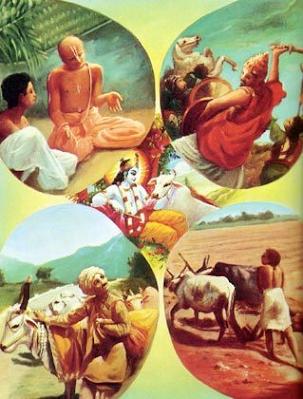
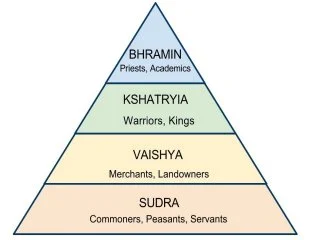
For thousands of years, Hindu society has been divided into four estates (varna), which are incorrectly referred to as castes: 

  1. the priestly or briihmana estate or class;
  2. the warrior or kshatriya class; 
  3. the "common people" or vaishya class (comprising farmers, traders, and artisans); 
  4. and the servile or shudra class. 


This arrangement is believed to have its origins in the heavenly order. 

  •  The primal being or macranthropos is depicted as giving birth to the four estates as follows in the RigVeda's "Hymn of Man" (purusha-sfi.kta) (1 0. 90.  1 2): 
    • The brahmin is His lips; the warrior is made of His arms; the merchant is made of His thighs; and the servant is made of His feet. 
  •  Members of the slave estate were systematically barred from acquiring holy knowledge, and they ultimately became outcasts. 
    •  The feet are metaphorically "filthy," and the shudras' assignment to the Cosmic Man's lower limbs denotes their poor social position.
    • However, since the feet are an essential component of a fully functioning human person, the servile estate is also vital to society's well-being. 
    •  However, the shudras are karmically predestined for menial labor rather than intellectual, leadership, or creative activity, according to Vedic beliefs, since their awareness is of a darker color (varna). 


 It is a common misconception that the word varna ("color") relates to skin color and that the four states are divided by ethnic lines. 


  •  All four estates, however, are part of the Vedic Aryan social body, which, according to the Rig-Veda, valued the hue of the soul above ethnic traits. 
  •  Only the top three estates are regarded "twice-born" (dvija), meaning they have been "born again" via appropriate Vedic initiation. 
  •  Boys and girls from the priestly, military, and agricultural/mercantile estates were customarily married at the ages of eight, eleven, and twelve, respectively. 
  •  They were then given a holy thread (yajna-upavita, spelled yajno­ pavita) to wear permanently over the left shoulder, hanging diagonally across the chest, as part of the investiture (upanayana) ceremony. 


Allowing marriages between members of different estates resulted in the formation of social groupings known as castes (jati). 


  •  As a result, a growing number of subcastes emerged. 
  •  The conduct and actions of members of various castes are tightly regulated by complex rules that control this social order. 
  •  This stratification very certainly resulted in marginalized people being labeled "outcasts" or "untouchables."

Visionaries and reformers have often questioned this enormous social superstructure. 


  • The founder of Buddhism, Gautama, was one of the first to reject it. 
    •  Despite this, it has persisted throughout the ages and has had a strong effect on all other subcontinental cultures. 
  •  Social innovators who opposed the caste system in general had to oppose the Vedic revelation that legitimized it as well. 
  •  The caste system, with its social inequalities, is as natural to the devout Hindu as democracy is to us.
  •  The caste system is justified by citing the law of karma, much as we defend democratic principles by emphasizing the value of the individual. 
    •  Because of previous decisions and acts, each individual has a certain station in life. 
    •  Brahmins are brahmins because of their past lives' moral and spiritual endeavors. 
    •  Outcasts are outcasts for a variety of reasons, including a lack of desire for a better life or serious crimes. 


 Although the caste system offends our modern Western sensibilities, our forefathers formerly had beliefs and ideals that were comparable to those of traditional Hindus. 


  • The old social order, which was clearly hierarchical, was only questioned, contested, and eventually destroyed with the development of a strong individualism during the Renaissance. 
  •  Even our modern so-called egalitarian countries, with a super-wealthy elite at one end and a large number of impoverished people at the other, are not without social stratification. 


The caste system's rigidity has been counterbalanced by a considerable ideological flexibility. 

  •  As a result, Hinduism has shown an incredible ability for absorbing even the most diametrically opposed elements inside itself. 
  •  For example, at one end of the spectrum is Shankara's extreme non­ dualist school, and at the other end is Classical Samkhya's rigorous dualist school, which, despite its atheism, is nevertheless considered one of Hinduism's six main philosophical systems (darshana). 
  •  The "cool" contemplative approach of nondualist Jnana-Yoga of the Upanishads on the one hand, and the passionate emo­ tionalism of certain schools of monotheistic Bhakti­ Yoga on the other, is another example of such radically divergent philosophical views. 
  •  The medieval way of devotionalism (bhakti-marga) is very syncretistic, including aspects from Islamic Sufism, for example. 
    •  The Allah-Upanishad, a late book written under Muslim influence, exemplifies Hinduism's all-inclusive ethos. 
  •  Even a well-defined religious tradition like Christianity fell prey to Hinduism's spongelike absorptive capacity, and had to be saved from Hinduization by Jesuit missionaries in the sixteenth and seventeenth centuries. 

The inclusive nature of Hinduism is often misconstrued as universal tolerance, which is not the case. 


  •  There have been many examples of intolerance between different schools or factions of Hinduism throughout India's history, such as the long-standing conflict between the Vaishnavas and the Shaivas. 
  •  Hinduism is best understood as a complex sociocultural process that has evolved via the dynamics of continuity and discontinuity, or the survival of ancient forms and the incorporation of new cultural and religious manifestations. 
  •  Thus, Hinduism may be considered to have begun with Vedic civilization from one perspective (possibly as early as the fi fth millennium B . C. E. ). 
  •  From another perspective, the Vedic sacred culture and Hinduism as we know it now have genuine and significant contrasts. 
  •  Nonetheless, the general consistency has been remarkable, perhaps more so than the shifts that have occurred through time. 

 Most Western and Indian academics, until recently, emphasized the discontinuity in India's cultural development. 


  •  They perceived a conflict between the Indus Valley civilisation and the Vedic "Aryan" culture, which they believed originated outside of India. 
  •  However, this long-held Aryan invasion hypothesis is currently being actively contested. 
  •  A increasing number of academics in India and the West view this historical model as a scientific fiction that was created without sufficient evidence and has had a negative impact on our knowledge of ancient India's history and culture. 
  •  The book In Search of the Cradle of Civilization documents this significant shift in scholarly thinking. 


All evidence suggests that the Sanskrit-speaking Aryans who wrote the Vedas were not barbaric nomads who arrived from outside India and wreaked havoc on the local people. 

 Rather, the available evidence suggests that they were genuine Indian natives. 


Furthermore, there are compelling grounds to believe that the Vedic civilization, as represented in the Rig-Veda and the other three Vedic Samhitiis, was substantially, if not entirely, similar to the so-called Indus civilization. 


You may also want to read more about Hinduism here.

Be sure to check out my writings on religion here.

You may also want to read more articles on Yoga and Holistic Healing Here.


Remembering Gail Omvedt - American Born Indian Author, Sociologist And Human Rights Activist


Gail Omvedt (2nd of August 1941 – 25th August 2021) was an Indian sociologist and human rights activist who was born in the United States. 


She was a prolific writer who authored many books about India's anti-caste movement, Dalit politics, and women's issues. 


  • Omvedt was active in anti-caste and Dalit movements, as well as environmental, farmers', and women's movements, particularly among rural women. 
  • Cultural Revolt in a Colonial Society: The Non-Brahman Movement in Western India, - was the title of Omvedt's dissertation. 


  • Numerous books and essays on class, caste, and gender problems are among Omvedt's scholarly writings. 
  • She worked as a consultant for FAO, UNDP, and NOVIB, as well as a Dr Ambedkar Chair Professor at NISWASS in Orissa, a professor of sociology at the University of Pune, and an Asian guest professor at Copenhagen's Nordic Institute of Asian Studies. 
  • She was the research director of the Krantivir Trust and a senior fellow at the Nehru Memorial Museum and Library. 


Gail Omvedt was born in Minneapolis and received her bachelor's and master's degrees in sociology from Carleton College and UC Berkeley, respectively. 


  • She has been a citizen of India since 1983. 
  • She and her husband, Bharat Patankar, resided in Kasegaon, Maharashtra, with their mother-in-law, Indumati Patankar, and relatives. 
  • She worked as a consultant sociologist on gender, environment, and rural development for the United Nations Development Programme (UNDP), Oxfam Novib (NOVIB), and other organizations in the years leading up to her death. 
  • She worked as a consultant for UN agencies and NGOs, as well as a Professor of Sociology at the University of Pune, an Asian Guest Professor at the Nordic Institute of Asian Studies in Copenhagen, and a Senior Fellow at the Nehru Memorial Museum and Library in New Delhi. 
  • She worked as a Visiting Professor and Coordinator at the University of Pune's School of Social Justice, as well as a Fellow at the Indian Institute of Advanced Study in Shimla. 
  • Dr. B.R. Ambedkar Chair of Social Change and Development at IGNOU has Gail Omvedt as a previous Chair Professor. 


At the age of 80, Omvedt passed away in August, 2021. She is survived by her husband Dr. Bharat Patankar, daughter Prachi, son in law Tejaswi and grand daughter Nia who are settled in the United States.


  • In India, Omvedt worked with social movements such as the Dalit and anti-caste movements, environmental movements, farmers' movements, and particularly rural women. 
  • Shramik Mukti Dal, Stri Mukti Sangarsh Chalval, which works on problems of abandoned women in the Sangli and Satara regions of southern Maharashtra, and the Shetkari Mahila Aghadi, which focuses on issues of women's land rights and political power, were both active in her community. 


Omvedt was critical of Hinduism's holy texts (or what she referred to as "brahminism") for promoting a caste-based society, according to her. 


  • Omvedt criticized the Hindu practice of venerating the Vedas as sacred, in addition to criticizing their seeming support for the caste system. 
  • She expressed her views on the Rigveda in an open letter to then-BJP President Bangaru Laxman, which was published in The Hindu: The Vedas, particularly the Rg Veda, are magnificent literature. 

  • I can only speak from translations, but I'm happy the prohibition on women and shudras reading them has been lifted, and that excellent translations by women and shudras themselves are now accessible. 

    • But to treat them as though they were holy? Check them out for yourself. 
    • The majority of the songs are aimed at achieving victory in battle, cattle rustling, and love-making, among other things. 

  • They celebrate conquest; hymns about Indra and Vrtra sound suspiciously as if the Aryans were responsible for destroying dams built by the Indus valley people; despite archeologists' claims that there is no evidence of direct destruction by "Aryan invasion," the Rg Veda reveals enmity between the Aryans and those they called dasyus, panis, and the like. 


Despite the prevalence of caste-based discrimination, Omvedt claims that Hindutva organizations promote an ethnic definition of Hinduism based on location, lineage, and history in order to build unity across different castes. 


Omvedt agreed with Dalit activists who said during the World Conference Against Racism that caste discrimination is akin to racism in that disadvantaged groups are seen as "biologically inferior and socially harmful." 


  • She has called the United States a "racist country" and advocated for affirmative action; however, she has compared American affirmative action policies favorably to those of India, saying, "It is a sad commentary on the state of Indian industrialists' social consciousness that such discussions have begun in an organized way in the United States before they have been thought of in India itself." 
  • In terms of perceptions of "group performance" in the United States and India, Omvedt wrote: "Whereas the debate in the United States assumes an overall equal distribution of capacity among social groups, in India the assumption appears to be that the unequal showing of different caste groups on examinations, in education, and so on is a result of actual different capacities." She has backed large-dam projects and GMO crops on occasion.


Omvedt's academic writing includes numerous books and articles on class, caste and gender issues, most notably:


  • Cultural Revolt in a Colonial Society: The NonBrahman Movement in Maharashtra (Scientific Socialist Education Trust, 1966)
  • We Shall Smash This Prison: Indian Women in Struggle (1979)
  • "We Will Smash This Prison!.: Indian Women in Struggle " (Zed, 1980)
  • "Violence Against Women: New Movements And New Theories In India" (Kali for Women, 1991)
  • Reinventing Revolution: New Social Movements in India (M.E. Sharpe, 1993)
  • Gender and Technology: Emerging Asian Visions (1994)
  • Dalits And The Democratic Revolution: Dr. Ambedkar And The Dalit Movement In Colonial India (Sage India, 1994)

  • Dalit Visions: the Anticaste movement and Indian Cultural Identity (Orient Longman, 1995)
  • Growing Up Untouchable: A Dalit Autobiography (Rowman and Littlefield, 2000)
  • Buddhism in India : Challenging Brahmanism and Caste (SageIndia, 2003
  • "Ambedkar: Towards an Enlightened India " (Penguin, 2005)
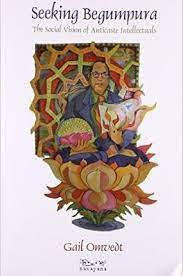
  • Seeking Begumpura: The Social Vision of Anticaste Intellectuals (New Delhi, Navayana, 2009)
  • "Understanding Caste: From Buddha To Ambedkar And Beyond" (New Delhi: Orient Blackswan, 2011)
  • Songs of Tukoba with Bharat Patankar she has published (translations) (Manohar, 2012)
  • Jotirao Phule and the Ideology of Social Revolution in India.


Awards And Recognition:


  • Matoshree Bhimabai Ambedkar Award (2012)
  • BA received Magna Cum Laude, with Distinction in Senior Comprehensive Examinations
  • PhD qualifying examinations passed with Distinction
  • Honorary Woodrow Wilson Fellowship, 1964–65
  • Fulbright Fellowship as Tutor in English in India, June 1963-March 1964
  • University of California Graduate Fellowships, 1964–65, 1965–66
  • American Institute of Indian Studies, Junior Fellowship for PhD research in India on “The NonBrahman Movement in Maharashtra,” January–December 1971
  • American Association of University Women, Fellowship for research on “Women’s Movement in India,” January–December 1975
  • Savitribai Phule Puraskar, Padmashri Kavivarya Narayan Surve Sarvajanik Vacanalay, Nashik, 2002
  • Dr. Ambedkar Chetna Award, Manavwadi Rachna Manch Punjab, August 2003
  • ABP Majha Sanman Purskar, 2012
  • Vitthal Ramji Shinde Award, April 2015


You may also want to read more about Hinduism here.

Be sure to check out my writings on religion here.


Ram Rajya Parishad


 (Ram Rajya Parishad) (Ram Rajya Parishad) (Ram Rajya Parishad) (Ram Rajya Parishad) ( Northern India's first political party was founded in 1947, shortly after India's independence.

Swami Karpatri, a well-known contemporary Hindu ascetic, created it.

The word Ram Rajya has mythological connotations, alluding to the time of virtuous reign by Rama, the protagonist of the epic Ramayana, after his return from a four-teen-year exile in the jungle.

Rama's reign is said to have been characterised by perfect peace, justice, and social harmony.

The Ram Rajya Parishad aimed to restructure India in accordance with the mythological period's ideal, and the party's political agenda was firmly based on conservative Hindu religious beliefs.

The party firmly thought that the caste system, with its historic separation of social rank and work, was necessary for a well-functioning society.

Most low-caste individuals would have been doomed to a life of slavery in this position, but the party did provide them with a few scant opportunities for progress.

One of them was managing shoe manufacturers, since upper castes consider leather to be spiritually unclean, and hence working with leather is a typical low-status employment.

Apart from their views on the caste system's legality, the Ram Rajya Parishad also supported other traditional Hindu issues, such as a complete ban on cow slaughter and the manufacturing and use of liquor.

The Ram Rajya Parishad drew its support mostly from orthodox, upper-class Hindus, notably those living around the Ganges River.

Outsiders have no reason to embrace it because of its conservatism.

Although it enjoyed little electoral success in the years after independence, the party had been reduced to a marginal influence within a dozen years.

Hinduism - What Is Varnashrama Dharma?


What Is Varnashrama Dharma?

In the dharma literature, varnashrama dharma is the ordering of dharma or religious duty based on the hierarchical social ordering of the four major social groups (varnas) and the four successive stages of life (ashramas).


According to this theory, all people would be able to discern their social status and appropriate function based on their social class and stage of life.


The interrelationship between these two sets of categories is often used to denote traditional Hindu society, in theory if not always in fact.


The term survives in modern times, but because the doctrine of the ashramas is now largely ignored, those who uphold varnashrama dharma are primarily defending the hierarchical social divisions commonly known as thecaste system.


What are the four fundamental varnas and what do they do?

The Varna system is a system of social stratification based on caste. 

According to this system, there are four major groups: 

  1. Brahmins (priests, educators, and intellectuals), 
  2. Kshatriyas (warriors, monarchs, and administrators), 
  3. Vaishyas (agriculturalists, merchants, and farmers), 
  4. and Shudras (workers, labourers, artisans).


~Kiran Atma


You may also want to read more about Hinduism here.

Be sure to check out my writings on religion here.


Hinduism - What Is Bijak?


    Bijak means "inventory." 


    The Adigranth and the manuscripts of the religious institution Dadupanth include the other two major collections of poetry attributed to the poet-saint Kabir (mid-15th century?). 


    • Kabir is the most well-known of the sants, a group of poet-saints from central and northern India who share several concepts, including a focus on individualized, interior religion leading to a personal experience of the divine, a dislike for external ritual, particularly image worship, faith in the power of the divine Name, and a tendency to disregard traditional caste distinctions. 
    • In terms of established religious rituals and authority, Kabir is the most iconoclastic of all the sants. 
    • He always stresses the need of personal seeking and fulfillment. 


    What Is The Bijak?


    The Bijak is the scripture of the Kabirpanth, a religious group claiming to be Kabir's followers, which is noteworthy given the nature of Kabir's message. 


    • Certainly, the idea of declaring Kabir the founder of anything, or of his words acquiring the authority of a scripture, would have been rejected by him. 
    • The Bijak includes a variety of poems, including brief epigrams that have become proverbial wisdom, lengthier chaupai stanzas, and shorter two-line poetry (doha). 
    • The Bijak has linguistic characteristics that place it in the eastern portion of the Hindi language area, thus its popular moniker of "eastern" recension. 


    NOTE: Linda Hess and Shukdev Singh (trans. ), The Bijak of Kabir, 1983, contains translations of the text itself.


    Kabir Bijak Pdf 


    Kabir Bijak Pdf - In English


    Kabir Bijak Pdf - In Hindi

    Frequently Asked Questions:


    What is Bijak according to Kabir?

    A document containing holy writings is referred to as a bijak. It is also one of the oldest important writings in contemporary Hindi. According to Kabir, the True God is with the individual who is following the path of justice, views every living thing as his own self, and maintains a passive detachment from worldly matters.


    How many parts are there in Bijak?

    All renditions of the Bijak include a fourth portion that contains other folk song types in addition to the three major sections known as Ramaini, Sabda, and Sakhi.


    What are the followers of Kabir called? Name the three main sections of the Bijak?

    The Bijak is divided into four sections: Ramain, Shabda, Skh, and another segment with other folk music.


    What is Bijak?

    The sacred text for adherents of the Kabirpanthi faith, Bijak is the most well-known of the Kabir's collections. There are also other folk tunes in it. One of the first important texts in contemporary Bagheli is the Bijak.


    Kabir worships which God?

    He adored the Nirguna form of God, whom he refers to by several names, including Rama, Allah, Hari, Sain, and Sahib. Thus, Kabir is the subject of all the claims.


    What is Bijak in history?

    The word "Bijak" refers to a book that contains religious passages. Kabir Das was an Indian mystic poet and saint who lived in the 15th century. His poetry may be found in the Sikhism holy book Guru Granth Sahib and his works had an impact on the Bhakti movement in Hinduism.


    What does the Bijak mention as two main teachings of Kabir?

    (1) He stressed the word "Bhakti." (2) According to him, only true love and devotion to God, which he termed Bhakti, could free a person from the cycle of life and death and bring them closer to God.


    What were the major four teachings of Saint Kabir?

    rejection of the great religions. criticism of all manifestations of Brahmanical Hinduism and Islam's exterior worship. criticism of the caste system and the priesthood classes. belief in a supreme being without form.


    What was Kabir's followers known as?

    Its Kabir panthis, or members, number in in the neighborhood of 9.6 million. Up from 843,171 in the 1901 census, they are distributed across north and central India as well as abroad with the Indian diaspora.


    What is Bijak? how it is divided?

    Bijak: A bijak is a collection of Kabir's poetry. It is divided into three major portions, Sakhi, Ramaini, and Shabda.


    Who wrote the Bijak?

    For the Kabir Panthis, the holy text known as Bijak was written by Kabir Das. Dohas and poetry of Kabir made up the majority of bijak.


    What is the meaning of ultimate reality concept of Kabir?

    By using a variety of traditions, including those from Islam, Kabir portrayed the "Ultimate Reality," depicting it as Allah, Khuda, Hazrat, and Pir. The names Alakh, Nirakar, Brahmana, and Atman were all adopted from the Vedantic traditions. outline of a heart


    What is God according to Sant Kabir?

    According to Sant Kabir, the genuine God is with the one who is on the road of righteousness, loves all living things as his own, and is uninvolved in the events of this world.


    What was the theme of Kabir's illusion and reality?

    A typical human is caught in the struggle between illusion and reality. The One Inexpressible God, the One and Only Truth, is manifestly incomprehensible. In this stanza, Kabir asserts that the only way to break free from the traps of illusion is to become conscious and govern one's affairs with awareness.


    Where is Kabir buried?

    In January 1518, which is known as Magh Shukl Ekadashi in Hindu tradition, the enlightened teacher Kabir departed his body in Maghar. This was followed by Vikram Samvat 1575. He was equally adored by Muslims and Hindus, and after his passing, each religion constructed a mazaar (tomb) and a samadhi in his honor.


    Why was Kabir abandoned?

    His mother was said to have been a Brahman who became pregnant after visiting a Hindu temple, according to one version. She left Kabir behind since she wasn't married, and a Muslim weaver later discovered and adopted him.


    What was Kabir's poetry influenced by?

    Though he was critical of certain parts of both religions, Kabir's poetry incorporates elements of both Islam and Hinduism. The Adi Granth, a collection of Sikh texts, contains some of his poems. His mystical poetry are rooted on the specifics and worldly elements of daily existence.


    Why Kabir Doha is famous?

    Songs known as padas, rhymed couplets known as dohas, words of wisdom known as shabd, and "witnesses" known as sakhis are among Kabir's works. Kabir did not adhere to the practices of idol worship or the caste system. His lyrics are straightforward and easy to grasp, and his ideology is founded on total devotion to one God.


    What is the contribution of Kabir to Bhakti movement?

    Kabir Das made an effort to harmonize the many faiths by presenting a universal path that all people might follow. He asserts that there is a connection between the two spiritual laws and every life (Jivatma and Paramatma).


    References And Further Reading:


    1. Grierson, George A. Review of The BÄ«jak of KabÄ«r, by Ahmad Shah. The Journal of the Royal Asiatic Society of Great Britain and Ireland, 1918, 151–60. http://www.jstor.org/stable/25209368.
    2. Meena, Pooran Lal. “THE ANCIENT REMAINS ON THE BIJAK-KIPAHADI ‘THE GREAT CENTRE OF BUDDHISM.’” Proceedings of the Indian History Congress 77 (2016): 928–32. https://www.jstor.org/stable/26552725.
    3. Gold, Daniel. History of Religions 43, no. 1 (2003): 80–81. https://doi.org/10.1086/381332.
    4. VAUDEVILLE, CHARLOTTE. “KABĪR’S LANGUAGE AND LANGUAGES, HINDUĪ AS THE LANGUAGE OF NON-CONFORMITY.” Indo-Iranian Journal 33, no. 4 (1990): 259–66. http://www.jstor.org/stable/24655578.
    5. Ranjan, Purnendu. “HISTORICAL EVIDENCE FOR THE STUDY OF KABIRPANTH.” Proceedings of the Indian History Congress 68 (2007): 1041–47. http://www.jstor.org/stable/44147909.
    6. Singh, R.P. “Kabir: The Articulator Par Excellence of Indigenous Indian Modernity.” Social Scientist 47, no. 5/6 (2019): 71–78. https://www.jstor.org/stable/26786189.
    7. Kalyani, Kalyani. “Tathagata Buddha Songs: Buddhism as Religion and Cultural-Resistance Among Dalit Women Singers of Uttar Pradesh.” CASTE: A Global Journal on Social Exclusion 1, no. 2 (2020): 51–62. https://www.jstor.org/stable/48643564.
    8. Cort, John. Review of WILL THE REAL KABIR PLEASE STAND UP?, by LINDA HESS and SUKHDEV SINGH. Journal of South Asian Literature 20, no. 1 (1985): 249–50. http://www.jstor.org/stable/40872765.
    9. Hess, Linda, and Sukhdev Singh. The Bijak of Kabir. Motilal Banarsidass, 2015.
    10. The Bijak of Kabir. Oxford University Press, USA, 2002.
    11. Lorenzen, David N. Kabir legends and Ananta-das's Kabir Parachai. SUNY Press, 1991.
    12. The Bijak of Kabir. A. Shah, 1917.
    13. Lorenzen, David N. "Traditions of non-caste Hinduism: the Kabir Panth." Contributions to Indian Sociology 21, no. 2 (1987): 263-283.
    14. Grierson, George A. "The BÄ«jak of KabÄ«r-The Bijak of Kabir. Edited by the RevAhmad Shah. Cawnpore, 1911.-The Bijak of Kabir. Translated into English by the RevAhmad Shah, according to his edited Hindi text published in 1911. Hamirpur, 1917." Journal of the Royal Asiatic Society 50, no. 1 (1918): 151-160.
    15. Lorenzen, David N. "Dissent in Kabir and the Kabir Panth." Devotion and Dissent in Indian History (2014): 169-187.

    You may also want to read more about Hinduism here.

    Be sure to check out my writings on religion here.