Showing posts sorted by relevance for query devotional. Sort by date Show all posts

Madhurya Bhava


    What Does Madhurya Bhava Mean?

    Hindu Pantheon Series by Kiran Atma


    From the serene (shanta) experience that comes from realizing one's total identification with Brahman or Ultimate Reality, to conceiving of God as one's master, friend, child, or lover, the five modes indicated increasing emotional intensity.

    The Madhurya Bhava is the last and most intensive of the five devotional forms.


    Rupa Goswami - An Example Of Madhurya Bhava.

    ("Honeyed") Rupa Goswami, a devotee (bhakta) of the deity Krishna and a disciple of the Bengali saint Chaitanya, defined the second of five ways of devotion to God.

    To depict the link between devotee and divine, Rupa exploited human ties.


    What Form Of Devotion Does Madhurya Bhava Exhibit?

    Devotees in this style see their connection with the divine as that of a lover and a beloved.

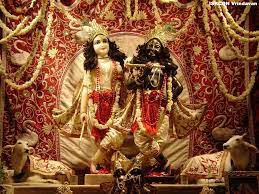
    This method was especially dominant when it came to the deity Krishna (whose model worshippers were the Braj cowherd women) and Radha(who is a symbol for the human soul.) 

    Because of its emotional proximity, this style is regarded as the most intense and demanding.

    It is also regarded as the sweetest for the same reason.

    Must Bhakti always have Bhavas?


    When a devotee or Bhakta develops in devotion, he or she loses all sense of self. This is known as Bhava

    The devotee and the Lord develop a real connection via Bhava

    The devotee then develops Maha-Bhava, in which he lives, moves, and has his existence in the Lord. 

    Parama-Prema, or Supreme Love, is the completion of love.


    What Are The 5 Different Types Of Bhavas In Bhakti? 

    Shanta, Dasya, Sakhya, Vatsalya, and Madhurya Bhavas are their names. 

    Because these Bhavas, or sentiments, are natural to humans, they are simple to cultivate. 

    Choose the Bhava that best matches your personality.


    What Is Shanta Bhava?


    The devotee in Shanta Bhava is Shanta, or tranquil. 

    He does not dance or leap. 

    He is not a particularly emotional person. 

    His heart is overflowing with joy and love. 

    Shanta Bhakta was Bhishma.


    What Is Dasya Bhava?


    Sri Hanuman belonged to the Dasya Bhakta sect. 

    He had a servant's mindset, Dasya Bhava. 

    He dedicated his life to Lord Rama

    In every manner conceivable, he satisfied his Master. 

    In the service of his Master, he discovered pleasure and ecstasy.


    What Is Sakhya Bhava?


    God is the devotee's companion in Sakhya Bhava. 

    This Bhava was directed against Lord Krishna by Arjuna

    On an equal footing with the Lord, the devotee progresses. 

    As close friends, Arjuna and Krishna liked to sit, dine, converse, and stroll together.


    What Is Vatsalya Bhava?


    The devotee in Vatsalya Bhava regards God as his child. 

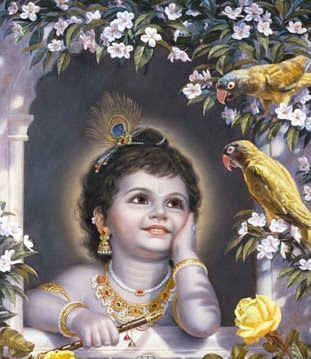
    Lord Krishna had this Bhava with Yashoda

    Because God is your pet kid, there is no fear in this Bhava. 

    As a mother would with her child, the devotee serves, feeds, and looks upon God.


    What Is Kanta Bhava?


    Madhurya Bhava or Kanta Bhava is the final. 

    This is the most advanced type of Bhakti. 


    The believer considers the Lord to be his lover. 

    This was Radha and Krishna's relationship. 

    Atma-Samarpana or a complete surrender of the soul manifests in this love . 

    The beloved and the lover merge into one. 

    The devotee and God are one with each other, yet they must preserve their separation in order to experience the happiness of their love play. 

    This is oneness in separation and oneness in separation. 

    This Bhava was shared by Lord Gauranga, Jayadeva, Mira, and Andal.


    A word of caution: Madhurya Bhava is not to be confused with worldly conjugality. 


    One must not be confused with the other. Earthly conjugality is totally selfish and pursued only for the pleasure of one's own self. 


    However, devotion to God is motivated by God's pleasure rather than the devotee's. 

    Divine love isn't self-centered. 

    Sattva gives birth to it. 

    Earthly desire, on the other hand, is the result of rajas and attachment to bodies. 

    Earthly conjugality is the result of egoistic self-regarding egoistic emotion, but heavenly communion is the result of non-egoistic feeling. 

    Strong egoism is the source of worldly desire, whereas heavenly love is the result of egoism's loss. 


    What Is The Difference Between Kama And Prema?


    This is the most significant distinction between desire (kama) and heavenly love (prema). 


    The two are linked in the same way that light and darkness are linked. 

    No growth of worldly attachment, no matter how flawless, can lead to the ultimate bliss of divine connection. 

    Due to the fire that burns at the root of everything, lust lurks in the heart. 

    The worldly man, no matter how pious, is unaware of divine love. 

    So long as man is simply a man and woman is merely a woman, the secret of divine love cannot be grasped, and should not be attempted to be understood. 

    True love for God begins with the austere transformation of the human into the divine.


    The Bhaktas indulge the notion of the lover and the adored in Madhurya Bhava. 

    He sees himself as Rama's or Krishna's wife. 

    This mentality is also shared by Mohammedan sufis

    A huge number of Bhaktas with Madhurya Bhava can be found in Brindavan, Mathura, and Nadiad. 

    They dress in ladylike attire and act and converse in a ladylike manner. 

    They dance a lot till they obtain Murchha Avastha (swoon) and collapse exhausted.


    The most intense type of religious love is madhurya bhava. 


    It is the genuine love for Krishna that the gopis have in their hearts.

    There can be no gender discrimination in the pursuit of this most pure kind of bhakti. 

    Krishna is the sensation (bhava) that develops from the jivatma or soul's relationship with the paramatma (universal soul). 


    The soul has neither masculine nor female characteristics.


    Many famous saints have exhibited their profound madhurya bhava for Krishna, including Chaitanya Mahaprabhu, Narasimh Mehta, and Ramakrishna

    It came easily to them, with little effort on their part.

    The ultimate purpose of the devotional path is to develop pure love for Krishna, and what better method to do this than via madhurya bhava? 

    Why should spirits encased in bodies (male or female) be denied pleasure?


    IN THE VRINDAVAN, MADHURYA BHAVA: 'Pancha vidha bhava' signifies assuming all five forms of Bhakti. 


    The Srimad Bhagavatam and the Narada Bhakti Sutra both tell about them. 


    To describe the nectars of bhakti, these five forms were developed. 

    'Bhava' means increasing in self-forgetfulness and devotion. 

    It is a genuine bond between the worshipper and the devotee. 

    Maha Bhava is when a devotee lives, moves, and exists in the Lord. 

    The completion of love, or Supreme Love, is known as Parama Prema. 


    MADHURYA BHAVA: The Lord is portrayed as a lover in this bhava. 


    In metaphysics, there is a distinction between form and content. 


    To comprehend the veracity of this philosophical theory, one must first grasp the core of the notion. 


    It is the greatest type of bhava, also known as Kanta Bhava. 


    It is the Atma Samarpana, or union of the atmas, in which the lover and the Beloved are One. 

    Their separation is for the purpose of enjoying the divine drama of love and bliss, in which the Lord manifests himself as pleasurable power. 


    This bhava, which is a manifestation of sattwa guna, should not be confused with physical desire, selfishness, or raja guna.


    By embracing this bhava, many saints from the jnana path adopted the bhakti path. 


    This bhava was shown by Radha and Mira

    In the south, Lord Gauranga, Jayadeva, and Andal of the Alvars all did. 

    Mira and Andal's poetry depicts the tradition of madhurya bhava devotion. 

    Mira and Andal's lyric symbolism is a summation of their passionate imaginations' sophisticated sexuality. 

    Was their bhava, however, any different from the devotional culture of mystics poet saints Manickavasagar, Ramalinga Swamigal, and the bhakti par excellence Sri Ramakrishna Paramahamsa, who lovingly caressed Ma Kali's bosom? Without perceiving any form, these celestial individuals attained pure joy. 

    In the divine thoughts, the shape did not exist. 

    They never used their minds to speak with God, instead used their emotions.


    VRINDAVAN: 


    Divine madhurya bhava is the result of full submission and the loss of ego. 

    The distinction between kama-lust and prema heavenly love is highlighted in this bhava. 

    Only the heart understands the mystery of heavenly love. 

    In reality, just as Radha's authenticity remains a mystery, it should not be attempted to be grasped. 

    All of this is sensed and recognized in the pure and magnificent heart.


    Madhurya bhava is the Rasa lila in Vrindavan. 


    It is a celestial love dance between the Lord and the gopis. 

    The Lord's flute elicits a response from them. 

    The Bhagavata Purana mentions their sudha-bhakti, or pure loving devotion. 

    The madhurya lila contains the highest prema in the Krishna lila. 

    Radharani, whose core is Mahabhava, the whole dispersion of Krishna prema, is the ultimate manifestation of Madhurya prema. 

    While it is believed that Lord Krishna's rasa lila is the secret of all mysteries, Madhurya bhava, which is the feeling of the lover and the beloved, is the pinnacle of Bhakti.


    There is no sensuality, no hint of carnality between Krishna and Radha. 


    This bhava is beyond the comprehension of ordinary brains. 

    The essence of Jayadeva's Gita Govinda is also this. 

    He claims that the gopis are the channel through which He may exhibit the endless diversity of His happiness aspect. 

    Radha, the embodiment of divine love, represents the ego's surrender in exchange for connection with the Purusha of the Heart. 

    She didn't even need the Lord's flute indication at one point.... 

    She had transformed into His flute and song. 

    They'd evolved into ananda-chinmaya-rasa: happiness and awareness' sweetness.


    Devotional rituals are used to feel closer to one's god or God. 


    If one considers God as a personal relative rather than the all-powerful, all-knowing God, one's relationship with God will only grow. 

    As a result, devotee saints advise practicing devotion in the feelings of a friend, parent, lover, and so on. 


    The bhava or feelings arise when one's devotion to God grows, or one might practice them according to his eligibility and preferences:


    Although devotional service is one, it manifests itself in eleven forms of attachment: attachment to the Lord's glorious qualities, beauty, worship, remembering Him, serving Him, reciprocating with Him as a friend, caring for Him as a parent, dealing with Him as a lover, surrendering one's whole self to Him, being absorbed in thought of Him, and experiencing separation from Him. 

    This is the most important attachment.


    When a person falls in love, he or she is always thinking about their lover. 


    A devotee who has fallen in love with God will always remember him. 

    As a result, of all sorts of devotion, madhurya bhava or kanta bhava (a lover's emotion) is believed to be the finest. 

    Because it allows a person to feel more connected to God. 

    And the Bible teaches that if one turns his affections towards God, regardless of desire, love, rage, or anything else, he will find Him:


    Those who aim their passion, rage, fear, protective love, sense of oneness, and friendship toward Lord Hari will undoubtedly get captivated in Him. [10.29 SB] .15]


    Unlike love between two people, where taints of selfish desire may remain, love for God is pure and crystal like the Sun's beams in devotional rituals. 


    There is no personal want left, simply a wish to see the Lord happy. 

    Madhurya bhava is the highest level of devotion, and only a few people, out of many, practice it effectively. 

    And for a select few, God is everything; from mother, father, friend, wisdom, and money, to all other gods (twameva mata cha pita twameva....mama deva deva).


    Let us now consider Bhava, as a Devotional Feeling in Mythology and Scriptures. 


    What is the best way to love or worship Radha Krishna? 

    As the all-powerful God? 


    On the battlefield before the Mahabharat War, Arjuna listened to Shri Krishna's lessons from the Gita. 


    Shri Krishna often alluded to Himself as the ultimate almighty God, saying, "There is nothing beyond Me." Everything started with Me. 


    Everyone's heart contains me." Arjuna, on the other hand, saw Shri Krishna as a buddy. 

    "You keep claiming to be almighty God," he remarked. 

    What makes me believe this? This might be said by anybody. 

    Show me how God works!"

    "How will you view this?" Shri Krishna said. 

    Your eyes are material, mayic. 

    They are formed of the same components as the rest of the planet. 

    Your body and senses are formed of material components, and they will revert to material elements once you die. 

    However, I am divine. 

    "Material components do not make up my body."


    The Padma Purana argues that all living creatures, even heavenly gods and goddesses, have a distinct body and soul. 


    God's body and soul, on the other hand, are one. 

    "How would you perceive My heavenly form with your material eyes?" Shri Krishna questioned Arjuna. 

    Material eyes can only view the world's material items if the user has adequate vision and enough light. 

    These two requirements must be fulfilled. 

    Even with magnification, humans can only see a certain distance, and microscopic things like atoms are undetectable to us.


    So, what emotion should we have when we adore God? God in His tremendous appearance terrifies even the heavenly gods and goddesses. 


    "We must offer praises to Him," all the heavenly gods and goddesses murmured when Narsingh Bhagwan came on this world to slay Hiranyakashipu. 

    He came into our planet to slay such a terrifying beast. 

    But He's taking on such a terrifying and enraged appearance! "Who'll be the first to go?"

    "Brahma, you are His son," they said. 

    "You're free." "Not now," Brahma replied. 

    "Shiva, you have the ability to cast this planet to ashes," they continued. 

    Please leave." "No, I won't depart right now," Lord Shiva said. 

    "Send for Prahlad and let him go first," they finally agreed. 

    After all, God showed up on his behalf. 

    He'll calm down when he meets Prahlad

    We'll all go to Him then." Lord Narsingh or Nara Simha began to smile when he met Prahlad. 

    He sat Prahlad on His lap and caressed and stroked him gently, as parents do with their children. 


    The heavenly gods and goddesses, as well as Brahma, Vishnu, and Shiva, then sang praise hymns.


    "First, I will bestow divine vision on you, and then you will see God," Shri Krishna told Arjuna. 

    Arjuna was given heavenly eyes so that he may glimpse His awesome appearance. 

    However, Arjuna began to shake with terror. 

    He closed his eyes. 

    He began to perspire. 

    "I don't want to see!" he replied, stuttered. 

    You really are the all-powerful God! I had no clue till today. 

    I've always considered you a buddy. 

    Please pardon me!"

    So you won't be able to love God if you adore His omnipotent form. 

    Instead, you will be terrified. 

    "My children, don't think of Me as a super omnipotent power," God says. 

    Connect to Me in the same manner that you relate to others."


    Dasya bhava, or a servant's love for his master, is the first sort of relationship experience with God. 


    Because a master is kind, not furious, our devotional sentiments may now grow. 

    We see servants in households all around the globe. 

    A personal assistant is assigned to a prime minister or president. 

    However, a servant's right to acquaintance with his master is severely limited. 

    According to the RamayanaSir bal chalau dharma as mora, sevak dharma kathora


    When Ram, Lakshman, and Sita left Ayodhya to visit the forest, Lakshman would walk behind Ram and Sita so as not to tread in their footsteps. 

    What a challenging task! Instead, a real servant merely puts his head where his Guru puts his feet. 

    Does this imply that we must walk on our heads? What gives that this is possible? This means that the position of a servant is quite challenging. 

    There are several propriety requirements that must be followed.


    Beyond this comes sakhya bhava, the friend-to-friend relationship emotion. 

    What is a friend's role? "Hey, where did you go today?" he says casually as he wraps his arm over his friend's shoulders. 

    However, a friend's rights are likewise limited.


    Beyond that, there's vatsalya bhava, or the bond between a parent and a kid. 

    God is adored like a kid in this bhava. 

    You may smack Him, twist His ear, and chastise Him for his misbehavior. 

    "Son, please bring my slippers..." you may say. 

    He'll have to deliver them! He's grown into your son. 

    Even yet, there are certain limitations to this sensation of love.


    Madhurya bhava lies beyond this. 

    This is a lover's and beloved's relationship sensation. 

    This is not the same thing as a husband and wife's love. 

    A lover's and beloved's sentiments go much beyond this. 

    Although a woman's spouse is at home, she secretly loves someone else. 

    Jar prem is the kind of love that the Braj Gopis had for Krishna.


    Madhurya bhava love is unselfish. 

    This is what makes it special. 

    Selflessness entails having no personal interest in one's own happiness. 

    Another distinguishing feature of this bhava is that one might conceive of God as one's lover, child, friend, or master. 

    Those who love God with any of the lesser forms of relationship affections, on the other hand, may not consider Him with the closeness of madhurya bhava. 

    This is not their right. 

    A devotee who regards God as his master is incapable of loving Him even as a friend, much less as a cherished. 

    "What is this foolishness!" his master would chastise any servant who placed his arm over his master's shoulders. 

    "Keep your distance!" This kind of intimacy is not appropriate for a servant.


    The most intimate feelings are those of a lover and beloved. 

    The adored must comply with everything the lover requests. 

    A wife, on the other hand, cannot address her husband in this manner. 

    She must follow the standards of propriety that apply to her responsibilities as a wife. 

    This kind of connection is subject to a number of societal regulations. 

    "Son, come here," a lady cannot say to her husband. 

    "She called me'son?!" her spouse would exclaim. 

    He could then decide to take her to the hospital for treatment.


    However, in madhurya bhava, God grants us the right to love him with all of these relational feelings. 

    We may love and connect to Him as a Beloved, a Son, a Friend, and a Master.


    ~Kiran Atma


    You may also want to read more about Hinduism here.

    Be sure to check out my writings on religion here.


    Hinduism - What Is Varkari?


    Devotees (bhakta) of the deity Vishnu, manifested as Vithoba, form a religious group.

    Varkari devotion has concentrated on Vithoba's temple in Pandharpur, Maharashtra's southernmost district.

    Jnaneshvar, Namdev, Eknath, Tukaram, Chokamela, Gora, Janabai, Bahina Bai, and many others are among the extraordinary devotional (bhakti) poet-saints who lived from the twelfth to the seventeenth century.

    The pilgrimage to Pandharpur was one of the ways these saints expressed their devotion, and it is still the most important ritual act in the Varkari community.

    Varkaris visit Pandharpur twice a year, and they plan their journeys so that everyone arrives on the same day—the eleventh day (ekadashi) in the bright half of Ashadh (June–July) in the summer and the eleventh day in the brilliant half of Kartik (October–November) in the autumn.

    Individual pilgrims travel in small groups known as dindis, which are often made up of individuals from the same area or region.

    The dindis are grouped into palkhis, each of which is identified with one of the Varkari poet-saints and headed by a palanquin (palkhi, an enclosed single person litter carried on the shoulders of bearers by means of poles) carrying the saint's sandals.

    Each palkhi travels from a location linked with its own saint—for example, the palkhi of Jnaneshvar departs from the town of Alandi, where he lived—and so he and all the other saints continue to go to Pandharpur twice a year in symbolism.

    Pilgrims recite devotional songs composed by these poet-saints on their trek.

    The pilgrims are so imitating the saints before them, both physically and spiritually, by following in their footsteps and chanting their devotional melodies.

    Although the pilgrimage ends with the admission into Pandharpur and the adoration of Vithoba, the trip itself is the most significant element.

    G. A. Deleury, The Cult of Vithoba, 1960; I. B. Karve, "On the Road," Journal of Asian Studies, Vol. 22, No. 1, 1962; and Digambar Balkrishna Mokashi, Palkhi, 1987 for further details.


    ~Kiran Atma


    You may also want to read more about Hinduism here.

    Be sure to check out my writings on religion here.


    Hinduism - What Is Bhajan?


    Bhajan is a Sanskrit word that means "sharing." 


    A religious or devotional hymn is nearly typically sung in a vernacular language under this term. 


    • Bhajans have no defined forms as expressions of personal devotion, although they are often adapted to the melodies of cinema songs in modern times. 
    • Bhajans can have any or all of the following themes as a genre: detailing the deeds of a particular deity, praising the deity, addressing the god in a tone of complaint or humble supplication (vinaya), reminding the deity of the speaker's internal or external sources of difficulties, or warning the listeners to examine and reform their lives. 


    In the bhakti (devotional) movement, singing and listening to such songs was and still is a significant form of religious practice. 


    • Devotees (bhakta) "exchange" their songs and experiences with one another during these sessions. 
    • Although there are bhajans devoted to all of the gods in the pantheon, this singing tradition has been greatest among Vishnu worshippers historically. 
    • Because the company of his followers is considered to be paradise on earth, Vaishnava devotional literature is replete with stories of Vishnu appearing in disguise to participate in bhajan sessions.


    You may also want to read more about Hinduism here.

    Be sure to check out my writings on religion here.


    Hinduism - What Is Bhaktavijaya?


    (“Triumph of [God's] Devotees”) Bhaktavijaya. 


    Mahipati, an eighteenth-century writer and hagiographer of devotional (bhakti) poet-saints, penned the text. 


    • The saints associated with the Varkari Panth, a religious organization focused on the worship of the deity Vithoba at his temple in Pandharpur, are the subject of the Bhaktavijaya's tales. 
    • Because Mahipati was a Varkari himself, this emphasis is natural. 
    • He also incorporated stories of other famous devotees (bhakta), most notably Kabir, Namdev, Jnaneshvar, and Narsi Mehta, in line with the devotional movement's tendency toward unity. 


    The Bhaktavijaya's tales portray each of these saints as a model of devotion, emphasizing the ability of piety to transcend any difficulties. 


    • The Bhaktililamrta, Mahipati's other significant work, is likewise based on this subject. 


    Justin E. Abbott and Narhar R. Godbole translated the Bhaktavijaya as Stories of Indian Saints in 1988.


    You may also want to read more about Hinduism here.

    Be sure to check out my writings on religion here.


    Hinduism - Who Was Lal, And Lalleshvari? What Is The Lallavakyani?


    Lal, is another name for Lalleshvari(14th c.), a devotional (bhakti) poet-saint who is one of Kashmir's most prominent poets.

    "Lalla's Sayings" is Lallavakyani. Lalleshvari, a Shiva devotee (bhakta), is credited with this corpus of poetry.

    The poems in this book hint to her early life's harsh conditions, as well as the domestic issues that drove her to leave her husband's house.

    They also speak of her all-encompassing devotion to Shiva, whom she considers to be the sole genuine source of bliss.


    Lalleshvari was a bhakta (devotee) of Shiva, and her songs are about her devotion to him.

    She, like many other female religious exemplars, struggled to reconcile her marriage with her devotion to her chosen god.

    Her mother-in-law, according to legend, abused her horribly.

    Her husband was characterized as a cold guy who did not protest to the beating or console his wife.

    She left home after around twelve years of hardship to roam as a religious seeker.

    Lalleshvari walked naked to symbolize her rejection of all attachments and worldly ideals, especially feminine modesty.

    She created and sung Shiva devotional songs throughout her wanderings, which are still famous today.


    These poems have been translated into English, although all of the editions are fairly old: see Sir George Grierson and Lionel D. Barnett, Lalla Vakyani, 1920; and R. C. Temple, Lalla, the Prophetess, 1924.


    You may also want to read more about Hinduism here.

    Be sure to check out my writings on religion here.


    Sahajiya


    Sahajiya  is a Bengali religious sect that dates back to medieval times.

    The Sahajiyas combine devotional rites to the deity Vishnu with ritual practices from the secret tantric tradition, particularly the severe acts connected with tantra's "left-hand" (vamachara) lineage.

    The term sahajiya derives from the Sanskrit word sahaja, which means "natural" or "spontaneous," signifying the group's conviction that one's innate emotions, qualities, and inclinations should not be suppressed but rather directed to assist one achieve ultimate soul freedom (moksha).

    The devotion to the deity Krishna and his wife Radha was added to this foundation of tantric ritual practice, a devotional impetus heavily inspired by the Gaudiya Vaishnava religious sect, established by the Bengali saint Chaitanya.

    Obscure Religious Cults, by Shashibhushan B. Dasgupta, was published in 1962, and The Place of the Hidden Moon, by Edward C. Dimock Jr., was published in 1989.

    Sakhi


     ("companion," "friend") The followers (bhakta) of the deity Krishna, and to a lesser degree, devotees of the god Rama, created the concept of friendship as a religious ideal.

    Both of these gods are avatars (incarnations) of Vishnu, and Vaishnava devotion emphasizes not just the worship of the chosen deity, but also the concepts of connection and community—both between the deity and the devotee and among devotees themselves.

    Extensive visualization exercises were common in Vaishnava devotional practice, in which followers imagined the deity's everyday activities—for Krishna, the modest life of a rural cowherd, and for Rama, the life of a prince.

    To aid this visualizing process, some devotional guides include comprehensive daily timetables of the deity's activities.

    Devotees were able to symbolically join the deity's universe and participate in the deity's divine play (lila) on earth, allowing them to create a connection with God by sharing the ordinary elements of daily life.

    Devotees often saw themselves as the deity's sakhis or friends—in some instances, male companions, and in others, female companions of the deity's consorts, Radha and Sita—in this kind of vision.

    Taking on the identity of a sakhi gave a devotee a tangible presence in the heavenly realm, allowing him or her to both see and participate in the god's earthly activities.

    Other Meditation Techniques


    Meditation is a method in the sense of a consciously chosen and systematic practice including continuous (i.e., repetitive or long-term) action intended at generating specific results, at least in part, via universal processes. 


    Whether the use of attention is defined by a limited concentrative focus or an expansive and inclusive awareness, it is attention­ based. 


    • Its anticipated consequences include long-­term and basic interior change impacting many areas of a person's life, including perceptual, emotional, intellectual, and behavioral patterns, as well as a movement toward more fundamental components of existence. 
    • In addition, a number of additional qualities are often associated with meditation but do not appear in our description. 
    • We've seen that the popular notion of meditation includes closed eyelids and a sitting position. 


    In terms of effects, we've seen how meditation is often linked with short­term changes in state, including arousal reduction, mental absorption, mental clarity, and a feeling of touch with basic elements of reality. 


    • Although none of these qualities are mentioned in our description, they are nevertheless considered to be indicative of meditation. 
    • Meditation, when defined in this way, may be differentiated from a variety of other kinds of practice with which it has certain characteristics. 
    • The borderlines, on the other hand, are often gradient rather than absolute, and there is a lot of space for overlap. 

    The following is just a basic outline of some of these differences. 


    • Meditation and pure relaxation methods are often lumped together in scientific discourse. 
    • Only meditation, in our language, has long-­term transformational goals beyond the health and well­being that come with simple relaxation.
    • Methods like progressive muscle relaxation and autogenic training, with a few exceptions, are not promoted as transformational techniques. 
    • In general, contemporary relaxation methods that concentrate only on brief rest and enjoyment are excluded from our definition of meditation. 
    • Medicine and meditation are etymologically linked, thus they may overlap. 


    Meditation is often practiced for better health in both contemporary and traditional settings, and inner techniques may be complemented with medical plants, pills, and concoctions.


    • Meditation was formerly thought to have the ability to drive away demons that might otherwise cause sickness in early China. 
    • However, the overlap between meditation and medicine in early China was far from total, and the two were regarded as distinct professions. 
    • Only when health­ oriented methods are also utilized for long­term inner change are they considered meditation in our language. 
    • Prayer, like meditation, is a consciously performed activity that often follows more or less well-defined protocols. 
    • It is often intended to produce specific results, such as the forgiveness of sins, but it may also be driven by a feeling of duty rather than the expectation of future benefits. 

    One of the most important differences between meditation and prayer is the constant action required in the former. 


    • Prayer involves considerably more complicated behaviors, and it often involves sequences of acts or utterances rather than a single continuous activity; it is sequential rather than continuous. 
    • Meditation, unlike prayer, is a technical technique of self­transformation rather than a communication way of expressing devotion, supplication, submission, or thanks to a supernatural entity in the archetypal instance. 

    In reality, there is a lot of overlap, such as when an Orthodox Christian does the Jesus Prayer, which is a brief, formulaic, and very devotional prayer that is repeated again and over, sometimes with the use of breathing exercises. 


    • Sufism's dhikr, Hinduism's japa, and Buddhism's nianfo (Chinese) or nenbutsu (Japanese) are all related activities. 
    • Devotional visualization techniques need similar concerns. 


    Many kinds of meditation, like prayer, seek to make touch with basic elements of reality, which are often described in anthropomorphic terms as divine creatures with their own sense of action. 


    • Prayer approaches meditation when it becomes wordless, as in certain types of Christian mysticism. 
    • Although the word "mysticism" is broad and complex, it usually refers to personal experiences and states rather than technical problems. 
    • Although meditation as a self­-transformative practice may be associated with a mystical perspective, it is not always the case. 
    • Meditation varies from ritual in that it is usually more focused on the person rather than the group, and it involves continuous or repeated activity rather than the stepwise or sequential processes of ritual. 
    • Meditation, on the other hand, may be done in a group environment and ritual in an individual one. In a number of rituals, repetition is also an important component. 
    • Meditation is often accompanied by ritual, and rituals include contemplative elements, thus the line between the two is hazy. 


    Shamanism and spirit mediumship include entering a different state of consciousness and communicating with gods or spirits not for the shaman or medium's own benefit, but for the benefit of another individual or a community. 


    While this is not the same as the self­-transformational goal of meditation, many traditions believe that meditation is beneficial not just to the meditator but also to his surroundings, and communal meditation is often performed for the benefit of a whole community. 


    What about Hatha Yoga, Tai­ji, and Qi­gong, for example? 


    • These are focused with inner change and require the use of attention, despite the fact that they concentrate on the body. 
    • They vary from the most common types of meditation in that they include sequential rather than repeated movements in addition to static (and therefore long-lasting) postures. 
    • Traditional martial arts, which are often said to have meditative elements, place a greater emphasis on outward self­defense than interior transformation. 

    However, it is arguable that some of them achieve this aim in part by incorporating methods for inner change, but, like physical practices, in a manner that is focused on sequential rather than repeated motions. 


    Though it is likewise a transformational activity, psychotherapy varies from meditation in many ways. 


    • For starters, it necessitates the presence of a therapist, while meditation often occurs without the active or interfering presence of another person. 
    • Second, psychotherapy barely qualifies as a method in our limited definition, since it lacks the long-term or repeated elements that define meditation. 

    Note, however, that other kinds of guiding, which are often associated with meditation and are sometimes regarded necessary for its efficacy, share these and other therapeutic characteristics. 


    There are meditative and non-meditative aspects to many activities. 


    • Some practitioners want long-­term change, while others seek short­-term relaxation; some prioritize inner growth, while others prioritize physical health; some pursue spiritual goals, while others attempt to enhance their job or sports performance. 
    • This phenomena isn't limited to contemporary meditation practices. 
    • Traditional meditation techniques may also be used to gain financial riches, physical health, and other worldly advantages.
    • This examination of the nature of meditation does not address all of the issues surrounding the word, and we may still be undecided about whether or not to include certain practices. 


    At the very least, we have a set of criteria to debate. 


    • Many activities, whether they are named meditation or have other titles, may come close to our description but lack one or two characteristics, thereby falling into the gray region between meditation and other kinds of practice. 
    • Some meditation ­like activities, for example, mirror ritual and prayer in that they are performed in steps rather than in a continuous or repeated manner. 

    Rather than defining a natu­ral class or taxon, our definition aims to provide a single point of reference for cross-cultural and comparative research based on practical and theoretical considerations.


    You may also like to read more about Meditation, Guided Meditation, Mindfulness Mediation and Healing here.