Showing posts sorted by relevance for query Brahman. Sort by date Show all posts

Dissolution - When Knowledge Comes to an End


The existence of the person (Jiva) is determined by its faith. 

Your religion or conviction influences how you perceive things. Recognize that everything is a lie. The entire structure is built of clay. 

The city of Mumbai is entirely constructed of clay. It's all just soil, yet we refer to it as "Mumbai." It's only an idea, the product of someone's mind when they say "Mumbai." It's a chair if you say it's a chair. If you claim it's made of wood, it's made of wood. All of this is just theoretical. If there is a lady, she will have a large family. 

One individual refers to a lady as "wife," while another refers to her as "sister," and still another refers to her as "mother." 

She is, in fact, nothing more than a collection of flesh and bones. What are your thoughts on this? Because one's perception of something influences one's experience of it. According to his imagination and religion, the individual possesses certain attributes. Ravana refers to the pride of being "Me." Everything is, in fact, Brahman. Those who own this abode known as the body should relinquish control. 

There are a lot of emotionally tied body owners. 

They must leave the body-consciousness behind, and only He (Brahman) shall remain. The sense items themselves are the demons. You have become devils because you idolize them. The actual monarch is not Ravana (the realm of the senses). He has only become a king in his thoughts. He seemed to have become king after accepting the information of the outside world as truth. 

If you wish to free yourself from his enslavement, you must abandon the illusory priority of object knowledge. Recognize that all conceptual understanding is erroneous. Ravana, the ego, can only be slain via human birth. Any other species will not be able to kill him. Hundreds of thousands of reincarnations will not be enough for him to survive. 

The fourteen domains where Ravana dominates are made up of the five sense organs and five action organs, as well as the four inner principles of mind (manas), intellect (buddhi), thinking (chitta), and the sense of "I am" or the ego (aham). The demons are sent to the netherworld once gods' dominion is established on Earth (where the objects of the world are forgotten). 

The gods go into hiding for spiritual exercise while demons dominate the Earth (they remain as they are, but seem to be hidden). 

Death vanishes automatically when one is convinced that all that appears is fake. Adopt the mindset that "I'm not one of them. This individual does not exist. Nobody exists." When a person with Brahman Knowledge sits down to eat, everything associated with the meal is Brahman. Brahman is the seat, Brahman is the meal, Brahman is the diner, and Brahman is the one who serves the meal. If he sleeps, he will remember that the bed and even the crib are both Brahman. 

The principle of "All is Brahman" should be practiced. 

Then "knowing," or coming into contact with objects, comes to an end, and the "Kingdom of God" reigns supreme. Everything that is seen is merely Brahman. It's not as if one item is Brahman and another isn't. Everything is Brahman. It's similar to ice, which is water, and water, which is ice: as ice melts, its original shape vanishes, but it's still just water. 

You're getting a better knowledge, yet you're still looking for physical pleasures. Except for this need for sensual pleasures, you have a complete comprehension of everything. You feel you are an individual because you are proud of your body (identify with it) (Jiva). 

You're a Brahman if you're not a Brahman. 

There is one One, who we name God, who is both "manifest" and "formless." You are genuinely just Brahman if you do not make any changes to the form. You become Brahman when you fully comprehend this notion. The Kingdom of God arrives at that point, and the reign of devils ends. The devils vanish. All living and non-living objects are part of the same "Unity." 

The Illusion only survives due of emotional ideas. 

When that illusion vanishes, everything is revealed to be Brahman. Even if he eats, one who eats with the belief that it is Brahman has maintained a fast. Whatever a person like this says is Vedic Truth. It is Brahman while he walks and talks, and it is Samadhi when he sleeps. He's a pure Brahman. 

A king may go wherever he wants and yet be a king. It has no bearing on his authority if he issues commands while suffering from a stomachache. 

He still reigns supreme. Chaitanya, Brahman is the Life-Force. Although he may be in any condition, a "Realized-One," the Jnani, is only Brahman. The one who has realized his True Nature is constantly in the domain of Paramatman, the Supreme Self. The body is nothing more than a spit mill. You can put any nice stuff in there, and it will just turn to shit. 

As a result, the body is nothing more than a shitmaking machine. The amazing marvel is that the same body may be used as an instrument for realizing Brahman. 

The gods received nectar (immortality) from Vishnu, who is the "Inner-Principle," or Consciousness, whereas the devils received wine (the sensuous world). 

We have the ability to drink nectar and become gods, and we also have the ability to drink wine. What should the wise do in this situation? 

They should maintain their gaze fixed on "Godliness," or observe everything and everyone through the lens of Brahman. Water the seedling until it has grown into a large tree. 

When the tree is sturdy and completely developed, there is no need to go through the difficulty of caring for it.


You may also want to read more about Spirituality and Healing here.

Be sure to check out my writings on Religion here.


Om Tat Sat ~ Getting to Know the Supreme by Design


~ Om Tat Sat ~


        The Supreme Being - Brahman, the Absolute - is designated as Om Tat Sat in a threefold definition or description. Knowers of the Vedas known as Brahmanas, and the Veda mantras, and the yajnas or sacrifices, are all purified and consecrated by the recitation of this mystic symbol Om Tat Sat. 


       The threefold description of Brahman as Om and Tat and Sat is always recited in all religious performances – during the study of the Vedas, at the conclusion of sacrifices of yajnas, and whatever ritual that Brahmanas, that is the knowers of the Vedas, may undertake. Sacrifices (yajna), charities (dana), austerities (tapas), are undertaken by people according to the rules and regulations of the scriptures and as laid down by knowers of Brahman, beginning with the chanting of Om: om ity udahrtya pravartante. Whenever we commence any holy act, we say Om. We will never see people commencing a worship without chanting Om first. Whether it is a prayer or a meditational session or a worship or a svadhyaya – all this commences with an inward recitation of Om.


"Tad ity anabhisandhaya phalam yajna-tapah-kriyah, dana-kriyas cha vividhah kriyante moksha-kankshibhih": 


Similarly, yajna, dana and tapas are associated with the other letter – Tat – in the same way as Om is associated with yajna, dana, tapas, and all religious performances. Sat is the third symbol, which signifies goodness. 


            We say sant, Mahatma, satsanga, sant, saint, which all come from the word Sat. Sadityeya ityuchyate: Whenever there is something good or saintly, we call that Sat. Whenever there is something auspicious – prasasta karma – then also we use the word Sat in regard to that auspicious beginning. The words yajna, dana and tapah – sacrifice, austerity and charity – are repeated again and again, but they become stable and meaningful and bear the requisite fruit only when they are associated with Sat, or Pure Existence. All the activities that we perform for the sake of fulfilling yajna, dana, tapas – karma chaiva tadarthiyam – anything that we do for the welfare of our own self as well as that of others, for the fulfilment of our spiritual aspirations, they all come under Sat, or immense goodness.


            The terms ‘Tat’ and ‘Sat’ signify the transcendent aspect of Brahman and the immanent aspect of Brahman, both of which are blended together in a universalised connotation or denotation, as we may call it, which is Om. The Supreme Being is called Om because of the inclusiveness of the Supreme Being. Though the Supreme Being is inclusive, It manifests Itself as transcendent and immanent when creation takes place. We are in this world of creation, and we know very well that every nook and corner and every cranny and particle of atom is pervaded and indwelt by the Supreme Brahman, yet this Brahman is not exhausted in this world. The whole of Brahman is present in this world, and yet the whole of Brahman is above this world. Purnamadah purnamidam purnat purnamudachyate: The whole Brahman manifests the whole universe, and the whole Brahman enters wholly this whole universe. Though the whole Brahman enters wholly into this universe, the transcendent aspect of Brahman is not in any way affected by this entry of Brahman into the cosmos.


    The usual idea of location that we have in our minds is that if we are in one place, we cannot be in another place; and if Brahman is inside this world, Brahman cannot be outside the world. That is to say, if God is involved in this world as the immanent principle enveloping the whole world completely, there would be no God left beyond the world. There would be no transcendence. But it is not so. The entire Brahman remains there, uninvolved in the creational process, in spite of the entire Brahman controlling the whole universe and entering into it even up to the smallest particle.


    Thus, the ' Tat ' is the transcendent, the otherwordly, impossible to grasp, beyond the reaches of space and time; and the Sat is that very same thing involved in this creation. It is here and also there. Our minds have a peculiar difficulty in imagining the connection between transcendence and immanence, because we always think that transcendence means something getting beyond our control and remaining far above, so distant from us that we cannot even imagine where it is. Far, far, infinitely far, is that unreachable Supreme Brahman. But Brahman which is so far, apparently unreachable even by the mind with its speed of thought, is also here immanently involved as the soul of all beings. Therefore, it is necessary to visualise a total picture of this transcendent existence as well as the immanent existence of God, and overcome the limitations of the mind which compel us to make a distinction between that which is far and that which is near. 


        We cannot even for a moment imagine how something that is very far away can also be something that is very near. It is impossible to imagine such a thing. The near thing cannot be the distant thing. But here is a peculiar situation where the most distant thing is also the nearest thing. That is the reason why we say that spatial definitions are not to be introduced into the characterisation of Brahman, the Absolute.

        Our difficulty in blending together the notions of distance and nearness arise on account of our thinking in terms of space. When we say God is far away, we think in terms of spatial distance. When we say that God is very near us, then also we think in terms of some location in space juxtaposed to our body, as it were. But, try to think a thing minus the measurable characteristic of space. The mind cannot perform this feat. Minus space, nothing can be thought and, therefore, an immeasurable thing or non-measurable thing cannot be conceived in the mind. This is why God cannot become an object of thought. Nobody can think God because thinking is a process involved in space and time, and the Thing called God is beyond space and time.


        Hence, that which is not involved in the distance of space and duration of time cannot be thought by the human mind which always thinks in terms of distance and duration. Yet, in spiritual meditations we are expected to wean the mind from this involvement of thinking in terms of distance and duration, and bring together the concepts of transcendence and immanence – Tat and Sat – together in an Om that is all-inclusive.


        This inclusiveness is signified by Om or pranava, which is partly a vibration that creates all substances constituting the universe, and partly scriptural as it is a name or nomenclature for God. Tasya vachaka pranava, says Patanjali in one of the sutras. If we want to designate God, we have to designate Him only by the term Om, pranava. We cannot call Him by any other name, because all names arising from language denote some object which is in some place. When we say tree, the name ‘tree’ denotes some object which is in some place. Everything else also is of the same nature. When we utter any word that designates some object – it could be any word in the dictionary – that word connotes or denotes something that is in some place or at some time; but it cannot denote something that is everywhere and for all time. So, no word in any language can designate That which is everywhere and at all times.


       Om is specially regarded as a symbolic expression which embodies in itself the total process of Universal Life. 


All the letters of the alphabet, when they are uttered, create a vibration in the vocal cords. The sound box operates in some way when one letter is uttered, and in another way when another letter is uttered; and there are varieties of operations of the vocal system when different letters are uttered. But when Om is chanted, the entire sound box vibrates – Aummmmm. This process originates from the deepest beginning of the process of sound and ends with just a rarified form of the sound ‘m’, which merges into a soundless ethereal pervading something. This total sound vibration goes beyond the process of sound production and becomes an intangible super-sensory force. In this kind of Omkara, the transcendent aspect and the Sat aspect are clubbed together.

         Thus, the three-fold definition of Brahman – Om Tat Sat – means God here, God above and God below, and God everywhere. 


    The everywhere-ness or the omnipresence and omnipotence of God includes the aboveness and the hereness of God. The above-ness is Tat, the here-ness is Sat, and the everywhere-ness is Om. Therefore, Om Tat Sat is a complete mystical symbol, an understanding which was evolved by ancient masters. Therefore, in all auspicious beginnings, Om is chanted; and when we conclude anything, we say Om Tat Sat, dedicating the performance to the Almighty.


"Asraddhaya hutam dattam tapas taptam krtam cha yat, asad ity uchyate partha na cha tatpretya no iha" :


           Faithless performance is asat, whether it is a performance in the form of yajna or sacrifice, charity, a philanthropic deed, or an austerity or tapas. Anything that is done without faith is asat. 


An answer to the question of what faith is in its sattvic, rajasic and tamasic aspects ~ Performance without faith is devoid of the immanent force of divinity because it is not conducted with the operation of the soul, which is called the faith of the person. Faith is nothing but the action of the soul and, therefore, it is more powerful than any other faculty working in a person. If this faith is not there, the performance brings no result either in this world or in the other world: na cha tat pretya, not after death; na iha, not even here. Faith is supreme, and its threefold character has been beautifully explained.


Faith begins when reason finds its limit and knowledge fails to express. Faith begins when belief  continues in its quest to build its bridges across to the Truth.

Blessings & Best Regards,
Jai Krishna Ponnappan

Hinduism - What Is Vivartavada In Hindu Philosophy?


    What is the Hindu philosophy of Vivartavada?


    The world is described as an illusory transformation of the Ultimate Reality or Realities, according to this philosophical model.

    The Advaita Vedanta philosophical school is known for its vivartavada model.

    The Advaitins believe in a causal model known as satkaryavada, which assumes that effects already exist in their causes and that when they appear, they are simply transformations (parinama) of those causes.

    Milk is transformed into curds, butter, and clarified butter as a classic example.

    Each of these effects was already present in the cause, according to proponents of asatkarya, and emerges from it through a natural transformation of the cause.

    The Advaita school adheres to the philosophical position of monism, which holds that everything is merely different manifestations of a single Ultimate Reality.


    Despite the appearance of difference and diversity in the world, Advaita proponents claim that reality is nondual (advaita), that is, that all things are "actually" nothing but the formless, unqualified Brahman.

    The Advaitins' belief that an effect already exists in its cause is based on the principle that all things in the universe ultimately rely on Brahman as the first cause.

    Simultaneously, the Advaitins refuse to acknowledge that Brahman ever changes because this would negate its eternal and unchanging nature.

    As a result, they talk about a fictitious transmission (vivartavada).

    The Advaitins believe that Brahman never truly changes because it is eternal and thus unchanging; the apparent changes are only illusory, based on human ignorance through shifting superimposition patterns (adhyasa).

    Advaitins are able to maintain Brahman's transcendence while also accounting for (apparent) changes in the phenomenal world in this way.

    Proponents of a different approach, which portrays the perceivable world as an actual trans creation of this unified reality, argue against this stance.


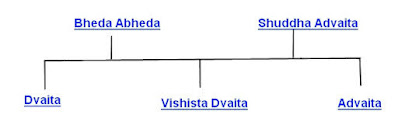
    Proponents of the Samkhya, Vishishthadvaita Vedanta, and Bhedabhada philosophical traditions, who, like Advaitins, believe in satkaryavada, hold this position.


    Each of these three schools thinks that the world as we see it is real, that it is rooted in a single ultimate source, and that this fundamental principle undergoes a genuine metamorphosis through which the universe is born.

    This parinama connection permits these schools to explain the phenomenal world, but in a manner that undermines the transcendence of these initial principles by incorporating them within it.

    Philosophically, they struggle to explain how the sublime might become commonplace, then transcendent again.


    What is the vivartavada view of Advaita Vedanta?

    According to the post-Shankara Advaita advaitins' vivartavada view of Advaita Vedanta, the cosmos is only a "illusory mutation" of Brahman.


    What does Vivarta mean?

    The Sanskrit term vivarta denotes a change in form, a modification, or a changed circumstance. 

    The word vivarta is the root of the phrase vivartavada.

    The Satkaryavada thesis, which states that the cause precedes the consequence, is accepted by all Vedanta schools

    However, there are several points of view about how Brahman gave rise to the material universe. 


    The concept of parinamavada holds that the universe is a genuine (parinama) metamorphosis of Brahman. 


    • The concept of vivartavada holds that the universe is only a fictitious (vivarta) representation of Brahman. 
    • According to Vivartavada, despite the fact that Brahman seems to alter, nothing really changes. 
    • The multitude of creatures are false manifestations because Brahman, the ultimate truth that is unborn, unchanging, and utterly devoid of any parts, is the only true being.


    The Brahma Sutras, early Vedantins, the majority of Vedanta schools, and Samkhya all support parinamavada. 


    According to Nicholson, the Advaitins, who are devotees of Shankara, are the "most conspicuous champions of Vivartavada." 

    The Advaitins say that before the individual ego may be freed, all of Brahman's consequences must eventually be accepted as unreal, despite the fact that the universe can be represented as conventionally real, continues Nicholson.

    However, academics are divided on whether Adi Shankara and his Advaita theory used vivartavada or parinamavada to explain causation. 


    Adi Shankara did not support Vivartavada, according to scholars like Paul Hacker and Hajime Nakamura, and his justifications are "far from any connotation of illusion." They claim that the concept of Vivarta was given by the scholar Prakasatman, and it is Prakasatman's thesis that is sometimes mistaken for Adi Shankara's perspective. 


    According to Andrew Nicholson, who agrees with Hacker and other academics, Shankara's thoughts are more closely related to parinama-vada than the vivarta-vada, and the vivarta explanation most likely developed gradually in the Advaita sub-school later.


    Casual connection is depicted by Vijnanabhiksu as having three terms: effect, variable locus cause, and immutable locus cause. 

    The locus cause cannot be separated from the changing cause and effect and does not originate in them.


    By proposing the theory of Svatantryavada (the "Universal voluntarism"), which maintains that Effect develops from Cause due to the sovereignty of God's Will, the Pratyabhijna philosophy of Somananda disproves the Arambhvada (the "Realistic view" of the Nyaya-Vaisesika), the Parinamavada (the theory of Transformation of the Sankhya-Yoga), and the Vivart.

    Ramanuja recognizes Prakrti as the material cause, but Madhava disputes this claim since a material cause does not necessarily imply control or supervision. 


    Madhava also disagrees with the Vivartavada because it does not acknowledge the need to account for any effects. 


    In his pure non-dualism (Shuddhadvaita) philosophy, Vallabhacharya also opposes "vivartavada" and asserts that Maya (or the "Jagat") is real and is only a power of Brahman who manifests as Jiva and the world of his own volition. 


    In doing so, there is no transformation of Brahman; it still remains only gold. 

    As a result, Shuddhadvaita is also called as "Avikta Parimavda" (Unmodified transformation).


    Frequently Asked Questions


    What does Vivartavada mean?

    The concept of vivartavada holds that the universe is only a fictitious representation of Brahman. 

    According to Vivartavada, despite the fact that Brahman seems to alter, nothing really changes. The multitude of creatures are false manifestations because Brahman, the ultimate truth that is unborn, unchanging, and utterly devoid of any parts, is the only true being.

    What distinguishes Parinamavada from Vivartavada?

    The non-advaitin doctrine of real change is referred to as parinama-vada.

    Vivartavada, the advaita theory of seeming change, is distinct from this. The idea is that the cause really changes into the consequence.


    References And Further Reading:


    • Majumder, B. and Ray, S., 2022. Rajju Sarpa Bhranti-A Metaphysical Analysis of Visual Illusions in Light of Doctrine of Vivarta Vada. Journal of Ayurveda and Integrated Medical Sciences7(5), pp.80-90.
    • Sayanolibavan, M., 2022. The importance attributed to Mandukya Karika in the tradition of Advaida Vedanta.
    • Roodurmum, P.S., 2002. Bhåamatåi and Vivaraòna Schools of Advaita Vedåanta a Critical Approach.
    • Chari, S., 2011. Indian Philosophical Systems: A Critical Review Based on Vedānta Deśika's Paramata-Bhaṅga.
    • Majumder, B. and Ray, S., 2022. Doctrines of Different Philosophical Schools Regarding the Theory of Cause & Effect and Their Validation in Light of Charaka Samhita. Journal of Ayurvedic and Herbal Medicine8(2), pp.94-100.
    • Bhattacharyya, S.P., 2000. Sarvajñātmamuni's contribution to Advaita Vedānta.
    • Brooks, R.W., 1963. Śaṁkara: A Psychological Study.
    • Isaeva, N.V., 2009. Vivartavada.
    • Duquette, J., 2015. Is Sivadvaita Vedanta a Saiddhantika School? Parinamavada in the Brahmamimarrisabhasya. Journal of Hindu Studies8(1), pp.16-43.
    • Chaliha, A., 2017. ON SRIBHASYA-THE BASIC BOOK ON THE THEISTIC VEDANTA. The Philosophical Journal of JB College (Autonomous), Jorhat Assam, India, p.10.
    • Goswami, N., The concept of aventa philosophy of Sankaracharya.
    • Singh, P., 2021. The Problem of Causation: Nagarjuna Vs Hume. Journal Of International Buddhist Studies College (JIBSC)7(1), pp.66-75.
    • Gupta, A.S., 1958. Ramanuja on causality. Philosophy East and West8(3/4), pp.137-148.


    Reality Stops when the Perceiver Ceases to be


    It is to sense that "All is Brahman" when one sees with insight. You've already heard it, but it's not meant to be just heard. It's supposed to be experienced. 


    All entities are fundamentally of Brahman's essence. 


    If you start studying others, you will become one of the analyzed, a different creature, and you will be bound. Because you are thinking about a thief when you think of another person as a thief, the content of your thoughts is "thief." When you talk about worldly things, you treat everything as if it were real, and you act and react appropriately. 

    When you listen to or understand spiritual lessons, however, you seldom hold them in your mind as genuine. Maintain the mindset that,


    "All is Brahman," and behave in accordance with that belief. Simply stating, "I've heard that," will not keep it dormant in your life. 


    Try it out in your life to see whether it's true! If you consider everything to be only paramatman, you will become God (Shiva), but if you consider everything to be simply the phenomenal mundane world, you will remain a person (Jiva). The world looks in many ways depending on how you look at it. If you consider it in terms of Brahman in numerous forms, you will find just Brahman. If you do this, the "me" fever, or ego pride, will dissipate. 


    • For instance, if there is a wife, there is a husband; but, if there is no wife, who can be the husband?
    • There is a seer because there is the seen. How can the seer exist if there is nothing visible to see? 
    • There is only Brahman if you dismiss the visible, and what can the mind conceive about if all of your possessions are destroyed? 


    Only Brahman remains when the notion of "I" is submerged or drowned. Pure Brahman is characterised by the absence of "Me" or "I" in that stage. Everything is merely Brahman. Mr. "So-and-so" is not Brahman, but what you see objectively as a person by some name or label. 


    • What good is it to go to hallowed pilgrimage sites like Varanasi or somewhere else if you haven't discovered who you are? 
    • What good is it to talk about Brahman like a parrot if there isn't an internal awakening to one's spiritual nature? 

    Get rid of the poison that has been affecting your thoughts. What you do continuously over and over again gives you greater experience. 


    1. Everyone has a tendency of talking about their senses. Drop the habit and talk about Brahman's insight instead. You become Brahman in this way by thinking on "That" all the time. 
    2. Spend your time talking about Spiritual Knowledge. When you converse about sensory items repeatedly, you become more worldly. 

    Self-Realization aspirants should surround themselves with family and friends who are interested in these topics. 

    Do not squander your time conversing with people. Having devoted relatives is an unusual occurrence. 


    What good are all worldly activities if you don't know who you are? 


    Because the guidance offered by Saints, who are our "actual family," is a discourse in Oneness, it is immediately applicable to daily life.

     Our genuine relative is the Master who gives us "The Path of Liberation." Like tightening the strings of a Veena, one should tune oneself (an Indian musical instrument). 


    The sound of the instrument will be resonant if it is properly tuned. 

    That is the type of relationship you should have with the Master. The person who helps himself is genuinely fortunate.


    You may also want to read more about Spirituality and Healing here.

    Be sure to check out my writings on Religion here.


    Hinduism - What Is Bhedabhada?


    Bhedabhada (“difference-in-identity”). 


    Bhartrprapancha and Bhaskara were two of the most well-known members of this philosophical school. 


    The Bhedabhada viewpoint recognized three layers of being: Brahman, the Ultimate Reality, and Sakshin, the human being's "witness" awareness. 


    • The school said that these three levels are both similar and dissimilar. 
    • As a result, the universe is similar to Brahman yet, unlike Brahman, is susceptible to change and destruction. 
    • Similarly, although each human soul is equal to Brahman, unlike Brahman, it is subject to bondage and rebirth (samsara). 


    The primordial ignorance known as avidya created the soul's bonding, but it may be broken via a mix of action and knowledge (jnanakarmasamucchaya). 


    • Because they thought that Brahman was really changed into the universe and the Self (parinamavada), Bhartrprapancha and his followers had a fundamental philosophical problem: Brahman was susceptible to bondage and ignorance. 
    • As a result, if avidya must be destroyed in order to achieve freedom, a portion of Brahman must also be destroyed. 
    • The transcendence of Brahman was firmly established by holy writings such as the Upanishads, making these views difficult to defend, and this issue may explain for the school's brief existence.


    You may also want to read more about Hinduism here.

    Be sure to check out my writings on religion here.


    Hinduism - Who Is Bhartrprapancha?


    Bhartrprapancha (7th c. C.E.) is the founder of the Bhedabhada (“identity-in-difference”) philosophical system in Indian philosophy. 


    Bhartrprapancha lived at an unknown time, although he predates the eighth-century Bhedabhada commentator Bhaskara. 


    The Bhedabhada viewpoint recognized three levels of being: 

      1. Brahman, the Ultimate Reality, 
      2. “witness” awareness (sakshin) in humans, 
      3. and the universe. 


    This school claimed that these three levels were both identical and dissimilar. 


    • As a result, the universe is similar to Brahman yet, unlike Brahman, is susceptible to change and destruction. 
    • Similarly, although each human soul is equal to Brahman, unlike Brahman, it is subject to bondage and reincarnation (samsara). 
    • The primordial ignorance known as avidya created the soul's bonding, but it may be broken via a mix of action and knowledge (jnanakar- masamucchaya). 


    The fundamental philosophical difficulty for Bhartrprapancha and his followers stemmed from their conviction that Brahman was really converted into both the universe and the Self, a doctrine known as parina- mavada. 


    • Brahman was subjected to slavery and ignorance because people thought it experienced actual transformations. 
    • Because Brahman was seen as flawless and unchanging, this viewpoint was unsustainable and unacceptable from a religious standpoint. 
    • This issue may have contributed to the school's brief existence.


    You may also want to read more about Hinduism here.

    Be sure to check out my writings on religion here.


    Hinduism - What Is A Mahavakya In Hindu Literature And Speech?


     ("extensive utterance") Short remarks from the Upanishads, speculative literature dubbed "great" because they disclose the fundamental essence of existence and the Self.

    Tat tvam asi ("that thou art") is a well-known mahavakya that expresses the Self's union with Brahman.

    Ayamatma Brahman ("This Self is Brahman"), sarvam idam khalu Brahman ("Truly, this world is Brahman"), aham brahmasmi ("I am Brahman"), and prajnanam Brahman ("Knowledge is Brahman") are some more well-known utterances.

    In the jump philosophy propounded by the philosopher Sureshvara, these big words are most essential.

    Complete freedom, according to leap philosophers, is achievable but beyond of our immediate control, since it cannot be obtained by a precisely stated series of causes and consequences.

    When a person whose understanding has been cleansed hears one of these mahavakyas, the deep truth in the speech gives the flash of insight that delivers complete freedom of the soul, according to Sureshvara's understanding (moksha).


    You may also want to read more about Hinduism here.

    Be sure to check out my writings on religion here.


    Hinduism - Who Is Bhaskara?


    Bhaskara was an eighth-century proponent of the Bhedabhada (“identity-in-difference”) school of Indian philosophy. 


    The Bhedabhada viewpoint recognized three layers of being: Brahman, the Ultimate Reality, and Sakshin, the human being's "witness" awareness. 


    • They claimed that these three levels were both identical and dissimilar. 
    • As a result, the universe is similar to Brahman yet, unlike Brahman, is susceptible to change and destruction. 


    Similarly, although each human soul is equal to Brahman, unlike Brahman, it is subject to bondage and rebirth (samsara). 


    • The primordial ignorance known as avidya created the soul's bonding, but it may be broken via a mix of action and knowledge (jnanakar- masamucchaya). 
    • Because they thought that Brahman was really trans- formed into the universe and the Self (parinamavada), the Bhedabhada school's fundamental philosophical issue was that Brahman was susceptible to bondage and ignorance. 
    • Because the transcendence of Brahman was firmly established by holy writings such as the Upanishads, this concept was difficult to defend, and this issue may explain for the school's brief existence.


    You may also want to read more about Hinduism here.

    Be sure to check out my writings on religion here.


    Hinduism - ADVAITA


    What Is Advaita?

    Non-duality or 'not two-ness' is the literal translation.

    One of the primary schools of Vedanta, Advaita, advocates a philosophical perspective. 


    It is the concept that multiplicity is, in the end, the manifestation of a non-dual reality.

    This philosophical stance is sometimes referred to as monism in the West (the belief that reality is one), but the meaning of 'non-duality' in a Hindu context is more nuanced, because it does not involve the postulation of even a single entity, because 'Being' (sat) is said to be beyond all signification, including the postulation of a One.


    The non-dual principle of reality underpins the cosmos, yet it is not an entity in the same way that the many objects and entities do.

    It is the foundation of their existence.

    Furthermore, labeling such schools as monistic is difficult since they often preserve a multi-leveled definition of truth that does not necessitate rejecting the existence of plurality.

    The idea is that the ontological substratum that permits such creatures to appear is fundamentally a non-dual principle of being.


    The Upanisads include the oldest explicit exposition of non dualist notions, with Brahman as the basic substrate of existence from which the cosmos is believed to originate.

    Early Upanisads, such as the Chandogya, compare the connection between Brahman and each individual being's basic self (Atman) to the mixing of salt and water in salty water.

    The water tastes like salt that can't be seen, and the difference between the two is undetectable, just as Brahman can't be seen yet permeates the whole cosmos.

    'You are That,' the sage concludes (tat-tvam-asi, Chandogya Upanis.ad 6.10.3).

    Numerous schools evolved in response to the primary topic of the link between the individual ego and Brahman, the substance of the cosmos, as a result of various efforts to construct a systematic philosophical interpretation of such passages in the Upanisads (veda-anta or 'end of the vedas').


    The difference-non-difference school, dualists (who claimed a clear ontological split between the two), qualified non dualists, and non-dualist interpretation were among them.

    The Mandukya Karika (also known as the Agamasastra or the Gaudapada Karika) is the earliest unambiguous explanation of Advaitaphilosophy.

    It was presumably written about the sixth century of the Common Era.

    Sankara, however, is the most well-known Advaita proponent (eighth century CE).


    The universe of plurality, according to believers of the Sankarite view, is ultimately nothing more than a magical illusion (Maya).

    The specific nature of this illusion was the topic of much debate (and opposing schools' contention), but the general consensus was that maya is unexplainable, being neither completely existing nor non-existent.

    The key to grasping this concept is to recognize that there are two degrees of truth for Sankara: ultimate truth (where the non-dual Brahman is the solitary reality) and daily, practical truth (where a variety of diverse things exist).

    Maya is a cosmic illusion, but it is not a mental delusion (as in a hallucination or a dream), not least because the concept of an individual self (jivatman) is ultimately illusory from the standpoint of ultimate truth.

    The world of waking awareness is not a subjective deception, according to Sankara; it exists and acts on a practical plane of reality.

    This universe is unreal in and of itself, but real in the sense that it is identical to Brahman, the source of all existence.

    According to Sankara, avidya - metaphysical ignorance – is the root of the universe's seeming manifestation, which is basically our ignorance of the reality that everything is Brahman.

    At the individual level, this entails projecting categories or 'adjuncts' derived from previously acquired experiences (including those from prior incarnations) onto the non-dual reality, causing it to look as something it is not.

    Sankara utilizes the well-known example of the rope and the snake to convey his point.

    In low light, a rope might resemble a snake.

    We think we're looking at a snake, but it's only a rope.

    We can realize the error that was committed in daylight (that is, with the benefit of knowledge) and no longer project the image of a snake onto the rope.

    Similarly, Brahman is the source of all things, but we misinterpret it as distinct objects due to our inability to transcend our ignorance of reality's actual nature.

    Sankara's interpretation of Advaita, on the other hand, is far from the sole kind of nondualism found in Hindu traditions.

    The Bhagavata Purana (c. eleventh century CE) is centered on the playful figure of Krishna and mixes non-dualistic notions with Vaisnava devotionalism (bhakti).

    Non-dualistic philosophies may also be found within the many Saivite movements.

    The Pratyabhijna or Recognition School, which is commonly connected with Kashmir but also exists elsewhere, is notable for its clear rejection of Sankara's notion of maya's illumination.

    The world is real, according to this school, since it is a vibration (spanda) of Siva's dynamic and creative awareness.

    Later works, such as Vasistha's highly poetic Yoga Teachings (Yogavasistha), synthesize themes and concepts from a variety of non-dualist schools (including Buddhist ones), but with a clear orientation towards Vedantic interpretations.

    Interest in Sankara's philosophy by various Western Orientalists and Hindu reformers in the late nineteenth and early twentieth centuries helped to establish non-dualist ideas as important sources. 

    Many of the key intellectual figures and gurus of Hinduism in the modern period, including Ramakrishna, his disciple Swami Vivekananda, SarvepalliRadhakrishnan, Ramana Maharshi, Nisargadatta Raj, Sri Aurobindo, and, to a lesser extent, Mahatma Gandhi, advocate non-dualism as a central aspect of their teaching.

    Swami Vivekananda, perhaps more than anyone else, was responsible for catching the imagination of Hindus and Westerners alike with his promotion of non-dual ism as Hinduism's basic doctrine and 'spirituality' as the distinguishing quality of Hindu devotion.


    ~Kiran Atma


    See also: 

    Atman, Bhakti, Brahman, Buddhism's relationship with Hinduism, Mohandas Karamchand Gandhi,Aurobindo Ghose, Modern and contemporary Hinduism, Kashmiri Saivism, Krishna, Maya, Puranas, Sir Sarvepalli Radhakrishnan,Sri Ramakrishna, Ramana Maharshi,Saivism, Sankara, Siva, Upanisads, Vaisnavism, Vedanta, Swami Vivekananda,Yogavasistha


    References And Further reading:

    King, Richard. 1999. Indian Philosophy: An Introduction to Hindu and Buddhist Thought. Edinburgh: Edinburgh University Press.

    Ram-Prasad, C. 1991. An Outline of Indian Non-realism: Some Central Arguments of Advaita Metaphysics. Oxford: Oxford University Press.

    Sharma, A. 1993. The Experimental Dimension of Advaita Vedanta. Delhi: Motilal Banarsidass.