Showing posts sorted by date for query Ramananda. Sort by relevance Show all posts

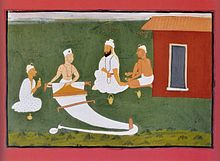
Hinduism - Who Was Pipa?


Pipa (15th century?) is a poet-saint in the Sant religious group.

Sant is an umbrella term for a group of poet-saints from central and northern India who share a number of common traits, including:

  1. A focus on individualized, interior religion leading to a personal experience of the divine; 
  2. Disdain for external ritual, particularly image worship; 
  3. Belief in the power of repeating one's patron deity's name; 
  4. And a willingness to ignore traditional caste distinctions.


Pipa was born into a Rajput royal family in the Malwa area, but he finally abdicated his kingdom and traveled to Benares to study under the poet-saint Ramananda.

Pipa was a follower of the mighty goddess Bhavani (an epithet of Parvati), according to the hagiographer Nabhadas, demonstrating the scope of the Sant tradition.

A couple of Pipa's lyrics have been preserved in the Adigranth, the Sikh community's holy scripture, and they are congruent with these traditions in terms of language and theological focus.


~Kiran Atma


You may also want to read more about Hinduism here.

Be sure to check out my writings on religion here.

Hinduism - Who Is A Vaishnava?


A devotee (bhakta) of the deity Vishnu in any of his many manifestations.

The doctrine of the 10 avatars, or divine incar nations, is particularly prevalent in Vaishnava theology: Fish, Tortoise, Boar, Man-Lion, Vamana (dwarf), Parashuram, Rama, Krishna, Buddha, and Kalki.

The avatar idea is widely recognized as a means of assimilating lesser regional deities into the greater pantheon by classifying them as manifestations of Vishnu, and Vishnu is most generally worshiped in the guise of these avatars.

Although the Boar avatar and the Man-Lion avatar were powerful regional deities in the early centuries of the common period, the two most important avatars have been Rama and Krishna.

The early Vaishnava faith is hazy and enigmatic.

Despite the fact that Vishnu occurs in multiple hymns in the Vedas, the earliest Hindu religious books, he was obviously a lesser god, and it is impossible to get from there to becoming the universe's greatest force.

Some academics believe that the worship of Krishna, a deified local cowherd hero, originated outside of the Vedic religious framework and that Krishna's cult was integrated into legitimate Vedic religion via the identification of Krishna with Vishnu.

These concepts are fascinating, but there is little empirical evidence to back them up.

The worship of Krishna was well-established by the first century B.C.E., according to inscriptional evidence.

These followers are known as Bhagavatas ("devotees of the Blessed One"), a term that was used to apply to Vaishnavas in general for the following thousand years.

The Pancharatrikas ("followers of the Pancharatra") were a subgroup of the early Bhagavata society who eventually developed distinct cosmological ideas.

These mainstream Bhagavatas demonstrated their love for Krishna by writing works that included portions of the Bhagavad Gita, the Harivamsha, and many puranas, culminating in the Bhagavata Purana in the eleventh century.

The Alvars, a group of twelve devout (bhakti) poet-saints who lived in southern India during the seventh and tenth centuries, changed the tone of Vaishnava devotion dramatically.

The Alvars preached a bhakti distinguished by fervent devotion to God and characterized by a great emotional relationship between god and devotee, singing their songs in Tamil, the vernacular language of their period.

The Alvars, together with their Shaiva counterparts, the Nayanars, pioneered the renewal of Hindu religion in relation to Buddhists and Jains, and in doing so, changed the tradition as the devotional wave they had started spread northward.

Various Vaishnava communities arose throughout the time between the twelfth and sixteenth centuries, generally as a result of a particular charismatic religious personality.

This process started in southern India, where the philosopher Ramanuja (11th century) established the Shrivaishnava group and the philosopher Madhva (1197–1276) established the Madhva community.

Jnaneshvar (1275–1296? ), Namdev (1270–1350), Chokamela (d. 1338), Eknath (1533–1599), and Tukaram (1598–1650) were some of the finest characters in the Varkari Panth, which was centered on the shrine of Vithoba at Pandharpur.

From the thirteenth century onwards, the Mahanubhav cult flourished in Maharashtra.

Jagannath, a tribal god integrated into the pantheon as a version of Krishna, is worshipped in Puri on India's eastern coast.

As the poet Jayadeva's Gitagovinda demonstrates, this was firmly established by the eleventh century.

Finally, many active religious organizations may be found in northern India.

The twelfth-century philosopher Nimbarka, whose Nimbarki society preserves his name, is a very early character; many centuries later, Vishnuswami, about whom little is known, appears.

The Pushti Marg was founded by the philosopher Vallabhacharya, the Gaudiya Vaishnava community was founded by the Bengali saint Chaitanya, and the poet saint Harivamsh (d. 1552) and the Radhavallabh community was founded by the poet saint Harivamsh (d. 1552).

The Pushti Marg and the Gaudiya Vaishnavas viewed Krishna to be the greatest god, whilst the Nimbarkis and the Radhavallabh group worshiped him in conjunction with his consort Radha, whom they considered Krishna's wife and equal.

The devotion of Rama has its deepest roots in northern India, as seen in the poems of the poet-saint Tulsidas (1532–1623?).

Many of these schools, many of which have a lengthy history, are still important in today's world.

Ascetics are the last Vaishnava group that has to be addressed.

Vaishnava asceticism is a more recent development than Shaiva asceticism (though dates are unknown), and it is mostly found in India's northern regions (the Shaivas are spread throughout the country).

Bairagis ("passionate") Vaishnava ascetics are divided into four sampradays (religious groups characterized by distinct bodies of teachings), each associated with a notable Vaishnava figure.

The Shri Sampraday of the Ramanandi ascetics is by far the most powerful, tracing its spiritual lineage from poet-saint Ramananda to the southern Indian philosopher Ramanuja, whom they claim was Ramananda's guru.

The Nimbarki ascetics' Sanaka Sampraday may trace their spiritual heritage back to the philosopher Nimbarka.

The Vishnuswami ascetics' Rudra Sampraday may be traced back to an older person, Vishnuswami, via the philosopher Vallabhacharya.

Finally, the Brahma Sampraday, a Gaudiya Vaishnava ascetic subgroup, traces its spiritual lineage from Bengali saint Chaitanya to southern Indian scholar Madhva.

Each of these sampradays is distinct not just in terms of its founder, but also in terms of its tutelary god or deities.

The Ramanandis worship the deity Rama, whereas the rest revere the god Krishna and his bride Radha, however they differ in how they place Radha.

Scholars have pointed out that these historical assertions are either very suspect or utterly false, and that the differences between the sampradays are mostly academic in nature.

Given that Ramanandis make up the vast majority of these ascetics, the others seem to be relevant solely for symbolic purposes, such as having a representation from each of the great Vaishnava religious personalities.

~Kiran Atma


You may also want to read more about Hinduism here.

Be sure to check out my writings on religion here.
Shri Sampraday


One of the Bairagi Naga ascetics' four branches (sampraday).

The Bairagi Nagas are followers (bhakta) of the deity Vishnu who are arranged into several anis or "armies" in a military form.

Their principal activity until the beginning of the nineteenth century was as mercenary troops, while they also had significant commerce interests; both of these have mostly vanished in recent times.

The Shri Sampraday traces its spiritual heritage back to the poet-saint Ramananda, who is said to have been Ramananda's master, the southern Indian philosopher Ramanuja.

This assertion is reflected in the sampraday's name, since Ramanuja's descendants, the Shrivaishnavas, devote their devotion to Vishnu and Shri (Lakshmi).

However, the Ramanandi ascetics worship a completely separate set of deities—Rama and Sita—and any links between the Ramanandis and the Shrivaishnavas were publicly relinquished in 1921 at the Ujjain Kumbha Mela, at the Shrivaishnavas' request.

The claim to be linked to a prominent religious person, like with another Bairagi organization, the Brahma Sampraday, seems to be a means to attain the authority and status of an old and established institution.

The Shri Sampraday is the biggest and most significant of the Bairagi Naga orders even without this claim.

For further detail, read Peter van der Veer's 1988 book, Gods on Earth.

Ramananda


Ramananda  (14th century?)

Traditional references to him as the spiritual teacher (guru) of poet-saints Kabir, Ravidas, Pipa, and others.

The Sants were a group of poet-saints from central and northern India who shared a number of common traits, including a focus on individualized, interior religion leading to a personal experience of the divine, a dislike for external ritual, particularly image worship, faith in the power of the divine name, and a willingness to disregard traditional caste distinctions.

Ramananda was a prominent spiritual leader who was reported to be a direct pupil of Ramanuja, a southern Indian philosopher who sent Ramananda north to assist promote the devotional movement.

Given that the single passage incontrovertibly attributed to Ramananda is contained in the Adigranth, the Sikh community's scripture, the latter assertion is probably definitely untrue.

This poem indicates the impact of the Nathpanthi ascetics, who emphasised yoga, rather than Ramanuja's Shrivaishnava tradition, in which Vishnu is the major god.

Other lines attributed to Ramananda have been found in subsequent sources, although their validity is disputed, and nothing is known about his life.

Renunciant ascetics, worshippers of the deity Vishnu (bhakta), who are by far the most numerous and influential of the Vaishnava ascetics.

The Ramanandis believe that their order was created by Ramananda, a religious teacher about whom nothing is known for certain.

For a while, the Ramanandis claimed that Ramananda was a student of the southern Indian philosopher Ramanuja, and that their sect sprang from Ramanuja's Shrivaishnava religious society, but this claim was falsely denied following a disagreement during the Kumbha Mela event in Ujjain in 1921.

Ramananda is also claimed to have been the guru of a number of northern Indian bhakti personalities, including Kabir, Ravidas, Pipa, and Sen, however there is little strong historical evidence for this.

All of the anecdotes about Ramananda, on the other hand, indicate to a guy who was steadfast in his dedication and eager to initiate individuals from all areas of life.

Rama, as depicted in the Ramcharitmanas, a vernacular version of the epic Ramayana penned by the poet-saint Tulsidas (1532–1623? ), is the tutelary god for the Ramanandi ascetics.

The text's principal topic is the power of devotion, and Tulsidas presents Rama as God incarnate, who has come to earth for the sake of his believers.

Within the greater Ramanandi fold, however, there are various diverse variants on practice that have little in common with one another.

The tyagis, for example, emphasize renunciation and austerity.

A second thread is that of the Nagas, who fought ascetics in the past but whose military structure is now mainly prominent during the Kumbha Mela bathing (snana) processions.

The fourth strand is that of the rasiks ("aesthetes"), whose religious practice is based on very intricate vision patterns in which they see themselves in Rama's palace; this kind of visualization was definitely adopted from Krishna devotion patterns in the Braj area.

The rasik tradition is by far the most literate and sophisticated; the tyagis and Nagas execute comparable ceremonies to other ascetics, but their inter pretation and deity are unique to their order.

For further detail, read Peter van der Veer's 1988 book, Gods on Earth.

Hinduism - What Is A Chatti?


A pilgrim refuge, especially in the Himalayas. 


The term chatti is a derivative of the word "umbrella," and it was coined because these shelters were often only roofs supported by pillars, keeping pilgrims dry in the event of rain. 


Many Himalayan pilgrims journeyed on foot until the middle of the twentieth century, using a network of chattis along the pilgrimage routes. 


These chattis were eight to twelve miles apart, making for a pleasant day's walk for youthful pilgrims but a difficult trek for the elderly. 

Each chatti was run by a local family that sold wood and food grains to the pilgrims and provided them with cooking equipment. 

During the pilgrimage season, this arrangement provided money to mountain families while also allowing pilgrims to carry just their personal items. 

The introduction of paved roads and bus transit made this network mostly obsolete, but it is still referenced in place names like Janaki Chatti and Hanuman Chatti. 


Nagas from Chatuh-Sampradayi. 


Four groups (sampraday) of militant (Naga) ascetics who are all followers (bhakta) of the deity Vishnu are referred to as the Vishnu Sampraday. 

They are all spiritual descendants of a distinct Vaishnava religious group, each of which is linked to a prominent Vaishnava person. 


The Shri sampraday of the Ramanandi ascetics is by far the most numerous and influential of these organizations, tracing its lineage back to the poet-saint Ramananda and the southern Indian philosopher Ramanuja, whom they believe to be Ramananda's teacher. 

The Nimbarki ascetics' Sanaka sampraday may trace their spiritual heritage back to the philosopher Nimbarka. 

The Vishnuswami ascetics' Rudra sampraday may be traced back to an older person, Vishnuswami, via the scholar Vallabhacharya. 

Finally, the Gaudiya Vaishnava ascetics' Brahma sampraday traces its spiritual lineage from Bengali saint Chaitanya to southern Indian scholar Madhva. 


Each of these sampradays is distinguished not only by its founder, but also by the god or deities that serve as its patron. 


The Ramanandis worship the deity Rama, while the rest revere the god Krishna and his wife, Radha, to varying degrees. 

Scholars dispute that these organizations were ever linked to the individuals who claim to be its founders. 

The differences between the sampradays seem to be mostly intellectual in nature. 

Given that Ramanandis make up the vast bulk of these ascetics, the others seem to be significant mainly as representatives of other prominent Vaishnava religious leaders. 


The group differences are only important during the Kumbha Mela bathing (snana) event, when they dictate the order of specific groups in the bathing processions. 


More information may be found in Peter van der Veer's 1988 book, Gods on Earth. 


~Kiran Atma


Discover more about Hindu Art, Architecture, and Iconography here.

You may also want to read more about Hinduism here.

Be sure to check out my writings on religion here.


Hinduism - What Is Bairagi?


Bairagi has the literal meaning of “dispassionate”. 


This is the generic term for any ascetic who worships Vishnu as their patron god, although it is most often used to refer to the warring ascetics known as Nagas. 


Bairagi Sadhus: Unveiling the Dispassionate Path of Renunciation in Hinduism


The Bairagi tradition within Hinduism stands as a testament to the profound pursuit of renunciation and devotion. Literally meaning "dispassionate," a Bairagi is an ascetic dedicated to the worship of Vishnu, seeking detachment from worldly desires. While encompassing various Vaishnava ascetics, the term is most often associated with the formidable Naga Sadhus, particularly those of the Chatuh-Sampradaya. This essay explores the multifaceted Bairagi tradition, examining its philosophical foundations, diverse practices, and the unique characteristics of the Naga Sadhus.


Central to the Bairagi ethos is vairagya, the detachment from material possessions and emotional ties. Rooted in Hindu scriptures, which emphasize the transient nature of worldly pleasures and the pursuit of moksha (liberation), this detachment is an active process of severing ties with the ego and senses. Bairagis strive for inner tranquility, free from distractions like fear, anger, and desire.


The Bairagi path involves rigorous discipline and self-control. Ascetics renounce familial ties, possessions, and social obligations, adopting a simple lifestyle focused on spiritual practices. These include meditation, chanting, fasting, and pilgrimage, aimed at purifying the mind and body for divine connection. The worship of Vishnu, the preserver god, is paramount, as he embodies compassion, righteousness, and cosmic order, ideal for those seeking liberation.   


While "Bairagi" encompasses diverse Vaishnava ascetics, the Naga Sadhus of the Chatuh-Sampradaya are distinctive. The Chatuh-Sampradaya, meaning "four traditions," refers to Vaishnava lineages founded by Ramananda, Vishnuswami, Nimbarka, and Madhvacharya, with the Naga Sadhus primarily associated with the Ramanandi Sampradaya.


Naga Sadhus, known for their ash-covered bodies, matted hair, and minimal clothing, embody renunciation. Often carrying tridents and swords, they historically served as warrior ascetics, protecting Hindu pilgrimage sites.   


Historically, Naga Sadhus safeguarded Hindu holy sites, engaging in militant defense against rivals and invaders. With the decline of organized warfare, their focus shifted to spiritual pursuits.   

The Kumbh Mela is a significant event for Naga Sadhus, where they emerge from seclusion to participate in elaborate processions, showcasing their unique traditions. Their presence underscores the enduring strength of the Bairagi tradition and its commitment to spiritual discipline.   

Naga Sadhus lead austere lives, often residing in remote locations, enduring harsh conditions. Their practices include intense meditation, prolonged fasting, and self-imposed austerities, aimed at transcending physical limitations.   

The Bairagi tradition, exemplified by Naga Sadhus, represents a powerful expression of Hindu renunciation and devotion. It is a path of rigorous self-discipline, unwavering faith, and surrender to the divine. Despite their seemingly extreme practices, they embody a deep commitment to spiritual liberation and an understanding of the transient nature of worldly existence, illustrating the transformative power of spiritual practice and the pursuit of moksha.

~ Kiran Atma

You may also want to read more about Hinduism here.

Be sure to check out my writings on religion here.


Hinduism And Hindu Theology - What Is Asceticism?


In its broadest meaning, this term refers to physical discipline, most often the abandonment of normal society and conventional social life in the pursuit of divine enlightenment and ultimate spiritual freedom (moksha). 

Throughout history, ascetic practice has emphasized many recurring themes. 


Celibacy has been one of the most popular for a number of reasons. 


  • Not only does sexual pleasure utilize the senses to entrap a person, but home and family ties are also regarded as a hindrance to serious spiritual pursuits. 
  • The notion that semen is a man's concentrated essence, and therefore something to be carefully guarded, motivates the focus on celibacy. 
  • Although semen must be spent in order to reproduce, it should not be spilt carelessly since it depletes a man's vitality. 
  • Celibacy is said to provide more vitality, which leads to higher spiritual achievement. 


The practice of tapas, or physical austerity, has long been a defining feature, with the belief that enduring physical suffering not only develops character but also produces spiritual force. 


  • Tapas may take on horrific self-mutilation and mortification forms at times. 
  • Other times, a gentler physical discipline, such as a type of hatha yoga, may be used to prepare the body and mind for long periods of practice. 


In general, ascetics' spiritual growth may take a number of routes, which frequently reflect the talents and preferences of the ascetics who pursue them. 


  • Some ways have emphasized conventional study, some have emphasized worship and devotion, others have emphasized physical austerity, while yet others have emphasized meditation and personal revelation. 
  • Almost often, spiritual instruction takes place under the supervision of a religious preceptor (guru), who is responsible for his students' spiritual growth. 
  • Although there is some debate over how long and how venerable asceticism has been practiced in India, it has a long and venerable history. 
  • The most bold assertion is that the Indian ascetic tradition stems from the Indus Valley civilization's religion. 
  • This assertion is based on an old artifact known as an Indus Valley seal, which depicts a person sitting cross-legged as though in meditation. 
  • Whether one believes this assertion or not, the Vedas, the oldest Hindu texts, provide plenty of evidence of asceticism. 


The Vedas describe renunciants like the vratya, yati, and muni, as well as ascetics who live in the woods. 


  • Indeed, the Aranyakas or "Forest Books," as one layer of the Veda is known, indicates that it was written by such ascetics. 
  • Buddhist and Jain literature, as well as certain later upanishads, clearly indicate that monastic living was firmly established by the fifth century B.C.E. 
  • All of these ascetics, whether Hindu, Buddhist, or Jain, were lumped together under the name shramana, which means “to strive” in Sanskrit. 


The theological conflict between the two main religious paradigms, the Brahmana ideal linked with Vedic religion and the shramana ideal associated with austerity, is well acknowledged. 


  • The Brahmana ideal was based on sacrifice, mastery of complex sacred texts, and hereditary priesthood; it was also so expensive that it almost required royal patronage—all of these factors made it the "establishment religion." These concepts clashed with the shramana ideal, which was renunciant, individualist, and focused on inner experience. 
  • This conflict had been partly resolved by the time of the Dharma Shastras (treatises on religious duty); asceticism had been consigned to the last of the four ashramas (stages of life), that of the Sanyasi. 
  • Even yet, there is still tension since, according to these scriptures, a twice-born man cannot become a Sanyasi until he has met his children's children, which would put him in his late thirties. 
  • These scriptures limit asceticism to twice-born males who have completed their householder duties, but they exclude women and low-caste men. 
  • Needless to say, the real world has never resembled the utopian society depicted in the Dharma Shastras. 


Initiated Hindu ascetics may be classified into many main categories based on their organizational structure. 


  • One distinction is based on the patron god of ascetics; the Shaiva are Shiva worshippers (bhakta), while the Vaishnava worship Vishnu. 
  • The Kapalikas, Kalamukhas, and Pashupatas are Shaiva ascetic groups that have vanished; the Dashanamis and Nathpanthis are the only two Shaiva groups that remain. 

  • The Dashanamis are the most renowned ascetics in the world. 
    • They are said to have been founded by the renowned philosopher Shankaracharya and have a long history of emphasizing study. 

  • Gorakhnath, a miracle-working yogi about whom little is known, is the ancestor of the Nathpanthis. 
    • The Nathpanthis are renowned for emphasizing the physical body's change via yoga. 

  • Vaishnava ascetics are more recently organized, and in northern India, they are divided into four groups (chatuhsampradayi Nagas), each named after the founder of the group:

    • Ramananda for the Ramanandis, 
    • Nimbarka for the Nimbarkis, 
    • Chaitanya for the Madhva Gaudiyas (Brahma Sampraday), and 
    • Vishnuswami for the Vishnuswamis. 


  • Both the Dashanamis and the Vaishnava ascetics have formed bands of warriors known as Nagas ("naked") from at least the sixteenth century, and perhaps much earlier. 
    • These soldier-ascetics were tasked with guarding the other ascetics, as well as acting as long-distance merchants and mercenary warriors. 
    • Although these Naga orders still exist today, they are no longer battle-ready. 

  • The Udasis, who worship the panchayatana ("five-fold"), a grouping of five Hindu deities: Shiva, Vishnu, Durga, Ganesh, and Surya, are another prominent sect. 
    • In terms of religion, the Udasis are in between the Shaivas and the Vaishnavas. 
  • Reform-minded ascetics have formed their own ascetic bands throughout the ages, a process that continues now. 


G. S. Ghurye, Indian Sadhus, 1964; Jadunath Sarkar, A History of the Dasanami Naga Sanyasis, 1958; Padmanabh S. Jaini, “Sramanas: Their Conflict with Brahmanical Society,” in Joseph Elder (ed. ), Chapters in Indian Civilization, 1970; Robert Lewis Gross, The Sadhus of India, 1992; and Peter van der Veer, Gods on Earth, 1988 for more information Also known as panchayatana puja.


You may also want to read more about Hinduism here.

Be sure to check out my writings on religion here.


Hinduism And Hindu Theology - What Is The Adigranth?

Adigrath literally means, “Primal Book”. One of the titles for the Sikh text that is most often used by non-Sikhs. 

Sikhs prefer to refer to the text as Shri Guru Granth Sahib, which indicates the book's position as the Sikh community's spiritual leader (guru). 


The tenth Sikh guru, Gobind Singh (d. 1708), bestowed this position after declaring that the community will no longer have human leaders after his death, relying only on their scripture for guidance. 

  • The Sikhs' treatment of the text demonstrates its religious authority. 
  • They treat the Adigranth as if he were a live being. 
  • The Adigranth is ceremonially put to bed at night in Sikh temples and awoken in the morning. 
  • It is worshipped beneath a canopy (a symbol of royalty), fanned in hot weather and warmed in cold, and carried on the bearer's head, which is regarded the cleanest portion of the body, if it must be transported anyplace. 
  • The Sikhs were most likely inspired by Muslim behavior with regard to the Qur'an, since most Hindus give little attention to a book itself, no matter how significant the content may be. 
  • The Adigranth is very important in Sikh life: Sikh couples marry by circling the book, similar to Hindu couples surrounding the holy fire (agnipradakshinam), and a popular dying ritual is an uninterrupted reading (akhand path) of the whole text. 

Guru Arjan, the fifth Sikh guru, composed the book between 1603 and 1604. 

According to legend, he wrote the book in response to competitors challenging his authority, some of whom had produced and circulated volumes ostensibly containing the teachings of Teacher Nanak, the Sikhs' founder and first guru. 

While there may be some truth to this legend, it is now widely accepted that Arjan was working from a compilation created a generation earlier. 


The mul mantra, which provides a set of characteristics and qualities attributed to the Supreme Being, is found in the first verses of the book. 


The Adigranth is divided into three sections after this entrance. 


  • The first is the Japji, a collection of thirty-eight verses by Guru Nanak that are considered the core of the Sikh religion and are repeated as the morning prayer by the devout. 
  • The hymns of the Sikh gurus are organized by raga, or musical mode, in the second part. 
    • The hymns are organized by poetic meter inside each raga, and within each meter, the hymns are ordered chronologically by who of the gurus wrote them. 
    • Because all 10 gurus, according to Sikh tradition, had the same heavenly essence, they all called themselves "Nanak." 
    • However, the songs' introductions distinguish them by using the word Mahala (literally "home," but metaphorically "body") followed by a number, ranging from Mahala 1 for Guru Nanak to Mahala 5 for Guru Arjan. 

  • The Adigranth's last part includes hymns written by a variety of different followers (bhakta), both Hindu and Muslim, who the Sikh gurus felt were preaching the fundamental Sikh doctrine of monotheism and the necessity to serve God. 
    • Trilochan, Jayadeva, Pipa, Ramananda, Sen, Namdev, Kabir, and Ravidas are among the Hindu devotional (bhakti) poets whose works may be found in this area, with major collections for the latter three. 
    • This final part makes the Adigranth a very significant book, even for people who are not interested in the Sikhs. 
    • This part not only provides manuscript tradition that can be exactly and properly dated, but it also ensures that the text has stayed unaltered from the beginning of the seventeenth century due to its holy significance. 

Many additional manuscript sources for these poets are far more modern, and textual degradation and pseudonymous additions make them difficult.


You may also want to read more about Hinduism here.