What Are Agamas?
Agamas refer to sacred Hindu texts recorded in various forms collectively.
The significance of texts of all kinds—prose and poetry, written and oral, spoken and sung (whether by a single expert or by a multitude), antique and vernacular, stable and fluid—distinguishes Hinduism, if Hinduism can be characterized as a single thing at all.
Here we explore the significance of texts in Hinduism, defines various textual categories, and provides links to entries that cover related topics.
Agamas can be Stable and Flowing, Written and Spoken.
Any utterance, long or short, that can be repeated in essentially the same manner on several occasions is referred to in this context as a "text."
There is a propensity to limit the word "text" to utterances recorded in writing, whether in handwriting, printed, or electronic form.
This inclination is supported by the nomenclature of mobile phones and text editing software.
When discussing Hindu culture, however, where certain texts exist without writing and are conveyed orally from one speaker to another, this limitation is improper.
Writing seems to have first arisen in India, apart from the Indus Valley script, about the middle of the last millennium BCE, but was not utilized for religious writings until much later.
With the exception of a few later ones, several of these—the Vedic texts—were written down during a period when there is no proof that writing existed.
Others, passed down within small communities, are only known to those outside those communities if they are written down or electronically stored by a third party.
There are texts in all of the Hindu languages that are interpreted in this broad meaning (including English and other languages of countries outside South Asia).
Many civilizations have incredibly stable ritual texts that must always be performed in precisely the same way—the same words in the same sequence, often even with the same vocal inflections—in order to avoid becoming insulting, ineffectual, or even catastrophic.
Vedic writings are one example of this.
Other texts may be changed by various reciters, scribes, or even the same person at different times by deleting, adding, or modifying specific words.
The art of the reciter may include improvised variation.
The Mahabharata and Ramayana, which change considerably in various regions of South Asia, are excellent examples of this.
Whether a text is written or spoken depends on whether it is stable or flowing.
While the Vedic writings have not altered despite being passed down orally for millennia prior to being recorded, there are hundreds of manuscripts and four distinct printed copies of the Mahabharata.
The idea that a text should be retained in tact without being recorded in writing runs counter to what literary historians and anthropologists have discovered about the nature of oral literature.
In societies where oral texts are fluid, significant study on oral transmission of texts has been conducted (Chadwick and Chadwick 1932–1940; Lord 1960; Ong 1982).
A typical orally transmitted text, like a ballad or an epic, exists as a variety of performances, each of which is somewhat improvised and not an exact replication of any prior performance.
This explains, for instance, the Mahabharata's several recensions and myriad modifications.
Some theorists (mostly from outside Indian studies) have questioned whether the Veda could have been conveyed unmodified without the use of writing, despite the fact that the oral transmission of the Veda in ancient and contemporary times is thoroughly proven (Scharfe 2002: 8–37, 240–51).
According to one anthropologist, the Vedic texts cannot have taken on a set shape before writing was discovered since the concept of a stable text can only exist in a community that is literate (Goody 1987).
He claims that the educational environment decontextualizes memory in literate societies by isolating learning from action (Goody 1987: 189).
In contrast, this was and is accomplished in India without the use of writing by isolating the study of the Vedas from the context of the yajna, where the texts would be used.
The practice of self-study (svadhyaya), in which the Veda-knower recites the texts he has learned, and the learning process are rituals in and of themselves.
A class of people who dedicate a major portion of their life to it must be able to do the mental labor-intensive task of oral transmission of a stable text.
It was accomplished by brahmans, whose standing relied on their knowledge; monks, similarly, transmitted Buddhist literature (Warder 1970: 205, 294).
Some of Paul Ricoeur's (1981: 147; cf. Graham 1987: 15) insights must be amended in a Hindu setting due to the potential of a stable oral text.
He contends that the act of writing simultaneously creates the text and distinguishes it from speech, and hence from the setting in which the words were first spoken and in which they had meaning.
Re-contextualizing the text in the interpreter's own context is the goal of hermeneutics, according to Ricoeur.
However, according to the Hindu perspective, the Veda and other writings are not distinguished from speech and are texts even if they are not written.
The Veda is speech in and of itself; it is frequently referred to as sabda-brahman, "Brahman as sound," and is a manifestation of the original speech that was spoken at the beginning of the cosmos (om).
Not just the Veda, but also the Epics, Puranas, Tantras, and other works that are passed down verbally yet written down in manuscripts are subject to the rule that voice takes precedence over writing (Carpenter 1992).
As shown by commentary (see below), recontextualization, or giving a text a new meaning in a new context, did occur in ancient India, but it had previously happened with the Brahmanas and writings like Yaska's Nirukta, completely independently of writing.
Until the widespread use of printing in the nineteenth century, other literature relied either on less stable techniques of oral transmission or on perishable manuscripts, or both, whereas the Vedic texts have been maintained stable by a closely regulated methodology of oral transmission.
While more well-known writings like the Panchatantra are available in several manuscript and printed copies in various locales, showing the unbridled inventiveness of anonymous storytellers, many ancient Sanskrit texts have been passed down in pretty dependable manuscript form.
Similar fluidity may be seen in the Mahabharata, Ramayana, Puranas, and other smrti works.
While certain vernacular collections, like the poetry of Kabir, have a very consistent history, others don't.
Some academics have tried to reconstruct the original shape of such a work by contrasting the readings of various manuscripts using textual criticism techniques.
Others argue that these approaches are unsuitable for works that have always been available in a variety of versions reflecting regional and ideological differences.
Others who seek the original text via the variation versions and those who believe that these versions themselves are the appropriate subject of study continue to have disagreements (Narayana Rao 2004: 110–03).
Printing altered the situation in the nineteenth century by giving certain copies of previously fluid writings preference and making Vedic texts, which were previously the property of twice-born men who had received upanayana, accessible to everyone.
Then then, recording and broadcasting in the 20th century altered everything.
Specialist reciters are no longer required because to sound recordings and written volumes of mantras (Buhnemann 1988: 96).
The Ramayana and Mahabharata on television have prioritized certain interpretations more successfully than printed copies could (Brockington 1998: 510–13).
The Mahabharata, Ramayana, and Puranas have certain stories that have rather solid literary forms, but popular storytelling is still a flexible art.
The vrat-katha is a significant kind of religious story that is told to a group of individuals engaged in a vrata.
The traditional form of a vrata includes the telling of the narrative, which explains how the vrata was established and what benefits come from following it.
However, a videotape might now take the role of the storyteller (Jackson and Nesbitt 1993: 65–70).
Hindu thinking places a high value on speech, as seen by the care with which texts are preserved and the respect accorded to individuals who recall them, both in the Vedic textual tradition and in less formal traditions (Graham 1987: 67–77).
However, in non-Vedic ritual writing has a place alongside speech despite the fact that speech is given priority and that the vocal aspect is dominant both in Vedic ritual and elsewhere.
Both inside and outside of temples, mantras are painted; home shrines often have metal sculptures of the om symbol, and some temples have neon signs.
On holy diagrams, this character and others that stand in for "seed mantras" are engraved (yantras).
Both Valmiki's Ramayana and the whole of Tulsidas' Ramcharitmanas are engraved on the walls of contemporary temples in Varanasi and Ayodhya, respectively (Brockington 1998: 506n.).
In many temples, a printed copy of the Rigveda Samhita is on display; however, it is not meant to be read, but rather to be revered, much as the Sikhs revere the Adi Granth.
What exactly are "holy texts"?
The term "holy texts" is a useful method to distinguish between writings that obviously have a religious purpose within a given tradition and those that do not.
The Veda, the Dharmasastra, the poems of the Alvars and Nayan-mar, the mantras spoken or chanted in worship, bhajan songs, or books of instruction like the Siks.patr of Swami Narayana are just a few examples of texts that are discussed in this entry that are used in ritual or that convey religious ideas or precepts.
Even though the Pancatantra and the Kamasutra are included in this encyclopedia because of their importance to Hindu culture, we are not concerned with these writings since they are obviously not holy.
Although many of them include mythical content or express significant principles like karma or purity, the majority of ancient poetry and contemporary books are also unimportant to us.
The Mahabharata and the Ramayana, on the other hand, are the subjects of our interest since they not only include tales but also serve as a repository for religious doctrine and mantras and are dramatized and repeated during certain ceremonial occasions.
A priceless legacy of editions, translations, and other works has been left by the study of Hindu writings written in Sanskrit and other languages throughout the nineteenth and most of the twentieth centuries.
The belief that every religion had its own "Bible" or "scriptures," serving a comparable purpose to the Bible in Protestantism (in theological theory if not in observable practice), was supported and, to some measure, driven by that scholarly tradition.
This presumption, exemplified by Muller's Sacred Books of the East series, ignores the many ways that texts may be employed in various traditions as well as the various ways that their authority or holiness may be perceived (Timm 1992: 2).
Like "the holy" itself, the notion of "sacred texts" or "scripture" is imposed from outside and is not always present among participants.
We may interpret it as texts that are "considered, in some way, as the primary center of spoken interaction with ultimate reality" (Graham 1987: 68).
They can be interpreted as such because they were said by a particularly wise person, like Valmiki, or by a great number of wise people, like the Vedic rishis or a group of bhakti poets, or by a deity, like Siva; or they can be interpreted as wise because they were eternal and independent of any author, which in the Purva Mimamsa view is the assurance of the Veda's authority.
Some works (e.g., Bhagavadgta 18, 67-78; S vetas.vatara Upanisad 6. 22f.) make a claim to being holy by offering incentives for hearing or reciting them or banning teaching them to unauthorized individuals.
However, the way a text is used, not its contents, can indicate whether it is considered sacred.
This includes whether or not it is recited in ritual settings, whether it is treated as a source of truths or moral imperatives, and whether written or oral versions of the text are revered or protected from tampering.
Speaking of sacred texts implies that there is a community who holds those texts in high regard (W.C. Smith 1993: 17f.).
For various Hindu groups, various texts are sacred in various ways.
Adherence to a text may define what is, for convenience's sake, a "sect" in Hinduism (Renou 1953: 91–99).
The word "sect" essentially translates to "tradition" in Sanskrit; unlike in European contexts where it may denote anything that differs from a church or societal standards.
Even when a sampradaya's founder left no written works behind, later generations continued to produce literary works in both the vernacular and Sanskrit.
This was the situation with the Chaitanya-founded Vaisnava tradition, where the six Gosvamins of Vrindavana composed Bengali and Sanskrit texts that were considered canonical for the Sampradaya.
Even the non-hierarchical Bauls, who have no known founder, have their own fluid corpus of songs.
What Are Smritis And Srutis?
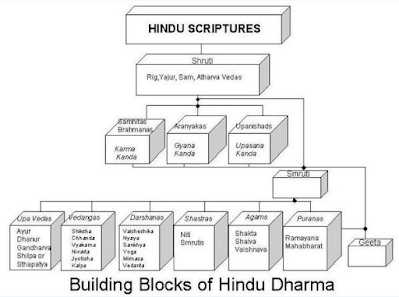
Smrti and Sruti Although the term "holy texts" or "scripture" is not an indigenous one, Hindus themselves have categorized such books in a number of significant ways.
We may start by dividing knowledge into sruti, which means "hearing, revelation," and smrti, which means "memory, tradition." Sruti is the Veda; it is timeless and was comprehended by the ancient r.s.is via extrasensory perception.
Even if the writers of Smrti writings were much smarter than modern humans are capable of becoming, they were still humans.
The word "sruti" does not relate to a fixed canon of writings since the bounds of the Veda are fluid.
Indeed, the phrase was not always limited to the Veda; in Manusmrti (12.95), books that are most likely Buddhist and Jain are condemned as "srutis that are outside the Veda" (Olivelle 2005: 234, 349).
Smrti is still not as exact. It contains the Kalpasutras, yet as they are a component of the Vedic ceremonial system, they are not typical of smrti writings.
The Mahabharata, the Ramayana, the Dharmasastras, the Puranas, the Agamas, and the Tantras are what are often meant by the word.
There may be disagreements on whether a text is authentic since none of these criteria are clearly established.
These works are often structured by a dialogue in which a mythological person learns something from a different figure, with the prestige of these individuals lending legitimacy to the lessons.
Conversations are often placed inside dialogues to provide a series of teachers and listeners, most notably in the Mahabharata.
As a result, their literary form places them in a setting of verbal instruction from an authoritative speaker to an attentive listener, a scenario that is repeated by a line of speakers and listeners down to the current reciter and his audience.
Smrti renders its listeners indirect receivers of linguistic communication from the divine, but Sruti makes audible the everlasting speech at the beginning of the cosmos.
The Smrti texts are publicly recited, with the reciter frequently interspersing a vernacular translation, in contrast to the Vedas, which must be protected from being heard by unauthorized people (such as non-twice-born men or women) and recited in a set ritual manner in the exact form in which they have been learned.
Despite the fact that printing and manuscripts have made such recitation easier, the majority of people encounter texts via voice.
The performance of reciting the Puranas is mostly oral, however it is carried out by a highly educated professional known as the pauranika, who not only reads the book aloud but also comments on it while referencing other works.
A similar performance erases the line between oral and written culture (Singer 1972: 150–55; see also Narayana Rao 2004: 103–14).
Since the proponents of smrti possessed in-depth knowledge of the Veda, historically, the authority of smrti is drawn from that of sruti.
Manu claims that the tradition (smrti) and behavior of people who know it are the second source of dharma after the Veda itself (Manusmrti 2, 6).
The Vedic redactor Vyasa is credited with writing the Mahabharata after compiling the Vedas (Mahabharata 1.1.52).
According to Mahabharata 1.1.204, "The epics (itihasa) and Puranas should be employed to reinforce the Veda, because the Veda dread an uneducated man lest he may ruin it."
The narrative is repeated in the Bhagavata Purana: Vyasa wrote the Mahabharata because women, sudras, and nominal brahman (those who do not fulfill the actual character of brahman by learning the Veda) could not access the Vedas (Bhagavata Purana, 1.5.25).
But it also adds a conclusion: Vyasa eventually wrote the Bhagavata Purana to instruct in Krishna worship because he was still unsatisfied (Bhagavata Purana 1.4. 26–31; 1.7.6–8).
The historical link between smrti and sruti weakens as we go from the Kalpasutras through the Dharmasastras and epics to the Puranas, Agamas, and Tantras.
The four yugas, the framework on which historical time is traditionally constructed, are used to acknowledge this historical variation in the tradition.
Only during the Kreta era could the Vedas be properly followed; during the Dvapara era, they were in danger of being lost, which is why Vyasa set them up.
The Vedas are poorly known and understood in the current Kali era, when the brahmans who should preserve them are degenerate and the status of the kshatriyas who once supported the yajna has been usurped by rebels; instead, the smrti texts, which contain the meaning of the Vedas, have taken their place.
The Kali era is claimed to outlaw several behaviors that are prescribed in the Vedic writings namely Kali Varjya(or kali-varjita).
These practices include animal sacrifice and niyoga, also known as levirate, in which a man's wife engages in sexual relations with his brother in order to produce a son for her dead husband.
The belief that the Bhagavata Purana, or any other specific smrti work, conveys the content of the Veda does not imply that specific sentences in one text may be connected to phrases in another.
Instead, it conveys the feeling that both have the absolute truth.
The Bhagavad Gita, which has been the subject of countless translations and commentaries since the late nineteenth century, is the smrti text that is currently printed the most widely.
Long before that, it served as the inspiration for numerous imitations, some of which are included in Puranas like the Ganesagta or the Devgta while the Anugta is contained within the Mahabharata itself (Gonda 1977: 271–76).
Although some people object to this, the Bhagavadgta is often utilized in funeral ceremonies and as a book for religious schools (Firth 1997: 84, 87).
Numerous smrti writings, whether they promote the worship of Siva, Visnu, or Sakti or another god, are well-known and acknowledged by devotees of other deities.
Many of the Puranas support this.
On the other hand, there are literature known as Agamas, Tantras, and Sam hitas that are particular to one or both of these deities.
The word "agama," which means "tradition," may be used to refer to works that provide guidance on ritual behavior and the pursuit of salvation generally, but it is particularly used to describe books that identify Siva as the ultimate god.
Tantra may also be used more broadly, however it is particularly employed in books on Sakti worship.
The Vedic Samhitas and the group of works dedicated to Visnu known as the Pancaratra Samhitas are the two principal usage of the term samhita.
Even while the phrases Agama, Tantra, and Samhita are often used to refer to Saivism, Saktism, and Vaisnavism, respectively, none of them are exclusive to any of these three.
However, the specific books they refer to are often just Saivism, Saktism, or Vaisnavism (Gonda 1977).
What Are Mantras, Vidhis, And Arthavada?
The Veda is divided into mantra, vidhi, and arthavada categories according to a different categorization created in Purva Mimamsa.
- A mantra is a passage of text chanted or spoken aloud during a rite.
- A vidhi is a paragraph that instructs ritual practitioners on what to do and how to execute it. It is often translated as a "injunction."
- Arthavada, which translates to "statement of purpose," explains why a ritual should be performed in a certain manner.
In practice, it refers to all Vedic texts that are neither mantras nor vidhis.
The Samhitas have mantras, but the Brahmanas and Aranyakas also commonly mention them.
The Brahmanas, Aranyakas, and Upanishads also contain vidhi and arthavada.
Although the word "mantra" is often used outside of the Vedic setting, this categorization specifically pertains to Vedic writings.
Non-Vedic literature may also be categorized into sections that are employed in ritual, sections that prescribe, and sections that offer motivation for ritual action.
The phrases vidhi and arthavada are less common writings in both Sanskrit and the local language.
The sruti and smrti writings mentioned above are all in Sanskrit, and many Hindus who do not speak the language are acquainted with the sound of Sanskrit due to its usage in ritual.
There are holy scriptures in all Indian languages.
Bhakti, with its focus on the relationship between the devotee and the divine, which eliminates the necessity for the brahman and his ceremonial writings in Sanskrit, encouraged the use of literature in vernacular languages.
However, we need not assume that the earliest vernacular texts, starting with the Tamil poems of the sixth century, were also the first bhakti texts to be made available.
The use of vernacular languages from the beginning in Buddhist and Jain texts suggests that Sanskrit's dominance in the religious sphere had long been contested.
Along with the bhakti poetry, there are many vernacular Puranas, some of which are completely independent of Sanskrit and others that have been translated or altered from it (Rocher 1986: 72–77).
Many regional and educational themes are addressed in vernacular versions of the Ramayana, such as Kampan's Tamil translation Iramavataram and Tulsdas's Hindi Ramcaritmanas.
In the Ramlla dramas, especially at Dasahra, these, especially the latter, are not only recited but also performed (Brockington 1998: 505-07; Lutgendorf 1991).
It is less common to dramatize the Mahabharata, but South India and Sri Lanka both stage plays centered on Draupad (Brockington 1998: 507; Hiltebeitel 1988-91; Tanaka 1991).
Sanskrit writings are explicitly rejected in certain bhakti traditions, as in the tale of the Marathi poet Namdev who had a cow recite the Veda (Ranade 1961: 71).
The concept of the fifth Veda and the notion that vernacular texts with concepts such as the Tamil Veda, as well as smrti texts with concepts like the Bhagavata Purana (see above), contain the meaning of the Veda, were both expanded.
On the other hand, in many lineages, the creation of vernacular literature has been followed by the development of texts in Sanskrit.
For instance, the Sanskrit works of Yamunacarya, Ramanuja, and others came after the Tamil songs of the Alvars.
The Alvars were also followed by the Bhagavata Purana, which, because it was written in Sanskrit, made emotional bhakti accessible outside of the Tamil-speaking region.
However, the change from the vernacular to Sanskrit was accompanied by a change from an emotional to an intellectual form of bhakti (Hardy 1983: 36–43).
Vernacular works must obviously be regional, although this does not preclude their translation into or imitation in neighboring languages; for example, poetry credited to Kabr are also available in Bengali, Panjabi, and Hindi.
Tyagaraja's (1767–1847) Telegu songs are popular in areas of South India and the diaspora but are seldom recognized outside of that region (Jackson 1991).
Up until the nineteenth century, when English usage started to rise steadily throughout the Hindu world, Sanskrit was the only language in which texts could be made available.
The English writings of non-regional, non-sectarian Hinduism pioneers like Gandhi, Radhakrishnan, and Vivekananda—a Bengali, Gujarati, and Tamil—show the significance of English in this process.
In the last fifty years, Hindi has surpassed English as the language spoken across all of India.
Some Sanskrit writings are regional or even local, while vernacular texts are by their very nature local.
What Are Mahatmyas And Sthala-Puranas?
In addition to texts from locally based sampradayas, there are texts from pilgrimage sites or temples.
These texts include Mahatmyas ('glorifications'), which extol the local deity and the advantages of visiting it, and Sthala-Puranas ('puranas of the place, local puranas'), which tell the history of the site's sanctity and the rules for visiting it.
Examples of these two types that overlap may be found in vernacular and Sanskrit languages (Rocher 1986: 71f. ; Gonda 1977: 276-81).
The readers or listeners of vernacular texts are not always able to understand them; Sanskrit is not the only language that is used in ritual without being fully understood.
The language of the Tamil bhakti poetry is not current spoken Tamil, although they are nevertheless widely performed in temples.
Tulsıdas’ Ramcaritmanas may have owed its popularity originally to its being in language familiar to its hearers, but it continues to be repeated in its original, now archaic form, its worth consisting in its holiness rather than its accessibility.
Sacred Poetry And Prose.
Most of the works we are interested in are in verse, however numerous mantras from the Yajur veda, all of the Brahmanas, the Aranyakas, certain Upanisads, and the Kalpasutras are in prose (interesting as the earliest instances of prose in any Indian language).
Also written in prose are the non-Vedic sutras.
There are a few portions in the Mahabharata and Puranas that are written in prose.
Sanskrit literature, especially technical works like the Sam.
hyakarikas, the founding book of the Sam.
khya philosophy, was and remains heavily verse-based.
The sloka, a stanza of thirty-two syllables split into four halves, is by far the most popular poetry form.
Unlike the other meters employed in the complex literature known as kavya, it is adaptable and simple to utilize (see below).
Slokas have been written by countless anonymous authors of the Puranas and other texts, in addition to well-known poets, and are used even for quite unpoetic subjects were cited in prose works of religion that inspired debate, such as:
- Swami Narayan's Vacanamrta ('Immortality in words') in Gujarati,
- Dayananda Saraswati's Satyartha Prakasa ('Light of truth') in Hindi,
- or Vivekananda's writings in English.
What is Kavya?
Even though kavya can be in prose, the term is occasionally translated as "poetry." It takes a significant amount of literary training to compose and appreciate this particular genre of Sanskrit literature.
It contains a variety of literary genres, such as verse epics, dramas, and one-verse epigrams.
Even today, despite the fact that few people are sufficiently educated to appreciate it, it is still being developed under the patronage of kings.
The Buddha-charita (also known as the "Life of the Buddha"), written by Asvaghosa in the first or second century CE, and inscriptions from the second century CE forward are the earliest instances that have survived.
Although textual scholars consider the Ramayana's only passages in which it claims to be the original kavya to be late and that it lacks the stylistic elaboration typical of kavya, it is still hailed as the genre's founding work (Brockington 1998: 23, 361).
Kavya, in contrast to smrti and other works, rigorously adheres to the grammatical rules established by Panini and other grammarians and makes use of sophisticated meters and aesthetic embellishments that are outlined in literary guides.
A thorough understanding of mythology as well as other disciplines is required to fully comprehend kavya, even though it generally does not come within the category of holy literature.
Kavya works frequently start with a prayer or deity's invocation.
Some, like Kalidasa's Kumarasam Bhava on the birth of Skanda, are based on mythological stories, while others, like his play Sakuntala, use epic tales.
The Gtagovinda and the Karnandana ('Delight of the ears'), poems from the Radhavallabh Sampradaya, which was formed by the poet's father, Hita Harivamsa, and focused on Krishna's beloved, Radha, are two instances of kavya compositions that are devotional throughout (Gonda 1977: 25–29; Entwistle 1987: 168).
The Kuncitan ghri-stava, written by Umapati Sivacarya in the year 1300 CE and translated as "Hymn of praise to [Nataraja's] curved foot," is one particularly intriguing example.
Each of its 313 verses concludes with a refrain that alludes to Siva's foot being raised in the dance and does so by way of a clever and moving fusing of mythological, theological, and philosophical ideas (D. Smith 1996).
What Is a Stotra?
The stotra, a hymn of adoration to a deity, is a common type of religious text that is written in both Sanskrit and vernacular (Gonda 1977: 232–70).
In contrast to sloka or the meters used in kavya, many stotras use rhyme and a metre with a strong recurrent beat, and they frequently contain a refrain.
Many stotras are credited to Sankara (Mahadevan 1980; Hirst 2005: 24f.).
The Gtagovinda contains stotras, which are songs.
Another example is the poem Bande Mataram by Bankim Chandra Chatterjee, which was originally written to honor Bengal as a mother goddess but was later changed to refer to India.
Its grammar is so straightforward that anyone who knows Bengali or Hindi can understand most of the poem (Lipner 2005).
The nama-stotra is one kind of stotra, and it consists mostly of a list of names, epithets, and descriptions of a specific god (Gonda 1977: 268–70; Gonda 1970: 67–76).
An early example is the Sata-rudrya ('[hymn] of a thousand Rudras'), which is still chanted in Siva temples and is part of the Black Yajur veda (Vajasaney Samhita 4, 5).
The prayers are interspersed with numerous names and epithets that invoke Rudra (Gonda 1970: 70f.; Gonda 1977: 241; translated Keith 1914: 353-62).
Other Sanskrit prose was utilized in theological works such as Ramanuja’s Vedartha-samgraha (‘Compendium of the meaning of the Veda’), and for the huge library of comments detailed below.
It was used for literary works such as the Pancatantra, theater, and other literary works that did not fall under the rubric of holy writings.
Except for letters and other related documents, little little prose was produced in the common languages until the nineteenth century.
The bhakti poems are in verse, though some, like the Marathi abhangs and the Kannad vacans, have a more flexible verse structure.
Since 1816, Rammohan Roy and his Hindu and Christian adversaries have contributed prose works in Bengali and English to religious debates that had hitherto only been held in Sanskrit.
In his earliest work, Roy noted that many people had trouble reading Bengali prose and offered some brief tips on how to do so (Killingley 1982: 12; Das 1966: 131f.).
Newspapers, books, and other advances encouraged the use of prose in the vernacular languages during the nineteenth century.
These well-known instances are the Lalita-sahasra-nama ('Thousand names of the luscious [Goddess]') in the Brahmanada Purana and the Visnu-sahasra-nama ('Thousand names of Visnu'; Raghavan 1958: 421-36).
What Is The Purpose And Place Of Commentary In Sacred Texts?
Hindu writings are meant to be analyzed and discussed.
Some comments, sometimes referred to as t.ka, just clarify challenging terms; the term for a more thorough commentary is bhasya.
Some comments, such as Saya's on Vedic literature, Sankara's on the Upanisads, or the countless commentators on the Manusmrti or Manavadharmasastra, explain every word in the original text on the grounds that nothing is without intent.
Some texts, like the Brahmasutras and the Bhagavadgta, have been discussed numerous times from various and frequently conflicting perspectives; one of the commentator's tasks is to disprove competing interpretations.
A commentary, particularly one on a sutra, may be a text of original authorship in and of itself, with subsequent commentary by members of the same school of thought elaborating on the first commentary's meaning in light of newer developments within the school.
Although it has been argued that the presence of substantial commentaries indicates a text's theological significance, a text that is religiously inspiring but not theologically significant may draw little to no attention (Clooney 2003: 461).
In addition to Sanskrit commentaries, vernacular commentaries exist.
Tamil commentaries on Tamil texts are one such example (Hardy 1983: 244f.).
Oral commentaries on the Puranas have also been mentioned.
~Kiran Atma
You may also want to read more about Hinduism here.
Be sure to check out my writings on religion here.
References And Further reading:
- J. A. B. van Buitenen, trans., Yamana’s Agamapramanyam or Treatise on the Validity of Pancaratra (Madras: Ramanuja Research Society, 1971).
- Bruno Dagens, Architecture in the Ajitagama and the Rauravagama: A Study of Two South Indian Texts (New Delhi: Sitaram Institute of Scientific Research, 1984).
- Mark Dyczkowski, The Canon of the Saivagama and the Kubjika Tantras of the Western Kaula Tradition (Albany: State University of New York Press, 1988).
- Kamalakar Mishra, Kashmir Saivism: The Central Philosophy of Tantrism (Portland, Ore.: Rudra Press, 1993).
- S. K. Ramachandra Rao, Agama-Kosa: Agama Encyclopedia (Bangalore: Kapatharu Research Academy, 1994).