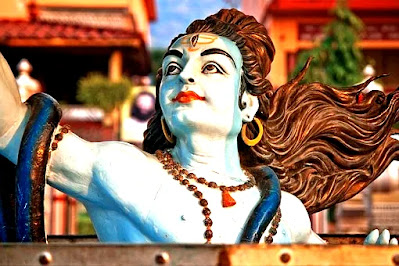
'Hinduism' is an English term coined by Raja Rammohan Roy,
an Indian social reformer, in 1816 and 1817. Rammohan Roy, a Hindu by birth and
an outspoken critic of Hinduism as it was taught at the time, coined the phrase
to characterize the religion of his forefathers, who believed in the unity of
God, as'real Hinduism.' The word 'Hindu' is derived from the ancient Persian
expression 'Sindhu', the name of the Indus river, which was initially used to
describe a person who lived in the lands east of the Indus. While Al-Biruni in
the eleventh century AD provided a precise and accurate description of those
beliefs and practices, it is unclear how and when 'Hindu' with its
ethno-geographical connotation came to mean a society with recognizable
socio-religious beliefs and practices. The archaeology of Hindu worship and
religion can be found in South Asia in the second millennium BC and Southeast
Asia in the early-mid first millennium AD. Hinduism is still a living religion
in India, Nepal, and Southeast Asia, where it lost its dominance in the
thirteenth to fifteenth centuries, with just around 5% in Singapore, 2% in
Indonesia, though more than 90% of the Balinese, and a very small group of
Chams in south-central Asia.

What distinguishes Hinduism as a faith in terms of worship
and ritual? The explanation of Hindu ritual conduct in India:
Within each or more of these classes, the average
middle-class Hindu may be brought by one or more aspects of his daily religious
practice, namely:
1. The veneration of ordinary stocks and stones, as well as
local arrangements that are odd or grotesque in scale, form, or place.
2. The veneration of inanimate objects endowed with
enigmatic motion.
3. Creatures who are hated are worshipped.
4. The veneration of visible, animate, or inanimate objects
that are explicitly or indirectly useful and beneficial, or that have some nonsensical
purpose or property.
5. Worship of a Deo, or ghost, a formless and empty object -
a hazy impersonation of the strange feeling that comes over in some locations.
6. Worship of departed ancestors and other people that were
familiar to the worshipper throughout their lifetime.
7. At shrines, people who had a good reputation in life or
who died in a strange or famous manner are worshipped.
8. The worship of demigods or minor deities as demigods or
subordinate deities in temples.
9. Worship of various territorial incarnations of the elder
gods, as well as their representations.
10. The worship of departmental or sub-deities.
11. Hinduism's supreme gods, as well as their ancient
incarnations and personifications, as documented in the Brahmanic scriptures.
And, in terms of the types of worship described in the
just-completed catalogue, they are all heavily tinged by a heavy skylight
reflection of overarching Brahmanism, from which the upper classes now claim to
derive their meanings instantly.
Hinduism is defined largely in terms of what Hindus 'do'
rather than what they 'say,' according to this definition. Hinduism, unlike
Buddhism, Christianity, and Islam, does not have a historical creator or a
codified canon that all adherents embrace. Hindu holy books are an incomplete
guide to what the faith is about because they emphasize only certain elements
based on the context from which they were written. Archaeology, with its focus
on experience rather than contemplation, is a good place to start when looking
into Hinduism's history.

Archaeological evidence has long been used to study
Hinduism: temple architecture, statues, pictures and their iconography, and the
spatial distribution of inscriptions are among the most studied categories. The
body of Indian archaeological evidence from specific time periods needs to be analyzed
on a regular basis. The essay explores holy sites in several spatial and
temporal perspectives, from early historic Rajasthan to mediaeval Vijayanagara
to Bali, to add to archaeology's contributions to the study of Hinduism.
Another critical part of Lyall's interpretation is his focus on the overlapping
existence of many modes of rituals and worship in most practicing Hindus' life
cycles. The appearance of some of these elements in the Indian archaeological
record indicates that they date from the late centuries BC; however, several of
these elements seem to have a much longer ancestry. The apsidal finished
shrines are part of a religious architectural pattern that dates to the third
and second centuries BC. At third-millennium BC Nindowari in Baluchistan, the
tradition of placing votive figurines at shrines is as old as the ceremonial
obsession with cultic bathing - which would find continuity in later Hinduism's
sanctity associated with water - and the worship of trees, with Harappan sites
yielding evidence of both. But does the existence of certain elements imply
that Hinduism can be traced back to India's protohistoric cultures? The
substantive disparity in proof character cautions against drawing such a simple
conclusion. For eg, at the Daimabad site in the second millennium BC, an agate
phallus - later a symbol of the god Shiva, a member of the Brahmanical triad
particularly synonymous with devastation - was discovered in an ash-filled pit,
but it is only one specimen from a culture that spanned a wide area in
Maharashtra. In comparison, there are many types of evidence of Shiva worship
from the late centuries BC, including lingas or phallus, depictions of devotees
worshipping a Shiva-linga, and emblems consistent with Shiva worship on coins.

By this time, a few deities had developed a transregional
influence, and a worshipper of one deity in one place would have been
completely at ease worshipping the same deity in another. Many regions of early
historic India, for example, had deities synonymous with fertility, water, and
safety, as well as shrines for their worship. The Brahmanical system, with its
numerous socio-religious sanctions and legislation, was still in effect by this
period, and was a defining characteristic of Hinduism. For the first time, a
cohesive body of evidence dating from the late centuries BC in South Asia and
the early-mid first millennium AD in Southeast Asia has been assembled, allowing
the 'archaeology of Hinduism' to be mapped out. As a result, this essay does
not subscribe to the view that Hinduism was a nineteenth-century colonial
invention, as premodern sources reveal the existence of Hinduism as a religious
system of beliefs and practices, and the Dharmasastra texts, some of which date
back to the second century BC, are a clear indicator of a self-aware social and
religious identity.

Furthermore, the archaeological prominence of Hindu values
and practices in India in the late centuries BC, which coincided with the
advent of a materially configured Buddhism, may have been partially a reaction
to and a result of a broader engagement with contemporary religious groups that
contested the Brahmanical tradition's dominance. The Mauryan dynasty's
consolidation of urban development and development of a pan-Indian empire were
key factors in the convergence of early India's religions. In a situation where
various religious traditions were both in conversation and rivalry with each
other, worshippers of Shiva, Vishnu, and other Hindu gods and goddesses seem to
have created and consolidated their own material language of theistic worship.
Architectural, sculptural, inscriptional, and other material evidence for Hindu
beliefs and practices exist many centuries later in Southeast Asia - especially
from the Malay Peninsula, parts of Cambodia, Laos, Vietnam, and Thailand, and
some of the Indonesian archipelago's islands - but not simultaneously or
identically manifested in all of these regions. Two early sources of evidence
currently come from Vietnam and two Indonesian islands: from the former comes
the Vo Canh inscription written in Sanskrit on three sides of a stupa, and
which is dated palaeographically to the third century AD: 'The surviving
passages appear to describe a donation of wealth made by "the joy of the
family of the daughter of the grandson of the king Sri Mara" to give
equality to his sons, brothers and male descendants .... Theological words used
in the text are most likely Hindu in origin, but they come from a pre-Puranic
tradition.' Slightly later are the east Kalimanatan stone pillars or stupa,
inscribed with Sanskrit verses and dated palaeographically to c. the
fourth-fifth century AD, which commemorate gifts given to brahmins for their
performance of rituals characteristic of archaic Hindu practices in India on
behalf of king Mulavarman.
Several fifth-century Sanskrit inscriptions from a polity
named Taruma or Tarumanagara, which refer to Hindu deities, as well as
fifth-sixth-century Vishnu sculptures, lingas, and other Hindu-related
materials from Cibuaya, have yielded roughly contemporary evidence. Evidence of
the local acceptance or transformation of other Indian ideas and components,
such as Buddhism, which coexisted and or or fluctuated in dominance within any
given region during the premodern period, models of kingship and social order,
Sanskrit, the calendrical structure, literary practices, and so on, occurs
around the early-mid-first millennium AD. The fact that Hinduism has been
shaped and reshaped by numerous influences over its history in South and
Southeast Asia warrants further investigation.
Identifying prayer and ceremonial spaces
Hindu worship and practice are made up of intertwined
components that can be used in both public and private spaces. Though a
detailed examination of this rich and diverse geography is beyond the reach of
this article, the following section provides a general typology of the contexts
in which Hindu worship took place.
Temples are a form of religious structure.

The temple, which was found both within and outside
villages, was the most visible place of Hindu worship. The first temples in
South Asia appear in the late centuries BC, and although no complete specimen
has survived, the ground plans indicate a variety of forms, ranging from
elliptical to apsidal. Many depictions of temples in Indian art from the late
centuries BC are made of perishable materials. Temples of this kind were
popular in village India until recently, implying that, although excavated
stone examples date from the late centuries BC, temples made of clay, bamboo,
or wood may predate them. The earliest temples in Southeast Asia date from the
mid-first millennium AD, and are known from the remains of their foundations,
as in India. For example, remains of fourth-sixth-century AD brick temples and
a fifth-seventh-century AD stone and brick temple foundation and linga
uncovered at Nen Chua, and remains of a sixth century Vaishnodevi temple
uncovered in the Malay Peninsula. Shrines were often made of perishable
materials, but whether they predate the oldest temples in Southeast Asia made
of robust materials needs further research. The remaining shrines from the
fourth to sixth centuries AD, coinciding with the Gupta dynasty, are comparatively
complete, with most of them having been discovered in central and north India.
Temple plans were more elaborate in the intervening years,
with podiums, superstructures, colonnaded rooms, vestibules, and open courts.
They are often adorned with reliefs portraying saints, mythological scenes, and
regal processions. However, though elaborate buildings became more prevalent in
later times, such as at mediaeval Vijayanagara; similarly, architecturally
simplistic shrines did not vanish in Southeast Asia, such as at Angkor. As
temples generally enshrined a presiding deity, which, particularly from early
shrines, often no longer survives in situ, an immense wealth of Hindu icons of
worship are encountered in South and Southeast Asia - rendered in a variety of
mediums such as wood, stone, various metals, and terracotta - as temples
generally enshrined a presiding deity which, especially from early shrines,
often no longer survives in situ. Where they do exist, they can be interpreted
in a variety of ways.
Shiva was worshipped in his aniconic form, the phallic
symbol, and sometimes in his human form, or a mixture of both. Vishnu, or the
preserver deity of the Brahmanical triad, was generally worshipped by images.
Brahma, the triad's creator deity, was often depicted in human form, but his
popularity as a cult god was limited. In India, goddesses such as Gajalakshmi
and Mahishasuramardini were widely worshipped, and some of the oldest temples
featured goddesses like Gajalakshmi and Mahishasuramardini on plaques. There
were also classic depictions of animal-human hybrids, such as Ganesha, the
elephant-headed deity. Humans were often often depicted as animals, such as
Vishnu as Matsya, a shark, Kurma, a tortoise, Varaha, a boar, and Kalki, a
horse. Outside of temples, images were revered in open air shrines and when
carried in processions, such as many of the famed South Indian bronzes carried
in processions.

Texts identify a wide range of temple rituals, and
archaeological representations of those activities can be looked for when
excavating temple sites. Some of them started well before the foundation was
built. For example, after a location was selected, it had to be consecrated by
foundation ceremonies; ceremonial deposits were often deposited in temple foundations.
Furthermore, some temple rituals have left material remains, such as large
terracotta bowls excavated from the temple areas at Bhitari in north India
between AD 450 and 550, which were likely used to give food to the deity or for
the ceremonial feeding of large numbers of worshippers or pilgrims. Sprinklers
or from the Bhitari temple fields, which priests likely used to sprinkle water
when doing worship; animals sacrificed for the deity or e.g. domestic sheep and
humped cattle bones were discovered in the inner sanctum of the Parasuramesvara
temple in Gudimallam, Andhra Pradesh. Votive offerings in the shape of
terracotta figurines of various gods and goddesses, as well as lamps, ablution
basins, and votive offerings in the form of terracotta figurines of various
gods and goddesses.

Generally, the votive figurines given were associated with
the shrine's presiding deity, though this was not always the case. In addition
to a Vishnu portrait and sculpted panels portraying him, the excavated votive
artefacts at the ninth-century AD Avantisvami temple in Kashmir dedicated to
Vishnu contained terracotta miniature lingas, which were usually rendered to
Shiva. The appearance of such offerings can be explained by the surrounding
presence of a Shiva temple or Avantisvara: devotees may have reached the
Avantisvami temple after worshipping Shiva there, bearing the same kind of
paraphernalia that was used for Shiva worship. They made miniature linga
offerings to Vishnu as well, disregarding those who believed Vishnu and Shiva
worship were mutually exclusive. Mendicants and preceptors have traditionally
held a special role in Hinduism, which is also evident in the temples with
which they were associated during their lifetimes.

The temple of Srirangam in
Tamil Nadu, dedicated to Vishnu, is a well-known example of this; the
twelfth-century Hindu reformer and philosopher Ramanuja lived here for a large
part of his life and, evidently, was also buried here, his shrine being built
at that exact place. Although the origins of this tradition are unknown,
evidence of teacher shrines can be found as early as the Gupta period, for
example, a c. fourth-century AD stone pilaster from Mathura bears an
inscription suggesting that it was used in a shrine dedicated to recalling a line
of Maheshvara teachers. Preceptors may also influence the design of temples
constructed by their devotees.
Tanks, sacrifice places, and folk shrines
Though temples remain the most spectacular of Hinduism's
holy sites, public ceremonies were not exclusive to them. Other arenas include
sacrificial sites, areas where ceremonial donations are publicly performed,
prayer near rivers, and village shrines. The options for identifying such
locations, as well as the nature of archaeological evidence that may shed light
on the related rituals, are discussed further below. Many of India's popular
Hindu pilgrimage sites are situated at the source or along the banks of rivers,
where ancestor oblations, river worship with fire, and bathing in them on
special days are all practiced on a regular basis. Such performances rarely
leave permanent archaeological marks or Hooja, according to this article, while
Sringaverapura, on the left bank of the Ganga river, is one site that has
yielded such evidence in connection with a water source.

The river was some
distance from the village in ancient times, so a huge tank complex was built to
provide good potable water for the inhabitants. The system drained water from
the river into a silting chamber and a series of tanks through a canal. In the
first century AD, one of them, Tank C, became associated with certain religious
rites, and among the remains are terracotta figurines of deities such as
Kubera, Shiva, Parvati, and Hariti or Shashthi, as well as animals and votive
tanks. The essence of the ceremonies that necessitated such objects remains
unclear, but the tank complex seems to have served a dual purpose: its waters
offered both physical and moral nourishment. Outside of temples, archaeological
remnants of public ceremonies can be found in specially prepared grounds or
spaces for the execution of sacrifices. There are brick platforms in the shape
of a syena, hawk, or eagle with spread wings at Jagatgram, in the north Indian
state of Uttaranchal, that closely resemble descriptions in Vedic literature.

The epigraphs on some bricks show that these consecrate
rites were associated with the asvamedha or horse sacrifice. Oblations of
various kinds were commonly offered at such sacrifices, but no such evidence
has been found at Jagatgram. However, the Kushana period from AD 100-300 altars
at Sanghol in Punjab have yielded large quantities of organic material from
ritual fire altars, and a palaeobotanical investigation of these Kushana period
from AD 100-300 altars confirmed that the material was of the kind that was
usually used in sacrifices, e.g. of various food grains, such as rice, barley,
black gramme, lentil, and sesame; edible fruits These findings bring to life,
possibly for the first time, the detailed depictions of intricate sacrificial
sacrifices and oblations used in Hindu religious texts. The question of social
access to worship and the rights of various communities to conduct rites at
Indian religious sites is typically overlooked in archaeological studies. While
it is difficult to find archaeological evidence of the Brahmanical system in
Southeast Asia, in which different social classes were given entry based on
their caste hierarchy position, or which only occurred in theory, it is
difficult to believe that such sites were not distinguished by caste
exclusions.

Given that the Arthasastra, a text from the late third
millennium BC, prescribed where the cremation grounds of the various varnas, or
four social divisions, should be located, it seems possible that not everybody
was granted entry to arenas like temples, to worship and conduct rituals there.
In terms of whether there were any arenas outside of temple Hinduism where all
these communities could come together to pray, ethnographic records indicate
that there were. The 'Devi,' or goddess, who is commonly revered in such
places, is represented by a variety of village shrines, ranging from artificial
platforms on which a rough stone is worshipped as her embodiment to natural
objects such as trees, caves, and hills.

Since Brahman priests are not expected
to mediate at these shrines, devotees from all social classes attend.
Similarly, ethnographic accounts of village shrines are likely to be signifiers
of a premodern existence, as folk gods revered at such shrines can be found in
the early historical record. In the Hindu tradition, public places of worship
and ceremony were of different forms, some of which were distinguished by caste
sanctions that revealed limits. Convergences and backgrounds with shared social
values and tolerances may also exist; village shrines were one such
intersection point.
Worship in the home
Hindu rites and worship took place in a variety of domestic
settings. Unfortunately, little is known archaeologically about domestic-level
Hindu activities in Southeast Asia; much of what is currently known is focused
largely on what can be gleaned from excavation reports of historic settlements
in India, especially data on their structural remains. One point to remember is
that, much as today, citizens of diverse religious faiths lived together,
resulting in the spatial coexistence of various forms of domestic worship.
Excavations at Kapilavastu, for example, have uncovered habitational evidence
dating from about 800 BC to the third century AD, as well as terracotta Buddha
figures attesting to Buddhist icon worship in the early centuries AD.

However,
as shown by terracotta heads or, for example, one depicting Shiva with a
snake-hood on top and a long yajyopavita or holy thread on his back, there were
Shiva devotees. Jains may have also worshipped there, as evidenced by the
presence of a naked Jina figure or ibid. on the terracottas. In India,
terracotta figurines, votive terracotta reservoirs, and female and male
figurines were commonly used in domestic worship. Female terracotta figurines
have been discovered in ancient rural settlements, such as Narhan, where they
were particularly prevalent between c. 200 BC and AD 600. Some of the plaques
at Narhan are of the same genre as those found in the north Indian cities of
Tamluk, Kausambi, Ahicchhatra, and Rajghat, implying that those who believed in
the influence of this 'goddess' comprised a wide cross-section of urban and
rural communities. It's also worth noting that female figurines and terracotta
votive tanks are commonplace items with nothing particularly 'Hindu,'
'Buddhist,' or 'Jain' about them when seen in isolation. As a result,
interpretations of them as Hindu ritual markers must be dependent on their
archaeological background.


