Showing posts sorted by date for query liberation. Sort by relevance Show all posts

Hinduism - Who Was Ramanuja?


    Who Was Ramanuja?


    Ramanuja was a Southern Indian philosopher and the most important figure in the Shrivaishnava religious community in the 11th century.

    He was the greatest exponent of the philosophical position known as Vishishthadvaita ("qualified non-dualism") Vedanta, the core tenet of the Vedanta school of Hindu philosophy and the most important figure in the Shrivaishnava religious community.

    Ramanuja spent the most of his life at the temple town of Shrirangam in Tamil Nadu, where he served the temple's resident god, Ranganatha, a form of Vishnu.

    Ramanuja believed that Brahman, or Supreme Reality, was a personal god rather than an impersonal abstract concept, and that the most significant kind of religious activity one could perform was devotion (bhakti).

    His philosophical viewpoint, Vishishthadvaita Vedanta, emphasized both of these principles.

    God, according to Ramanuja, is entirely transcendent and without flaws in his basic essence.

    A notion taken from the Samkhya philosophical tradition is that the universe evolves from God via a process of evolution.

    The universe is therefore like God in that it comes from him, but it is also unlike him in that matter is unaware and insentient.

    Human beings, too, are comparable to God in nature since they have him as their source, yet they are susceptible to ignorance and suffering, unlike God.

    God, according to Ramanuja and his followers, is not the same as human beings or the earth, all of which are said to exist in their own right.

    Due to the differences in capability between God and humans, dedication is the most efficient way to achieve eventual soul liberation (moksha), which is defined as everlasting fellowship with God.


    What Is The Philosophy Of Ramanuja?


    A Brahmin initiate into the theistic and devotional South Indian Sri Vaisnava tradition, Ramanuja lived from from 1075 to 1140 AD. 

    Members of that tradition hold him in high regard as the theologian and scriptural interpreter who, in the tradition of Nathamuni (c. 900-950) and Yamuna (c. 966–1038), provided a strong and thorough theological and philosophical defense and articulation of their beliefs and practices in the system that would later become known as Visistsadvaita Vedanta. 


    What Is The Advaita Vedanta Tradition?

    The Advaita Vedanta tradition of scriptural exegesis, which maintains that the significance of those texts is the identity of the soul (atman) and the ground of being (Brahman), and that all experience of difference is the ultimately unreal result of ignorance or misunderstanding, was challenged in this (avidya). 

    Nothing in Vedanta, whether theistic or not, could ever be the same again as a result of his achievement in this area. 


    What Are The Beliefs Of The Vaisnava Sect?

    The Sri Vaisnava sect gets its identity from the fusion of traditional Vedantic components with sectarian Tantric (non-Vedic) Pancaratra temple ritual and theology, emotional devotionalism (bhakti) toward a personal god with characteristics (saguna), and Tamil Alvar poets. 

    The Pancaratra texts serve as a framework for the sect's liturgical activity (agama). 

    In the temple image, there is a focus on the immanent presence of the divine in creation (arcavatara). 


    Was The Alvar Worship Open To All Of Society?

    The Alvars' devotionalism is open to all social groups. Everyone is welcome to a relationship with God, regardless of caste or gender. 

    The songs portray a deep yearning for God, the "agony of separation" from him, and the joy of reestablished contact. 

    Vedanta, also known as the science of Brahman or the absolute reality, is the systematic exegesis and elucidation of those sections (the jnana-kanda) of the purportedly timeless and infallible Vedic sacred texts known as Upanisads that address in various ways such metaphysical issues as the nature of the absolute principle and summum bonum underlying the cosmos, the nature and destiny of the essential self (atman). 

    Its foundational text is the Brahmasutra, attributed to Badarayana in the second century A.D., which summarizes the major Upanisadic themes in a way that is easily remembered but inevitably highly ambiguous (given the aphoristic nature of the sutra genre), much like the Mimamsa sutras, attributed to Jaimini in the 100s A.D., which summarizes those sections of the Vedas (the karma- Vedanta is also known as Uttara Mimamsa (Later Exegesis). 

    Insofar as the road of ritual activity came to be viewed as antecedent and propaedeutic to the path of knowledge, the ritualist received the title Purva Mimamsa (Previous Enquiry). 


    Did Ramanuja Help Transform Non-Vedic Traditions To Vedic Traditions?

    Ramanuja is a key player in the non-Vedic tradition's transformation into a Vedic tradition. 

    The Upanishads, the Brahmasutras, and the Bhagavad Gita serve as the fundamental sources for the ancient Vedantic tradition, which he attempted to harmonize with the principles of his bhakti religion. 

    The most important of the criteria for Hindu Brahminical orthodoxy (smarta), which also include the acceptance of the Vedically derived social and religious obligations unique to hereditary caste members (varnashrama dharma) and the eternity of an essential principle in man (atman), is the Veda's authority. 


    What Is Vedanticization?

    Vedanticization is the process of articulating sectarian traditions' theory and practice in terms of a broadly accepted philosophy and code of conduct that has been upheld by the main Vedantic tradition. 

    Ramanuja argued for the Vedantic validity of his bhakti religion by writing commentary on the Brahmasutras and the Gita. 

    His theistic and dualistic readings of the Upanisads gave popular devotional religion a classical foundation. 

    Yamuna had created the groundwork for such an endeavor by using Tamil religious literature. 

    He aimed to show in his Siddhitraya that the fundamental self (atman) possesses a personal existence. 

    He promoted the idea of effects being the realm of material things. 

    He maintained that God is the right object of one's devotion since He has attributes of a personal kind. 

    In his Gitarthasamgraha, he argued that the Gita's fundamental goal is to instill bhakti as the only way to achieve liberation, which entails an intimate, loving connection with God in which the individual self is preserved. 

    Since the Upanisads are considered to be completely infallible with respect to the transcendent, synthesizing beliefs with the Vedantic worldview gives them the sanction of antiquity and ensures their reality. 

    The Vedantic language suggests that teachings have an unwavering, everlasting validity. 

    Vedanticization, or the notion that one's tradition has a foundation that is eternally and inherently legitimate, gives one a stronger base on which to develop their religious life. 


    How Was Ramanuja's Philosophy Pan-Indian?

    A theological system may have pan-Indian currency among the educated thanks to the usage of Sanskrit

    Nathamuni and Yamuna started the process, which Ramanuja reinforced. 

    We see a constant endeavor on their part to further the Sanskritization of the bhakti religion. 

    The worshipper's adoring contemplation of God in his heaven is equivalent to moksha (release from the cycle of births), and the acts of worship and veneration are on par with the rites outlined by scripture and tradition. 

    This is how the God of the bakhta is equated with the supreme principle of the Upanishads. 

    It has been claimed persuasively that Yamuna was a self-aware representative of a Pancaratrika Vedanta, who asserted that the sectarian Vaisnava Pancaratra writings are equivalent in authority to the Vedic texts. 

    Using literature that had never before been included in Vedanta or Uttara-Mimamsa, such as the Pancaratra Agamas, which was viewed as a "easily understood" divine revelation, he created a theistic Vedanta. 

    Ramanuja can't be stated to be the same. He is so preoccupied with proving Sri Vaisnavism's Vedantic validity that Pancaratra is left in the background. 

    Only while justifying the compatibility of that tradition with Vedic culture does he make reference to Pancaratra scriptures (SBh.2.2.40–43). 

    He makes no mention of the openly sectarian Vaisnava Bhagavata Purana for the same reason. 


    Ramanuja And The Tamil Veda.

    The Divya Prabandha, sometimes referred to as the Tamil version of the Veda, was compiled by Nathamuni from the passionate songs of the Alvars and utilized in temple worship. 

    Ramanuja doesn't mention the "Tamil Veda" at all. He views bhakti as an intellectual and philosophical phenomena rather than an emotional one. 

    In his conservative view, dedication must be placed within the framework of social and religious commitments. 

    However, there are clear parallels between his realistic and pluralistic metaphysics and the bhakti religion. 

    In the end, monistic Advaita-Vedanta is opposed to bhakti. 

    Ramanuja had to demonstrate that revealed scripture (shruti) and authoritative tradition (smruti), not the Advaitins' religion, was what was taught. 

    In order to do this, he critiqued the intellectual underpinnings of monism and offered theistic and dualistic readings of Upanisadic scriptures. 


    What Is Ramnuja's Visistsadvaita or Vedanta?

    The philosophy he developed, known as Visistsadvaita or Vedanta, is based on the premise that all conscious souls and material beings are one with and in God, who they are inextricably reliant upon since they make up the divine body. 

    Vedanta is the aphoristic summary of the Upanisads' significance found in the Brahmasutras and the systematic hermeneutic of the Upanisads. 

    The Vedantic theologian views himself as a scriptural exegete who draws theological conclusions from a body of scripture that is intrinsically valid (svatah pramanya), independent of God (although, according to Ramanuja, promulgated by the deity at the beginning of a cycle of cosmic emanation), and our only source of knowledge regarding the nature of whom it is (pramana). 

    The Vedic language is ageless, and its meaning is not dependent on any given situation, although it is acknowledged that it is difficult to grasp and requires interpretive clarification. 


    What Is The Significance Of Sampradaya In Vedanta?

    According to Vedanta, a prerequisite for a correct reading of the scriptures is adhering to an established religious tradition (sampradaya). 

    Tradition shouldn't breed damaging bias but rather awareness. Originality in theology is a flaw. 

    The theologian's endeavor, which entails the methodical explication of accepted concepts, is one of preservation. 

    The inherent (autpattika) and unchangeable (nitya) relationship between a Vedic term and the referent in which it participates metaphysically is the source of the infallible authority of text. 

    It was assumed that Sanskrit words were not only symbols for their objects, but also integral parts of them. 

    Neither supernatural intervention nor human convention have been able to mend the link. 


    The Vedas Are Considered A Revelation.

    Vedic speech is "non-personal" (apauruseya). 

    There is neither a divine nor a human author of the Vedas. 

    They are not a divine self-revelation, even yet they are the sole source of information about God. 

    The Purva-Mimamsaka theorists, whose primary religious concern was the clarification of those sections (the karma-kanda) of the intrinsically valid but frequently cryptic and ambiguous Vedic texts that are the only source of knowledge about those ritual performances which are an essential component of the cosmic order (dharma), developed these theories regarding the authority of the Vedas. 


    The Vedas Are Regarded As Infallible.

    The Vedas are regarded as being infallible in theory since all cognitions are taken for granted as true just by virtue of their occurrence and remain true unless refuted. 

    The Mimamsakas were atheists who believed that the universe's stability and human well-being in this world and the next (both covered by dharma) resulted from the disinterested conduct of Vedic rituals, whose proper execution would inevitably have beneficial effects. 

    While certain rituals (kamya) might be conducted with a particular goal in mind, the most important ones were to be carried out in a spirit of obligation for the sake of duty, independent of any particular benefits. 

    Those "twice-born" men (i.e., members of the higher three castes who have undergone the upanayana ceremony of initiation entitling them to participate in Vedic ritual) with the necessary qualification for legitimate access to the rituals (adhikara), according to the Prabhakara school of Mimamsa, are moved to action in the manner of categorical imperatives by the prescriptions enjoining them (vidhi or niyog Indicative, descriptive, or fact-asserting scriptural statements are to be construed as praising the sacrifice or explaining the mode of its performance, according to the Prabhakaras, who also held that only those scriptural statements that are injunctions bearing upon the essential rituals (karya — "things to be done") are an authoritative source of new knowledge (pramana). 


    Siddha And Sadhya.

    They are not authority for things that are already established (siddha) and do not need creation (sadhya), since they are the purview of knowledge-producing mechanisms like perception and inference. 

    As a result, the language of the scriptures cannot be considered authoritative in regards to Brahman. 

    They provide evidence for this by saying that all language has meaning when it is connected to an action. 

    They support a semantic theory known as "associated designation" (anvitabhidhana), which carries the weight that a word only has meaning when it is used in a sentence. 

    The Prabhakaras adopted an anti-realist stance, exemplified by their epistemically constrained definition of reality (satta), which they defined as anything that exists and is amenable to connection with valid cognition (pramana sambandha yogyata). 

    This definition is consistent with their view that reality is something that must be brought about in accordance with the dictates of Vedic injunction. 

    Insofar as it depends on following set rituals, the universe is truly of our creation. 


    A Theory Of Truth.

    A pragmatic theory of truth, which holds that knowledge is useful for directing action whereas mistake is worthless in that regard, complements this point of view. 

    In response, Ramanuja argues that effective action requires language with informational significance, which is often fact-assertive and descriptive. 

    Even if the Vedic jnana-kanda, the Upanisadic books, are taken as commandments that forbid meditation on Brahman, they can only do so if they have previously proven its existence. 

    According to Ramanuja, learning the meanings of words involves an ostensive defining process that results in the creation of an idea (buddhyutpatti) of the words' referents. 

    The young child learns that all words convey their intended meanings and that some word combinations signify various types of unforced linkages between basic items. 

    Thus, he holds to the kind of semantic theory (abhihitanvayavada) put out by the Mimamsaka direct realist Kumarila (c. 650 A.D.), which may be summarized as the idea that a phrase is made up of a string of word meanings that have previously been articulated singly. 

    The fundamental units of meaning are words as individual expressions of general characteristics. 

    A sentence is made up of a collection of distinct words, each of which, taken alone, designates a set of discrete objects, which serves as the main epistemological "given." 

    These words then each separately and serially express one of their proper senses, which are then combined to create a further syntactically connected whole, the purport (tatparya), of the sentence, which stands for a particular person or situation. 

    The grammar (anvaya) of the words' explicitly articulated (abhihita) meanings provides the purport. 

    The intent is particular even if the individual word meanings are universal. 

    It is important to note that they consider the Vedic commands as hypothetical imperatives that only apply to eligible individuals (high-caste men) who have an interest in the specific purposes they define. 

    The logic, epistemology, and metaphysics of the Nyaya-Vaisesika school acknowledged the inspiration of scripture as God's written word. 

    As a result, its validity is external. 

    They rejected the idea that the scriptures alone could answer questions concerning the nature of God and the soul and instead argued that inferential reasoning could be used to prove Isvara and atman's existence and characteristics. 

    They only sometimes used the scriptures to support a point that had previously been made by logical reasoning. 

    They were unable to make an argument for God's existence only based on the scriptures due to the danger of becoming circular. 


    Ramanuja As A Metaphysical And Epistemological Realist.


    Ramanuja is a realist in both metaphysics and epistemology.  Here, I briefly discuss some aspects of both realism and anti-realism in order to distinguish between them and how they restrict what is possible within the confines of language or human comprehension. 

    At its core, realism is the expression of a natural human desire to see beyond appearances that are caused by our limited human perspective on the universe and to get at a genuine perception of reality as it is in itself. 

    Any discussion of a reality that is incomprehensible to our cognitive abilities is questioned by the anti-realist. 

    As a result, "to be" is to be intelligible to us. 

    Such theories include idealism, which entails the mental nature of the ostensibly physical and the exhaustive reduction of everything to states of consciousness; phenomenalism, which holds that familiar physical objects can be reduced to human sensory stimulations; representationalism, which holds that what we are immediately aware of are sensory and mental impressions standing in causal relations to objects; and the type of semantic anti-realism propagated by the semantic anti-realism movement. 

    A realist philosophy, however, may include any or all of the following characteristics: There is an objective, mind-free world. 

    That is to say, even in the absence of occupied human subjective standpoints attesting to their existence, things proposed by an ontology as belonging to a domain exist, truths are true, and situations of events exist. 

    There may be more than we can comprehend or imagine. 

    In other words, certain facts are unreachable to humans. 

    While the degree of connection between our ideas and the outside world is decided independently of human cognitive activity, we are nonetheless capable of accurately imagining and understanding the human surroundings. 

    We often discuss actual objects rather than ideas, concepts, sensory data, or mental sensations. 

    Never are the objects of sense primarily cerebral and non-physical. 

    A universe of mindless physical things is seen as real until that view is refuted by another perception. 

    Similar to how they seem to humans, familiar macroscopic things would also appear the same to species with diverse sensory modalities. 

    (Epistemological realism or realistic common sense) Initially, consciousness is unformed, passive, and receptive. 

    Language and innate concepts do not significantly organize or perhaps even distort the sensory outputs. 

    According to facts about the mind-independent sphere, every proposition is categorically either true or false (realist empiricism). 

    Truth is some kind of relationship between ideas, words, and circumstances. 

    True thoughts and phrases have a representation that is structurally isomorphic to extra-mental reality. 

    Complex true cognitions depict complex situations of events and are causally connected to them. 

    True concept-laden cognition provides more information about the reality. 

    It does not alter or remove us from reality. 

    Certain sorts of property, like abstract universals, exist apart from the human mind and language. 

    (Platonism and the Naiyayika theory of universals, which Ramanuja does not agree with.) It is not possible to reduce claims about one domain (such as the mental) to statements about another kind of domain (e.g.  the physical).


    References And Further Reading:

    • A Sourcebook in Indian Philosophy, edited by Sarvepalli Radha Krishnan and Charles A. Moore, 1957.
    • John B. Carman, The Theology of Ramanuja, 1974.


    ~Kiran Atma


    Human Well-Being From A Hindu Perspective: Care, Healing, And Wellness


      It is reasonable to conclude that religion and spirituality in general contribute to human life fulfillment and pleasure in all civilizations. 


      Due to the increasing complexity of everyday life, providing care for persons' physical and mental needs has become a growing problem. 

      Indeed, life has become a source of worry, bringing significant challenges to religious thought and spirituality. 

      As a result, care and human well-being are prioritized in modern India, particularly among Hindu civilizations. 


      Hinduism, the world's third biggest religion, is very important to the people of India. It is considered "a way of life" (Chaudhuri 2012: 28). 


      As a result, it's critical to look at how Hindus see care, healing, and human well-being, as well as what their practice includes among their followers in India. 

      The current research begins with an overview of Hinduism as India's major religion. 

      It is descriptive and attempts to elucidate the notions of care, healing, and well-being within Hindu thinking's cultural and religious traditions. 

      The relationship between Hindu thought and how it is operationalized in its rites of passage (also known as "Hindu sacraments"), "goals for meaningful human life," and "five great sacrifices" will be a particular emphasis. 


      Finally, the article discusses care, healing, and well-being in the modern day, with a focus on renascent Hinduism and its ideas on gods and goddesses as its source. 


      Ayurveda as a Hindu science of medicine for holistic well-being, yoga as a path for mental well-being, and asrama-dharma as care and well-being for the elderly within the domain of gem-transcendence will all be discussed to further investigate modern Hinduism's viewpoints. 


      India's primary religion is Hinduism. 


      Hinduism is the most widely practiced religion in India, the world's seventh biggest nation (3.3 million square kilometres). 


      India, which is expected to have a population of 1.42 billion people by 2023, is noted for its religious variety and cultural diversity. 

      Aside from Hinduism, India is home to Buddhism, Jainism, Sikhism, and a number of other ancient religious traditions. 

      In addition, India is home to a diverse range of faiths, including Semitic religions. 

      According to the 2011 census, Hinduism is followed by 79.8% of the Indian population, 14.2% Islam, 2.3 percent Christianity, 1.72 percent Sikhism, 0.7 percent Buddhism, 0.37 percent Jainism, and 0.66 percent Zoroastrianism. 


      Despite the diversity of religious connections among Indians, the Hindu religious heritage plays a critical part in the country's spiritual, cultural, and social makeup. 


      In terms of Hinduism's texts, deities, and belief systems, the concept of 'unity amid variety' (Sarma 1996: 13-27) may be distinctively recognized. 

      The word 'Hinduism' does not refer to a single, closed religion tradition, but rather to a wide range of faiths, beliefs, doctrines, rituals, and practices linked with a variety of gods, goddesses, and cults found on the Indian subcontinent. 

      Although the name Hinduism refers to a specific religious tradition with a history that spans many centuries, its spiritual foundations date back almost four millennia. 

      Hinduism is considered by its supporters to be a sanatana dharma, or "everlasting religion," since it is founded on the eternal truth enshrined in the Vedas (the primary Hindu scriptures). 


      Hinduism, being one of the world's oldest alive religions, does not honor a single sage or prophet as its creator, nor does it claim a single central authority for its existence. 

      It is, in reality, based on an open canon. 

      It remains an all-encompassing, all-encompassing, and inevitably ever-evolving spiritual tradition in this way. 

      According to Shashi Tharoor (2018: 39), "Hinduism is a characteristically Indian development, a type of 'banyan tree,' as a consequence of its openness and variety. 

      Its branches spread far and wide, sinking back into the ground to take new root in the inviting soil." 

      One of its defining characteristics is the domination of a type of 'religious awareness.' 

      This centripetal perception leads to the domination of a very distinct religious point of view and spiritual sensitivity to all matters of life among Hindu believers (Griswold 1996: 24-26). 

      As expressed in Hindu scriptures, traditional thought, and culture, this complete worldview incorporates a spiritual perspective of care, healing, and human well-being. 


      Hindu themes of care, healing, and well-being are discussed in this paradigmatic context. 


      The themes of caring, healing, and well-being are implicitly ingrained throughout Hindu thought. 


      In Sanskrit (the Hindu tradition's holy language), the term 'care' has many distinct definitions: 


      Raksa Means to guard, look after, save, preserve, or keep away from. 


      Pala(-na) Means to keep an eye on, guard, defend, or govern. 


      Chinta = to consider a thought via contemplation and introspection,  (Williams 1994; 1976). 


      Raksha Bandhan, a prominent Hindu event, is strongly linked to the pledge of care and the safety of the family. 


      • The sisters tie the rakhi, a kind of amulet, around their brothers' wrists as part of the festival's ceremonial to protect them from negative influences and to pray for their long life and happiness. 
      • The sisters are given a gift at this event. 
      • The ceremony's origins may be traced back to a Hindu folklore in which Draupadi tore a piece of her saree and wrapped it to Krishna's wrist, injuring him accidently. 
      • Its purpose was to halt or prevent bleeding. 
      • As a result, a link was formed between them. 
      • Krishna vowed to safeguard Draupadi in exchange. 


      Furthermore, the Raksha Bandhan celebration serves as an annual ritual. 


      It historically authorized the brothers to take duty for the care of their sisters in order to keep them from being harmed, and it signifies protection and caring among siblings. 


      Sama = balanced; when anything in its original healthy nature is injured, it should be balanced, according to Sanskrit. 


      Svastha is the Sanskrit word for "health" or "being in one's natural condition." • Santhi is a Sanskrit word that means "rest," "quiet," "peace," "tranquility," "bliss," and "comfort" (Williams 1994). 

        • The word svastha in Ayurveda refers to a person's overall health. 
        • It typically refers to a "state of being in which one's body, mind, spirit, and senses are all in happy harmony" (Yogapedia Dictionary 2020). 
        • As a result, health is defined as the physical well-being of a person, as well as mental, emotional, spiritual, and energetic inclinations. 
        • As a result, healing is defined as the comprehensive restoration of health. 
        • Despite this holistic approach, doctors' cures for illnesses are different from the spiritual part of healing. 


      Svasti is a Sanskrit term that means 'well-being.' It might also mean 'benefit.' Well-being refers to a sense of fulfillment and happiness in life, as well as an inner sense of harmony with our surroundings. 


      Meditation, according to Hindu belief, leads to an inner feeling of serenity and tranquility. 


      • It promotes a sense of well-being that is rooted deep inside oneself (Lovato 2019). 
      • Hindus are taught to consider well-being, a feeling of pleasure with life, as vital to a sense of purposefulness, rather than the pursuit of artificial kinds of enjoyment (Menon 2012: 2; 4). 
      • Holi, a full-moon Hindu celebration in which married women celebrate their happiness and the well-being of all family members, is an example of this. 


      Yoga is another aspect of the Hindu tradition's concept of well-being. 


      • It is said to provide people with a feeling of well-being, encouraging a sense of being 'whole.'


      Sources and practices of conceptualization in Hindu thought. 


      The Hindu scriptures and Indian cultural traditions both include notions of care, healing, and well-being. 


      Hinduism is blessed with various texts as one of the world's oldest existing faiths. 

      The benefit is that they all have a canon that is open-ended. 

      There are four Vedas, as well as Sutras, Epics, Codes of Law, and Sacred History, among other sources. 


      Philosophical Manuals and Sectarian Scriptures are also included with the Vedas. 


      In addition to many other literature that Hindu devotees religiously study, all of them are deemed to have either main or secondary scriptural value. 


      Vedangas, or Sutra literature, is taken straight from the Vedas and contains many of Hinduism's theological principles. 

      In Hindu religious thought, the concepts and practices of caring, healing, and well-being are implied in the Grhya and Dharma Sutras

      The former is concerned with household rituals, whereas the latter is concerned with socioreligious rules. 

      Many other Hindu beliefs and practices, such as samskaras, purushartha, paru;amahayajna, and varnaasramadharma, are intertwined with its different elements. 


      Hindu rites of passage: the practice of samskaras. 


      Meaningful life and dying via Hindu rites of passage: the practice of samskaras. 


      The Hindu sacraments, or rites of passage, are known as samskaras (Pandey 2001; Antoine 1996c) and span one's whole life span as well as the world beyond (transcendent dimension), starting with prenatal rituals and ending with post-mortem existence. 

      • According to ancient scholars, three key prenatal rituals lay the way for care to be offered to pregnant women and the unborn child in order to assure health and protection against evil. 
      • Early childhood or infancy samskaras are for the child's intellectual well-being, longevity, safety, and even adornment. 
      • With basic and secondary education, educational samskaras secure an individual's profession outside of the family, preparing them for active citizenship obligations. 
      • The marriage (vivaha) ceremony is the most important sacrament, through which a person fulfills socio-religious and family duties. 
      • The penultimate sacrament, the funeral ritual (antyeshthi), takes into account the needs of both the dead and the living. 
        • This ceremony expresses 'sublime feelings' that make death pleasant for the one who dies, as well as for the society to accept death and dying as an unavoidable occurrence. 


      A person's life is made up of a succession of events. 


      • In this way, the sacraments offer people in society with the care and protection they need. 
      • These sacraments are intended to mold one's personality and connect our humanity to religious significance. 
      • As a result, the concept of life passages was born. 
      • Their purpose is to aid in the expression of pleasure and grief. 
      • The sacraments support an individual's well-being in this manner. 


      Simultaneously, they contribute to an individual's growth as a "full-fledged social person" (Dandekar 1996: 142). 


      As a result, the Samskaras provide a complete vision of what constitutes a healthy life and personal well-being in Hindu traditional culture. 

      All of these rites of passage are described and formulated in the Grhya Sutras, which defines and formulates household or domestic rituals, which were historically performed at home and in which priests had a little part. 


      The relevance of these family ceremonies is eroding as a result of modernization of schooling and changing societal attitudes. 


      Even the practice of samskaras has become fragmented and has lost its uniting effect. 

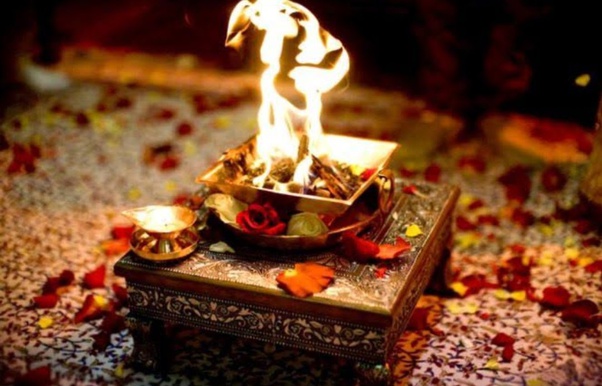
      However, some of the customs are still followed, such as the singing of Vedic hymns and the offering of ceremonial fire during official ceremonies, as well as at private occasions when no religious person is present (Gengnagel and Husken eds. 2005). 


      In reality, only the most devout Hindu households still follow these samskaras to the letter. 


      Fortunately, despite secularization, most Hindus in modern society are still eager to participate in a number of these samskaras, such as the naming ceremony, the first feeding of the infant, initiation into education, marriage, and burial customs. 

      These rituals are often carried out with the assistance of a priest, albeit not always at the temple. 


      Well-being in the context of the individual-society interaction: Promoting 'Human Life Goals' (Purushartha). 


       The four ideals of purushartha (literally: 'goal' or 'end' of man/human [Antoine 1996a: 155156]), dharma, artha, kama, and moksha form a four-fold network about what life is about and its relationship to the universal human desire for meaning and purpose. 


      Dharma as a life aim encourages people to be virtuous, righteous, and morally and ethically responsible in all aspects of life. 

      • The quest of money and success is the theme of ArthaIt is the source of human life and existence. 

      Kama is a Sanskrit word that means "pleasure" or "enjoyment of life." It denotes the method of procreation and, as a result, humanity's survival. Both artha and kama, or money and pleasure, must be consistent with dharma. 

      Moksha is the Hindu term for emancipation, which is the ultimate purpose of existence. 


      A person who acquires money (artha) and enjoys and fulfills life's wants (kama) via virtuous and righteous ways (dharma) would, in theory, achieve nirvana (moksha). 


      These four life objectives are traditionally taught at the student/learning stage of life (brahmachari) and implemented in the householder stage ( Grhastha )  Purushartha is made up of all of these life objectives. 


      In this way, they establish a set of life objectives that must be met in order to live a meaningful life. 

      Life would be blank and pointless without these objectives. 

      As a result, the purushartha dharma defines an individual's well-being in society and fosters wholeness in the public arena of life, resulting in a healthy society. 


      Affectionate treatment of family members, other people, and other living things: The Great Five Sacrifices Or Yajnas (Panchamahayajnas). 


      Every day, a homeowner is obligated to do the five-fold mandatory sacrifices, or duties: 


      (a) Brahma Yajna, homage to Brahman, is performed by reading scripture; 

      (b) Pitr Yajna, homage to the ancestors, is performed by offering water; 

      (c) Deva Yajna, homage to the gods, is performed by offering homa sacrifices

      (d) Bhuta Yajna, homage to elements or other beings, is performed by feeding animals and birds; and 

      (e) Manusya Yajna (Antoine 1996b: 203). 


      Both Bhuta Yajna and Manu-D-'a Yajna are closely tied to an individual's obligation as a caretaker to fellow human beings, animals, and other species; failing to do so implies failing to do one's major daily required task, which may destroy the prospect of liberation, or moksha (the ultimate goal of life). 

      Pitra Yajna, according to Wilson Paluri (2020), is the 'reverential connection' with parents and elders, which is particularly important for the 'well-being' of family life. 


      In the Hindu family structure, caring for parents and the elderly is both a virtue and an obligation. 


      In Hindu tradition, "may mother be god to you, may father be god to you..., may visitors be god to you"10 is the ultimate state of being. 

      Bhuta Yajna, or the offering of food to all creatures, decreases egomaniacal tendencies in humans and cultivates the practice of giving one's assets for the benefit of all sentient beings in need (Dandekar 1996: 139). 

      Hindu traditional societies reflect these mahayajnas. 

      They place a premium on caring for parents and seniors, respecting visitors, offering hospitality to everyone, and defining the pursuit of human well-being. 


      Troublesome Issues to Consider 


      Without mentioning its limits, a discussion of care, healing, and well-being in Hindu thinking and traditional practices would be insufficient. 

      The majority of traditional customs are geared at men and the upper caste. 

      Many people from the disenfranchised, so-called lower caste populations, have been denied access to Vedic traditions because they had to settle for a 'lower religion.' Early Vedic religion is supposed to be simple yet deep, promoting society and gender equality. 

      It has generated hierarchical structures and inequalities throughout its history in order to serve the entrenched interests of rich groups. 

      The most exploited victims of such a discriminatory practice are women and members of indigenous groups (Tribals, adivasis, Dalits) (Devi 2000: 15). 

      Although the dynamic position of people from disadvantaged groups and women in general can be traced throughout Hindu history, the society adopted hierarchical and patriarchal structures (Krishnan 2020a). 

      Current Hindu cultures, on the other hand, are not static, but are subject to social development, which has an impact on the dynamic position of women and indigenous people in religion and society.


      Kiran Atma


      References And Further Reading.


      Antoine, R. 1996a. "Hindu Ethics: 1. General Ethics." In Religious Hinduism, edited by R. DeSrnet and J. Neuner, pp. 149-158. Murnbai: St. Pauls. 

      Antoine, R. 1996b. "Rituals and Worship". In Religious Hinduism, edited by R. DeSrnet and J. Neuner, pp. 200-209. Murnbai: St. Pauls. 

      Antoine, R. 1996c. "The Hindu Saril.skaras." In Religious Hinduism, edited by R. DeSrnet and J. Neuner, pp. 210-219. Murnbai: St. Pauls. 

      Arulsamy, S. 2000. Religion for a New Society. Delhi: ISPCK. 

      Bowker, John. (ed.) 1997. The Oxford Dictionary of World Religions. Oxford: Oxford University Press. 

      Braam, Arjan W., et al. 2006. "Cosmic Transcendence and Framework of Meaning in Life: Patterns Among Older Adults in The Netherlands." The Journals of Gerontology- Series B 61 (3),pp. 121-128. DOl: 10.1093/geronb/61.3.Sl21. 

      Capistrant, B.D., et al. 2015. "Culture and Caregiving for Older Adults in India: A Qualitative Study," The Gerontologist 5(2), p.ll2. DOl: 10.1093/geront/gnv504.06. 

      Chaudhuri, Nirad C. 2012. Hinduism: A Religion to Live By [1st edition 1979]. New Delhi: Oxford University Press. 

      Dandekar, R.N. 1996. ''The Role of Man in Hinduism." In The Religion of the Hindus, edited by Kenneth M organ [first published 19 53], pp. 11 7-153. Delhi: Motilal Banarsidas. 

      Dasgupta, Surendranath. 1975. A History of Indian Philosophy, Vol. II [Cambridge Edition 1922], Delhi: Motilal Banarsidas. 

      Datta, Sukurnar. 2001. "Monasticisrn in India." In The Cultural Heritage of India, Vol. II, pp.582-593. Calcutta: The Rarnakrishna Mission Institute of Culture. 

      Devi, K.Urna. 2000. Women's Equality in India: A Myth or Reality? New Delhi: Discovering Publishing House. 

      Gautamananda, Swami. 2019. "Holistic Health." In Healthy Mind, Healthy Body: New Thoughts on Health [first published 1997] Chennai: Sri Ramakrishna Math, pp. 1-8. 

      Gengnagel, Jorg and Ute Hiisken (eds.) 2005. Words and Deeds: Hindu and Buddhist Rituals in 

      SouthAsia. Wiesbaden: Harrassowitz. 

      Griffith R. T. ( ed.) 1899. The Texts of the White Y ajurveda. https://www.sacred-texts.com/hin/wyv/index.htrn (accessed 13 Sept 2020). 

      Griswold, Harvey De Witt. 1996. Insights into Modern Hinduism. New Delhi: Aryan Books International. 

      Hall, C. Margaret. 1985. "Religion and Aging." Journal of Religion and Health 24(1 ), pp. 70-78. 

      Hinduscriptures. corn. 2021. "Hindu Samskaras." https://www.hinduscriptures.corn/vedic-culture/rituals/sixteen-sanskara/hindu-samskaras/11992/ (accessed 29 Sep 2021). 

      Ketchell, A., L. Pyles, and E. Canda. 2013. World Religious Views of Health and Healing. http://spiritualdiversity.ku.edu/sites/spiritualitydiversity.drupal.ku.edulfiles/docs/Health/World%20Religious%20Views%20of"/o20Health%20and%20Healing.pdf (accessed 10 Nov 2020). 

      Kimble, Melvin A., et al. (eds.) 1995. Aging, Spirituality and Religion: A Handbook. Minneapolis: Fortress Press. 

      Krishnan, Giri. 2020a. "Discovering the Dynamic Status ofWomen in Hindu Tradition: Re-reading of the Narratives of Hindu Women towards Gender Justice." UBS Journal (Union Biblical Seminary, Pune, India) 14(1), pp. 53-70. 

      Krishnan, Giri. 2020b. "Viinaprastha-Sannyiisa Schemes of Life as Gerotranscendence: An Appraisal of a Hindu Perspective of Ageing." In Ageing: Perspectival Explorations Towards Theo-Gerontology, edited by Songram Basurnatary, pp. 125-139. Chennai: Gurukul Publication. 

      Lamb, Sarah. 2005. "Cultural and Moral Values Surrounding Care and (In)Dependence in Late Life: Reflections from India in an Era of Global Modernity." Care Management Journals 6(2), pp. 80-89. 

      Lamb, Sarah. 2007. "Lives Outside the Family: Gender and the Rise of Elderly Residences in India." International Journal of Sociology of the Family 33(1), pp. 43-61. 

      Lamb, Sarah. 2019. "Hinduism Teachings and Aging." In Encyclopedia of Gerontology and Population Aging, edited by D. Gu and M. Dupre. DO I: 1 0.1007/978-3-319-69892-2~144-1. 

      Lovato, Chris. 2019. "Well-Being and Spirituality." In Healthy Mind, Healthy Body: New Thoughts on Health [first published 1997], pp. 147-151. Chennai: Sri Rarnakrishna Math. 

      Menon, Usha. 2012. "Hinduism, Happiness and Wellbeing: A Case Study of Adulthood in an Oriya Hindu Temple Town." In Happiness Across Cultures: Views of Happiness and Quality of Life in Non-Western Cultures, edited by H. Selin and G. Davey, pp. 417-434. Dordrecht: Springer. Manuscript with differing pagination online at https://www.researchgate.net/publication/279409932 (accessed 25 Sep 2020), quoted from this online source. 

      Paluri, Wilson. 2020. "Familial and Community Care in Vrddhavastha: Socio-Religious Jarasastra from Classical Hinduism." In Ageing: P erspectival Explorations towards Theo-Gerontology, edited by S. Basurnatary, pp. 141-153. Chennai: Gurukul Publication. 

      Pandey, R.B. 2001. "The Hindu Sacraments (Sarhskaras)." In The Cultural Heritage of India, Vol. II, edited by S. Radhakrishnan [2nd edition 1962], pp. 390-413. Calcutta: Ramakrishna Mission Institute of Culture. 

      Pandya, Samta P. 2016. "Aging Spiritually: Pitamaha Sadans in India." Cogent Social Sciences 2(1 ). DO I: 10.1080/23311886.2016.1219212. 

      Pathshala. 2020. Overview of Hindu Healing Traditions. https://epgp.inflibnet.ac.in/epgpdata/uploads/epgp_content/S000825CR/POO1532/MO18441/ET/1483520083Text.pdf (accessed 10 Nov 2020). 

      Premsagar, P. Victor. 1994. "Vanaprasthasrama Dharrna: A Programme of Renewal and Religion as Realisation for Retired People." Bangalore Theological Forum 26(3&4), pp. 15-24. 

      Radhakrishnan, S. 2009. The Hindu View of Life [1st edition 1927]. Noida: Harper Collins Publishers. 

      Rajan, K. V. Soundara. 2001. Concise Classified Dictionary of Hinduism, Vol. I. New Delhi: Concept Publishing Company. 

      Roy, Mira. 1986. "Ayurveda." In The Cultural Heritage of India, Vol. VI: Science and Technology, edited by P. Ray and S.N. Sen, pp. 152-176. Calcutta: Rarnakrishna Mission Institute of Culture. 

      Sarrna, D. S. 1966. Renascent Hinduism. Murnbai: Bharatiya Vidya Bhavan. 

      Sarrna, D.S. 1996. "The Nature and History of Hinduism." In The Religion of the Hindus, edited by Kenneth Morgan [first published 1953], pp. 3-47. Delhi: Motilal Banarsidass. 

      Sarrna, D.S. 2000. Hinduism Through the Ages [1st edition 1956]. Murnbai: Bharatiya Vidya Bhavan. 

      Sharma, Arvind. 2002. The Hindu Tradition: Religious Beliefs and Healthcare Decisions. Illinois: The Park Ridge Center. 

      Sri Sathya 2021. "Sri Sathya Sai International Organization." https://www.sathyasai.org 

      Tharoor, Shashi. 2018. Why I am a Hindu. New Delhi: Aleph Book Company. 

      Tilak, Shrinivas. 1989. Religion and Aging in the Indian Tradition. Albany: State University of New York Press. 

      Tiwari, S.C., and N.M. Pandey. 2013. "The Indian Concepts of Lifestyle and Mental Health in Old Age." Indian Journal of Psychiatry (January), pp. 288-292. 

      Valiathan, M.S. 2015. "Healing in the Ramakrishna Tradition." In Total Human Development in the Light ofRamakrishna-Vivekananda Tradition, pp. 109-116. Kolkata: Ramakrishna Institute of Culture. 

      Williams, Monier. 1976. A Dictionary English and Sanskrit [4th Indian edition 1899]. Delhi: Motilal Banarsidass Publishers. 

      Williams, Monier. 1994. Sanskrit-English Dictionary [new edition 1899]. Delhi: Munshiram Manoharlal Publishers. 

      WorldBookEncyclopedia. 1981. Vol. 21. Chicago: World Book, Inc. 

      Yogapedia Dictionary. 2020. "Svastha." https://www.yogapedia.com/definition/11783/svastha-ayurveda (accessed 10 Nov 2020).